

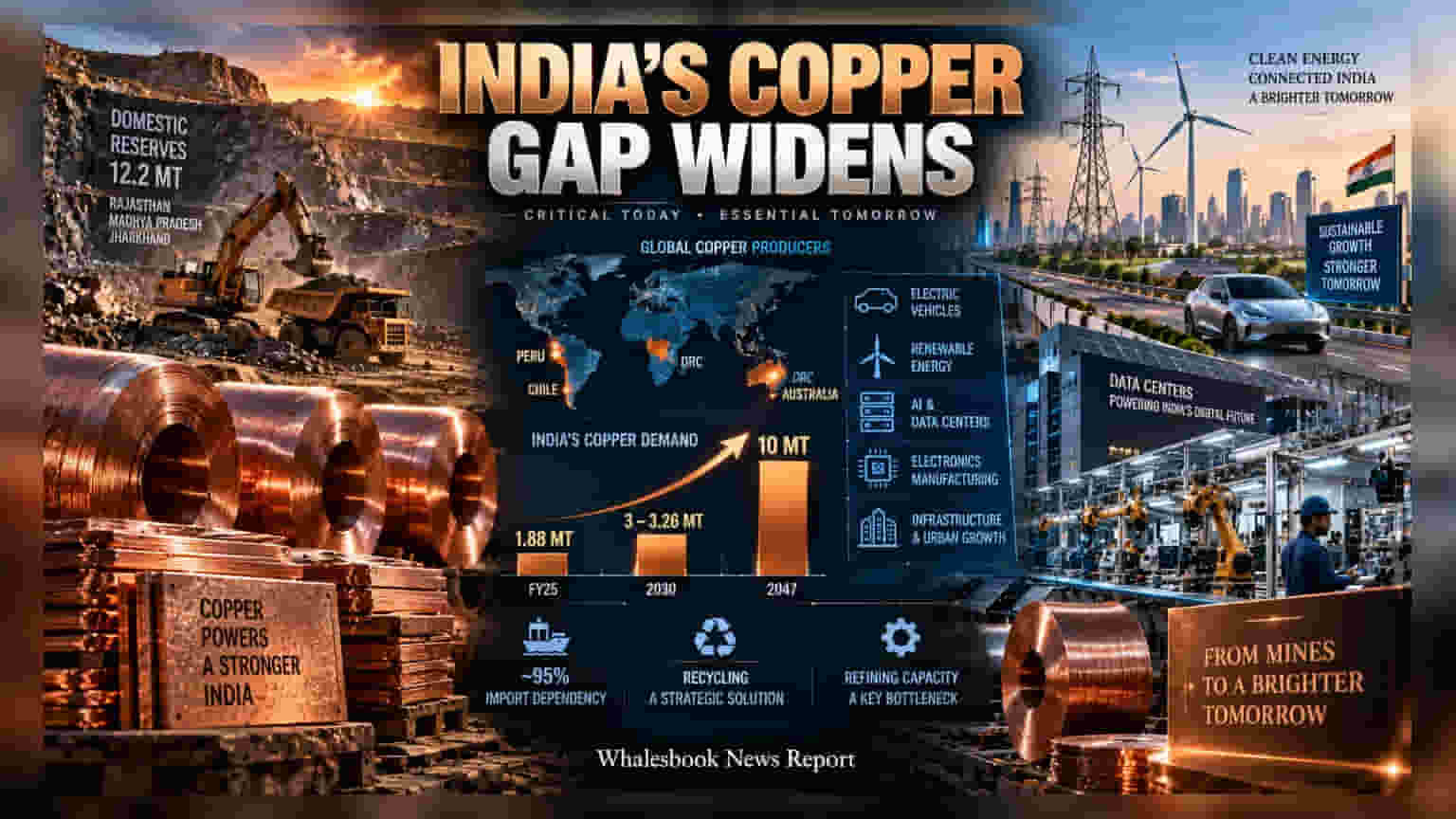
India’s copper demand is projected to surge from 1.88 million tonnes in FY25 to 10 million tonnes by 2047, driven by electric vehicles and infrastructure. With 95% of concentrate demand relying on imports, domestic refining capacity and recycling are becoming critical for supply security in a competitive global market.
India is bracing for a massive surge in copper demand as the country accelerates its shift toward electric vehicles, renewable energy, and expanded AI infrastructure. Data indicates that demand is set to rise from approximately 1.88 million tonnes in FY25 to between 3 million and 3.26 million tonnes by 2030, potentially reaching 10 million tonnes by 2047. As this metal is essential for electricity transmission and electronics, reliable supply is becoming a core industrial priority.
The challenge for the domestic industry is that India currently relies on imports for roughly 95% of its copper concentrate requirements. This high dependency leaves the market vulnerable to global supply fluctuations and competition from major buyers like China and Europe. While India has identified domestic resources of about 12.2 million tonnes, primarily in Rajasthan, Madhya Pradesh, and Jharkhand, the path from exploration to production is exceptionally long. Developing a new copper mine can take nearly 18 years, meaning supply decisions made today will only yield results well into the next decade.
Refining capacity remains a critical bottleneck. Beyond the difficulty of sourcing raw concentrate, India needs to consistently expand its smelting and refining infrastructure. The history of the domestic sector has shown that capacity risks are material; for instance, the long-standing closure of the Sterlite Copper plant in Tuticorin, which halted operations in 2018 due to legal and environmental issues, significantly reduced India's domestic refining capacity. This event highlighted how regulatory and environmental factors can suddenly disrupt output, making supply security a complex issue for players like Hindalco Industries, which operates the major Birla Copper facility.
Because domestic mining is slow to scale, the industry is increasingly looking toward the circular economy. Recycling is becoming a strategic resource, as copper can be reused repeatedly without loss of quality. Standardizing scrap collection and processing is now a priority for the government and industry to reduce the reliance on imported refined metal. The investment case for the sector has thus shifted away from pure mining toward an integrated strategy of overseas sourcing, domestic refining, and efficient recycling.
Investors may monitor several key areas as this sector evolves. These include the government's auction of critical mineral blocks, the commissioning of new refining capacity, and the implementation of tighter recycling standards. The ability of major domestic companies to secure long-term global supply agreements while navigating regulatory frameworks will be the primary factor determining their financial stability and profitability in the coming years.