 Whalesbook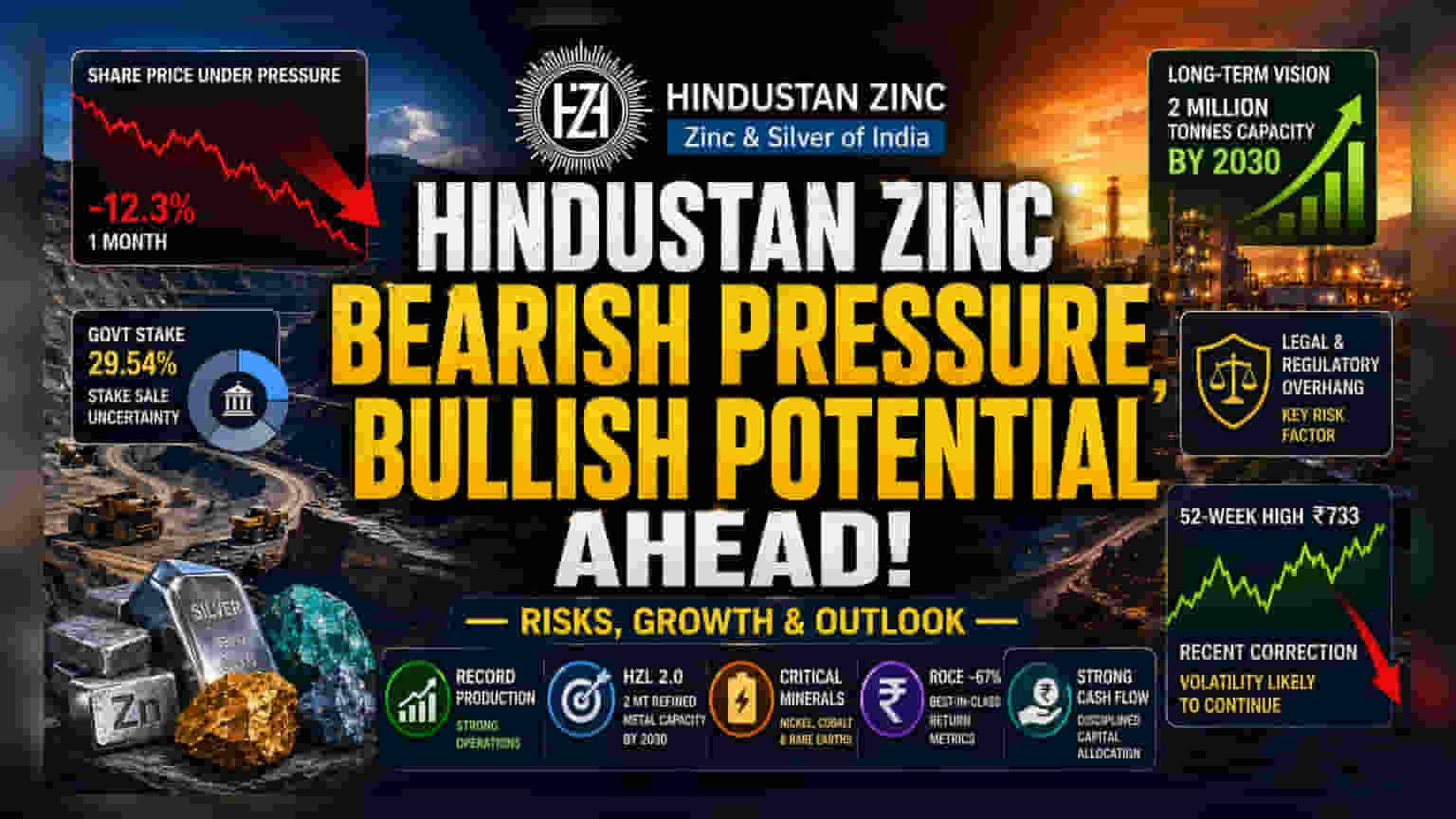


The Valuation Gap
Hindustan Zinc currently finds itself in a tug-of-war between aggressive industrial expansion and short-term market volatility. While the company’s "HZL 2.0" strategy aims to double refined metal capacity to 2 million tonnes per annum by 2030, investors are currently focused on potential supply-side pressures. Shares faced a sharp correction following reports that the Indian government may dilute its 29.54% residual stake, a prospect that has historically acted as an overhang on price discovery. Despite the company officially clarifying it has received no formal communication regarding a stake sale, the uncertainty has triggered a sell-off, leaving the stock lagging behind its recent 52-week highs near ₹733.
Analytical Deep Dive
The market’s current caution stands in stark contrast to the company’s operational successes. In the most recent fiscal year, the miner reported record-breaking production efficiency, achieving a return on capital employed of roughly 67%—a notable metric in the capital-intensive metals sector. By diversifying into critical minerals like nickel, cobalt, and rare earth elements, Hindustan Zinc is attempting to insulate itself from the traditional cyclicality of zinc prices. However, unlike pure-play miners, Hindustan Zinc carries a complex ownership structure tied to its parent company, Vedanta. This relationship, combined with previous regulatory scrutiny, complicates its valuation as institutional investors balance growth potential against corporate governance concerns.
The Forensic Bear Case
From a risk-averse perspective, the primary concern lies in the company’s capital allocation and structural dependencies. While the ₹40,000–₹50,000 crore investment program is technically transformative, it requires sustained high-margin operation to fund without compromising the company’s historically generous dividend payout policy. Additionally, the mining business remains at the mercy of global commodity fluctuations. While the company has successfully lowered production costs to near-industry lows, any sustained downturn in silver or zinc prices could strain free cash flows. Furthermore, legacy legal issues from the initial privatization process continue to simmer, creating a layer of headline risk that standalone mining competitors do not share. Management’s ability to execute these large-scale projects without relying on further debt or sacrificing shareholder returns remains the ultimate test for the current leadership team.
The Future Outlook
Despite the recent bearish sentiment, brokerage consensus remains mixed. Analysts generally acknowledge the company’s fundamental strength and its role as a key player in India's energy transition. If the company maintains its current trajectory of cost optimization and successfully integrates its new mineral blocks, it could realize significant long-term value. However, until the government stake sale narrative is definitively resolved, the stock is likely to remain in a period of heightened volatility, sensitive to both macroeconomic commodity trends and domestic policy shifts.