

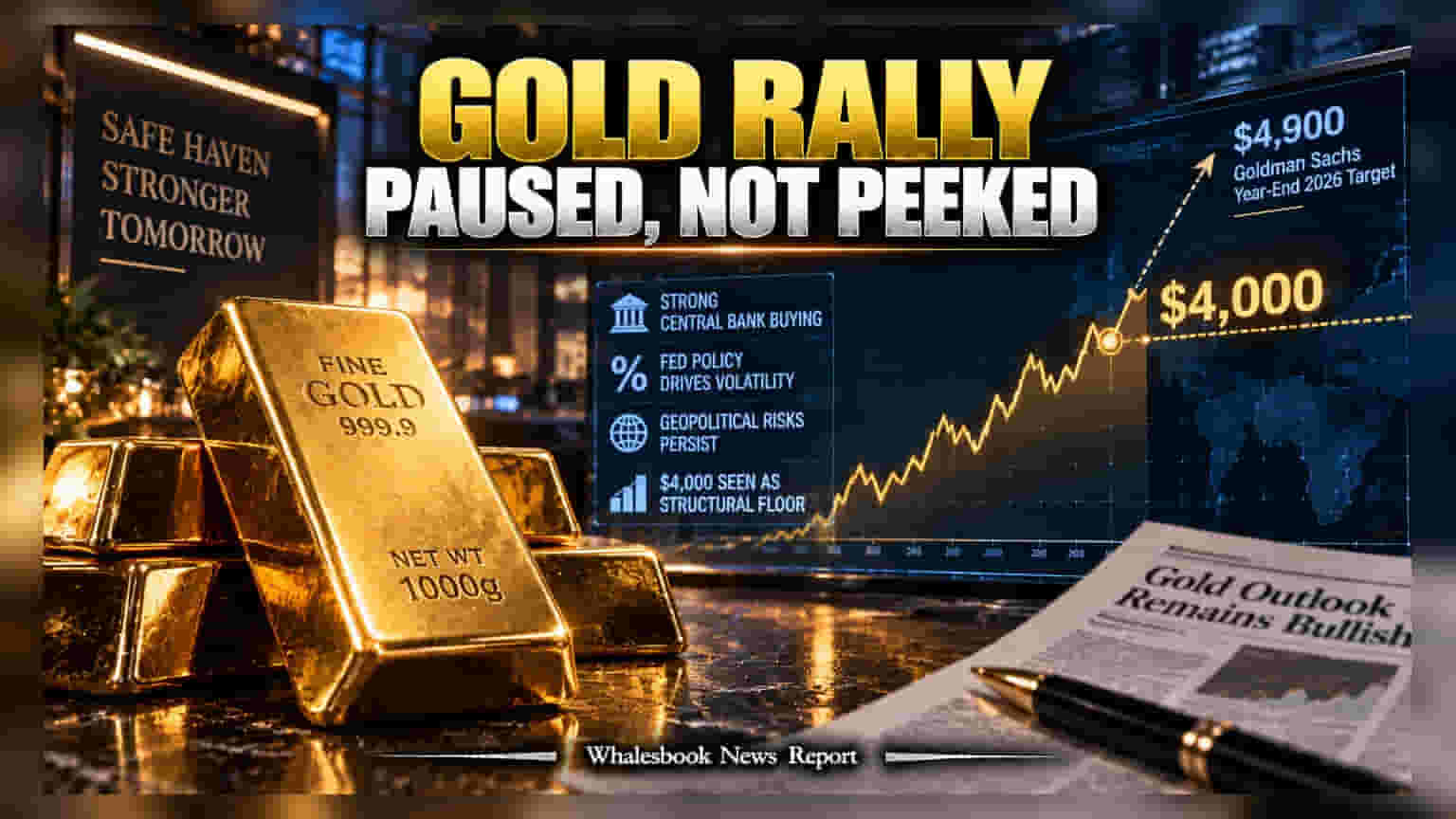
Goldman Sachs views recent gold volatility as an 'elongated pause' rather than a trend reversal. The investment bank maintains a bullish outlook for late 2026, identifying $4,000 per ounce as a critical support level. While Federal Reserve policy uncertainty and geopolitical tensions remain, robust central bank accumulation is providing a strong floor for the precious metal.
The gold market is currently seeing a period of cooling prices, but analysts at Goldman Sachs believe this is simply a pause rather than a fundamental change in the long-term trend. Tony Kim, the firm's global head of metals trading, indicates that the current volatility is largely driven by short-term market reactions to Federal Reserve policy expectations and geopolitical friction. Despite these pressures, the investment bank remains bullish, with a year-end 2026 price target of $4,900 per ounce. The firm views the $4,000 per ounce level as a structural floor for the asset.
The Central Bank Supercycle
The primary force supporting this price floor is a structural shift in how central banks manage their reserves. Since 2022, sovereign accumulation of gold has jumped to an elevated range of 1,000 to 1,100 tonnes annually, a significant increase from the historical average of 400 to 500 tonnes. This consistent buying activity has fundamentally changed market liquidity. With a larger portion of annual mine production being moved into official central bank reserves, the supply available for other investors and industrial users has tightened. This means that even moderate buying interest can have a more pronounced impact on price movements compared to previous market cycles.
Challenges and Market Headwinds
While the long-term outlook is supported by central bank activity, the market is not without friction. Uncertainty regarding U.S. Federal Reserve interest rate policies and potential rate hikes often creates volatility, as gold typically competes with interest-bearing assets. Additionally, geopolitical disruptions near the Strait of Hormuz have impacted energy markets and supply chains. For Indian investors, this environment is particularly relevant as elevated energy costs often force major importing nations to focus on foreign currency reserves, which can temporarily curb physical gold demand.
What Investors Should Monitor
Investors may keep an eye on how central bank buying trends evolve over the coming months. The ability of gold to hold above the $4,000 level will likely depend on whether energy markets normalize and how the Federal Reserve balances its interest rate strategy in the face of persistent inflation concerns. Any shifts in U.S. inflation data or changes in central bank reserve policies will be the key indicators to watch to determine if the gold market resumes its upward trajectory.