 Whalesbook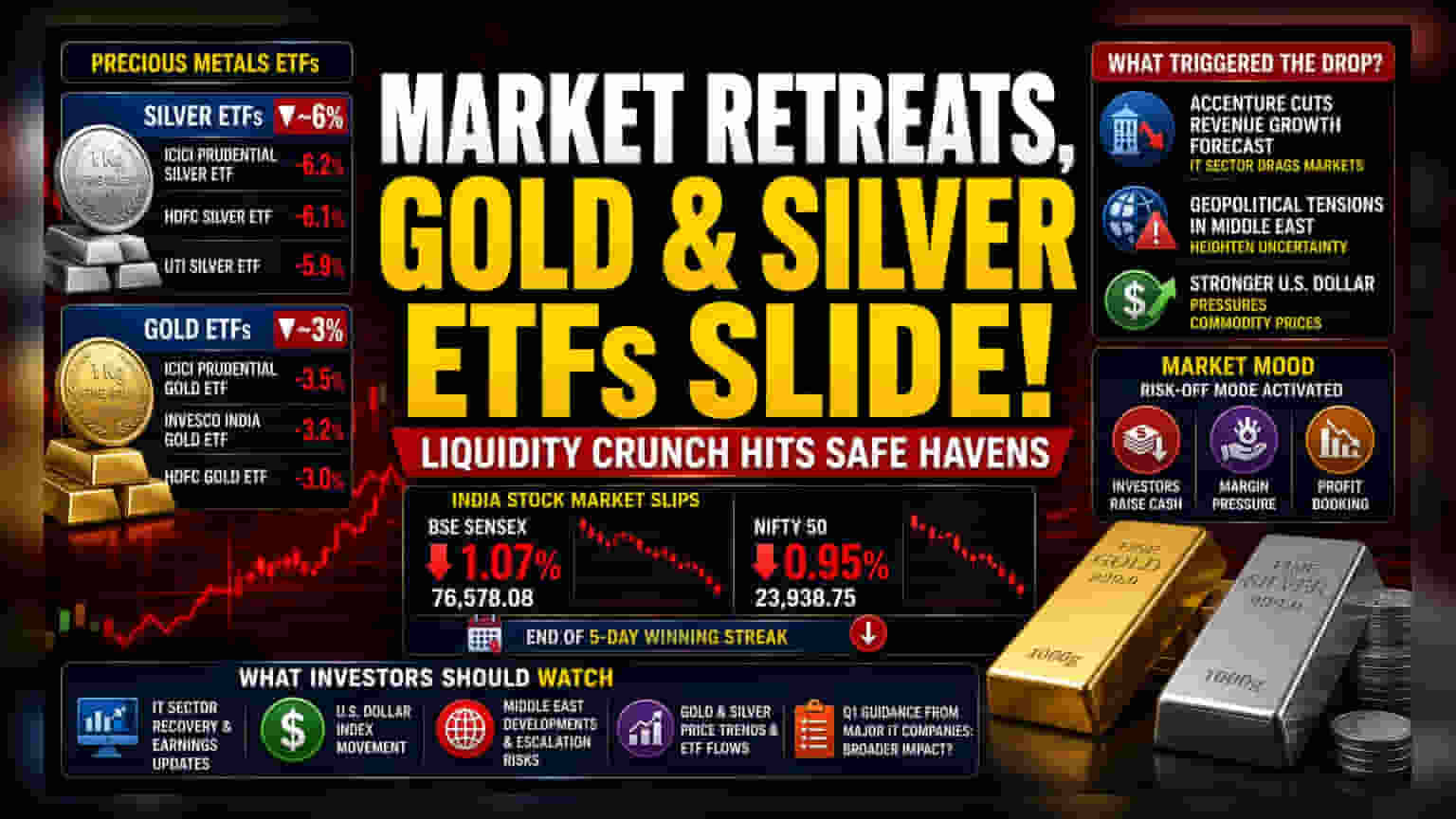
Gold and Silver ETFs faced a sharp downturn on June 19, 2026, with silver assets dropping up to 6% and gold declining over 3%. The selloff followed a major decline in IT stocks, triggered by a lowered forecast from global major Accenture. Indian indices Sensex and Nifty also saw their winning streaks end as investors reacted to global geopolitical uncertainty and a stronger U.S. dollar.
What Happened
On Friday, June 19, 2026, Indian investors witnessed a broad market retreat that impacted even safe-haven assets like gold and silver. Exchange-traded funds (ETFs) tracking these precious metals saw significant price corrections. Silver ETFs were hit harder, with funds like ICICI Prudential Silver ETF, HDFC Silver ETF, and UTI Silver ETF recording declines of approximately 6%. Gold ETFs also faced pressure, with the ICICI Prudential Gold ETF falling about 3.5% and the Invesco India Gold ETF dropping 3.2%.
This movement coincided with a decline in major Indian equity indices. The BSE Sensex fell by 1.07% to an intraday low of 76,578.08, while the Nifty 50 dropped 0.95% to 23,938.75. This marked the end of a five-day period of gains for both indices.
Why This Matters For Investors
The immediate trigger for the market downturn was a downward revision in revenue growth forecasts by Accenture, a major global IT firm. Because the IT sector holds significant weight in Indian stock indices, negative news from such a bellwether often leads to broad selling across the market.
However, the simultaneous drop in gold and silver assets is an important investor signal. While precious metals are often seen as a hedge against market volatility, they are not immune to liquidity events. When investors face sudden losses in their equity portfolios, they often sell their most liquid or profitable assets—including gold and silver ETFs—to raise cash or meet margin requirements. This "risk-off" behavior, where investors reduce exposure to almost all asset classes during uncertainty, appears to be the primary driver behind the decline in precious metal ETFs.
The Bigger Business Context
Several factors combined to create this negative sentiment. Alongside the IT sector drag, global geopolitical tensions in the Middle East have created an environment of uncertainty. Historically, such tensions often drive investors toward gold, but in this specific instance, the need for immediate cash and profit-booking seems to have outweighed the safe-haven demand. Additionally, a strengthening U.S. dollar often puts pressure on commodities priced in that currency, as it makes them more expensive for global buyers, further cooling demand.
How Investors May Read This
The current price action suggests that market participants are prioritizing liquidity over long-term holding. For investors in silver and gold ETFs, it is important to differentiate between a structural change in the commodity market and a temporary liquidity-driven dip.
While the IT sector news is a fundamental issue for tech-heavy portfolios, the movement in precious metals is often more reflective of global sentiment and currency fluctuations. Investors should evaluate whether their exposure to these ETFs is for long-term portfolio diversification or short-term trading. During periods of high volatility, broad market selling can often affect assets that are otherwise fundamentally sound.
What Investors Should Track Next
Investors may keep a close watch on several factors to understand the market's next move. First, the recovery or stability of the IT sector will be crucial for the indices. Second, monitor the U.S. dollar index, as its strength or weakness directly influences gold and silver prices. Third, observe the intensity of geopolitical developments in the Middle East; any escalation or de-escalation can rapidly change sentiment regarding precious metals. Finally, watch for any further company-specific guidance from other major IT players, as this will clarify whether the Accenture forecast is an isolated incident or a sign of a wider slowdown in the sector.

