

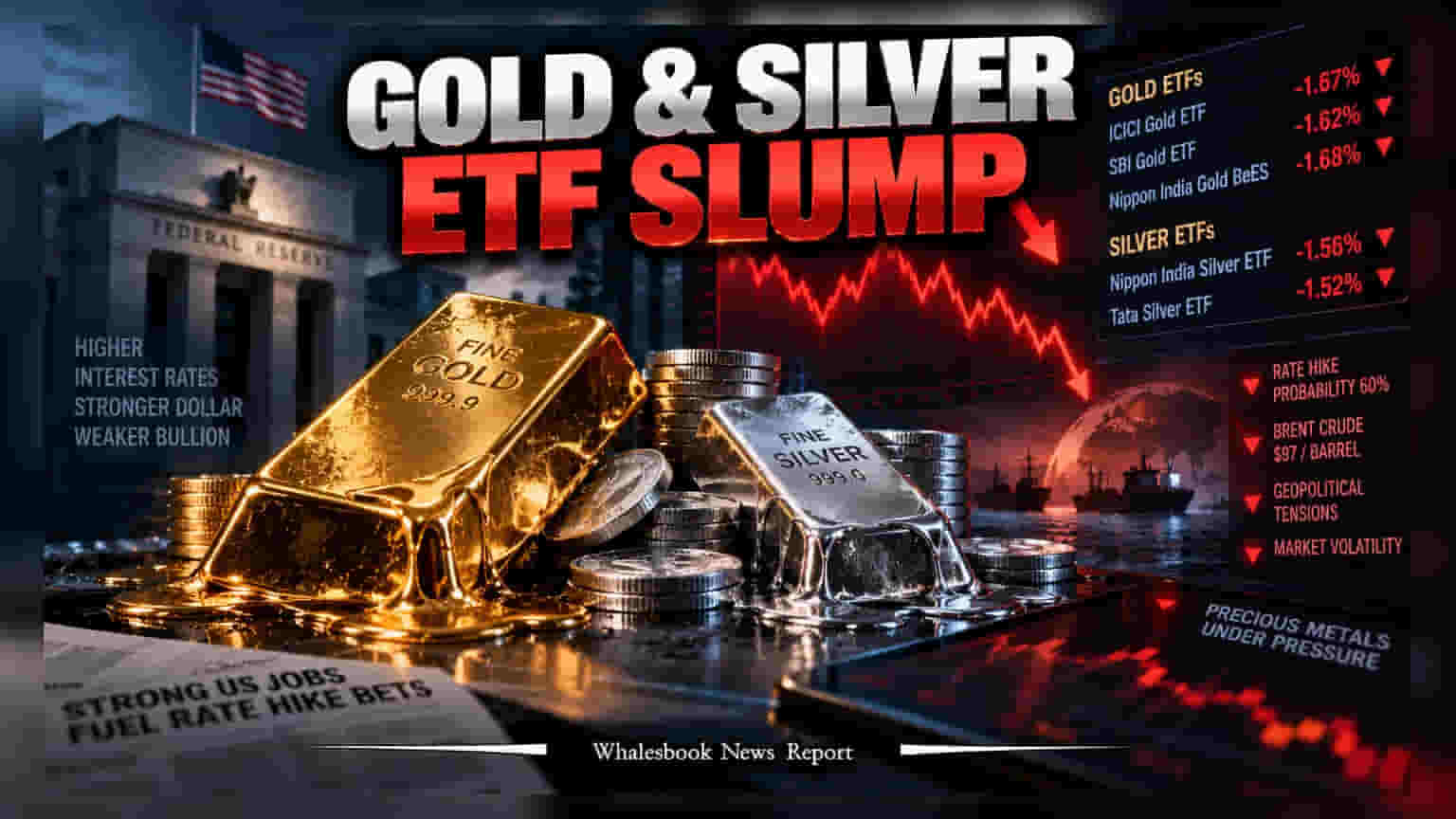
Gold and silver exchange-traded funds (ETFs) declined on Monday as strong US employment data fueled expectations of a Federal Reserve interest rate hike. Rising bond yields and a stronger US dollar reduced the appeal of bullion, while geopolitical tensions pushed Brent crude prices toward $97 per barrel.
Indian investors witnessed a broad decline in gold and silver exchange-traded funds (ETFs) on Monday, September 7, 2026, as global market sentiment shifted following the release of fresh US economic data. The sell-off was triggered by surprisingly robust US employment figures for August, which added 162,000 jobs. This resilience in the labor market has led investors to adjust their expectations for the Federal Reserve’s upcoming policy meeting scheduled for September 15–16.
Financial markets are now pricing in a 60% probability of an interest rate hike later this month. When the US central bank increases interest rates, it typically leads to higher yields on government bonds. Because gold and silver do not pay interest or dividends, they often become less attractive compared to bonds during periods of rising interest rates. This shift, combined with a strengthening US dollar, has placed downward pressure on the prices of precious metals.
Domestic ETFs tracking these commodities mirrored the global trend on Monday. ICICI Prudential Gold ETF, SBI Gold ETF, and Nippon India ETF Gold BeES all recorded declines of approximately 1.6% to 1.7%. Similarly, silver-focused instruments including Nippon India Silver ETF and Tata Silver ETF also faced selling pressure, sliding by over 1.5% during the session.
Beyond monetary policy concerns, the commodity market is grappling with geopolitical uncertainty in the Middle East. Reports of maritime skirmishes in the Strait of Hormuz have intensified, causing Brent crude oil prices to climb toward $97 per barrel. Higher energy costs are a concern for global inflation, as they often increase transport and manufacturing expenses. For investors, this creates a complex environment where the pressure from higher interest rates is amplified by rising energy prices.
As the market digests the current economic data, the next key monitorable for investors will be the upcoming US inflation metrics. These figures will likely serve as a crucial indicator for the Federal Reserve’s interest rate strategy and could further influence volatility in precious metal prices. Investors may watch for how sustained inflationary pressure or potential central bank comments on policy rates could impact the demand for bullion in the coming weeks.