

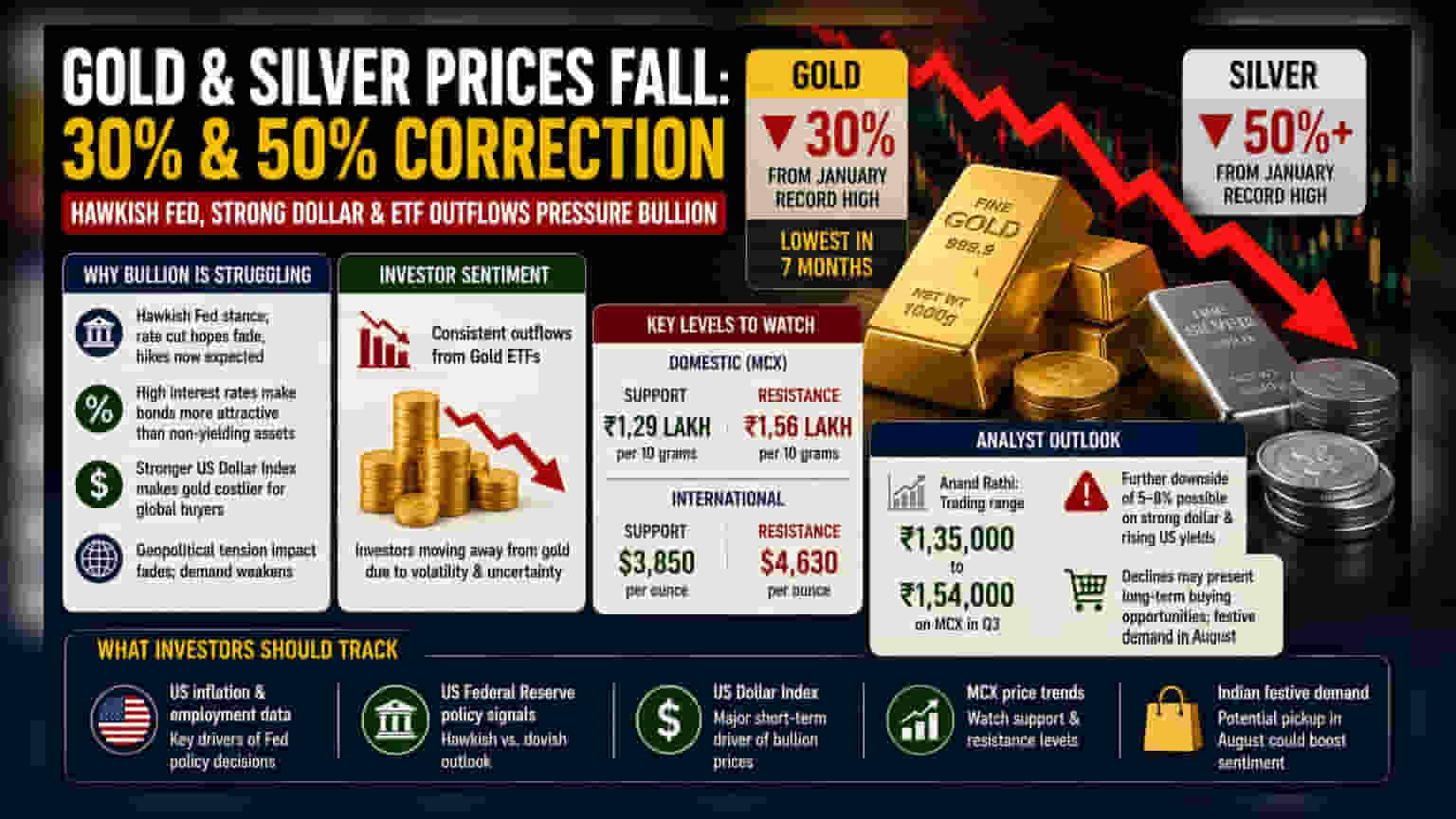
Gold prices have dropped 30% from their January highs, while silver has declined over 50%. A stronger US dollar and a shift toward hawkish interest rate policies by the US Federal Reserve have reduced the appeal of these non-yielding assets. Investors are now monitoring international price support levels and domestic market trends as volatility continues.
What Happened
Gold prices have faced a significant correction, falling approximately 30% from the record highs recorded in January. Silver has experienced an even steeper decline, shedding more than 50% of its value during the same period. This downturn has pushed international gold prices to their lowest levels in seven months. The drop marks a sharp reversal for precious metals that were previously considered safe havens during periods of geopolitical uncertainty.
Why The Bullion Market Is Struggling
The primary pressure on precious metals comes from a shift in the macroeconomic environment. While initial geopolitical tensions, such as the conflict involving Iran, briefly boosted gold prices, that momentum has faded. A major factor currently influencing the market is the US Federal Reserve's hawkish stance. Markets had previously expected the central bank to cut interest rates, but expectations have shifted toward potential rate hikes.
For investors, this change is significant because gold and silver are non-yielding assets, meaning they do not generate interest or dividends. When central banks keep interest rates high or increase them, yield-bearing instruments like government bonds become more attractive compared to precious metals. Additionally, the US Dollar Index has strengthened significantly. Since gold is globally priced in dollars, a stronger greenback makes the metal more expensive for buyers using other currencies, naturally dampening demand.
How Investors Are Reacting
Market sentiment has turned cautious, which is reflected in the consistent outflows from gold Exchange Traded Funds (ETFs). These investment vehicles, which allow people to hold gold without physically storing it, have seen a noticeable reduction in holdings since the tensions in the Middle East began. This selling pressure suggests that investors are moving away from gold toward other assets, deterred by high price volatility and uncertainty regarding future price movements.
Key Levels And Analyst Outlook
Analysts are watching specific price levels as the market attempts to find stability. Experts from Geojit Investments Limited have noted that domestic gold prices might find support around ₹1.29 lakh per 10 grams, with significant resistance levels near ₹1.56 lakh. Internationally, support is being monitored at $3,850 per ounce, with resistance near $4,630.
Other analysts, including those from Anand Rathi Shares and Stock Brokers, have forecast a trading range of ₹1,35,000 to ₹1,54,000 on the Multi Commodity Exchange (MCX) for the third quarter. While some experts suggest the possibility of further declines of 5–8% due to the strength of the dollar and rising US yields, others point out that such drops might eventually be viewed as long-term buying opportunities, especially if Indian festive demand picks up in August.
What Investors Should Track
Investors may monitor incoming US inflation and employment data, as these indicators heavily influence the Federal Reserve's policy decisions. If economic data shows signs of cooling, it could soften the Fed's hawkish stance, potentially providing relief to precious metals. Additionally, domestic investors should keep an eye on MCX price trends and the US Dollar Index, as these remain the key drivers of short-term volatility in the bullion market.