

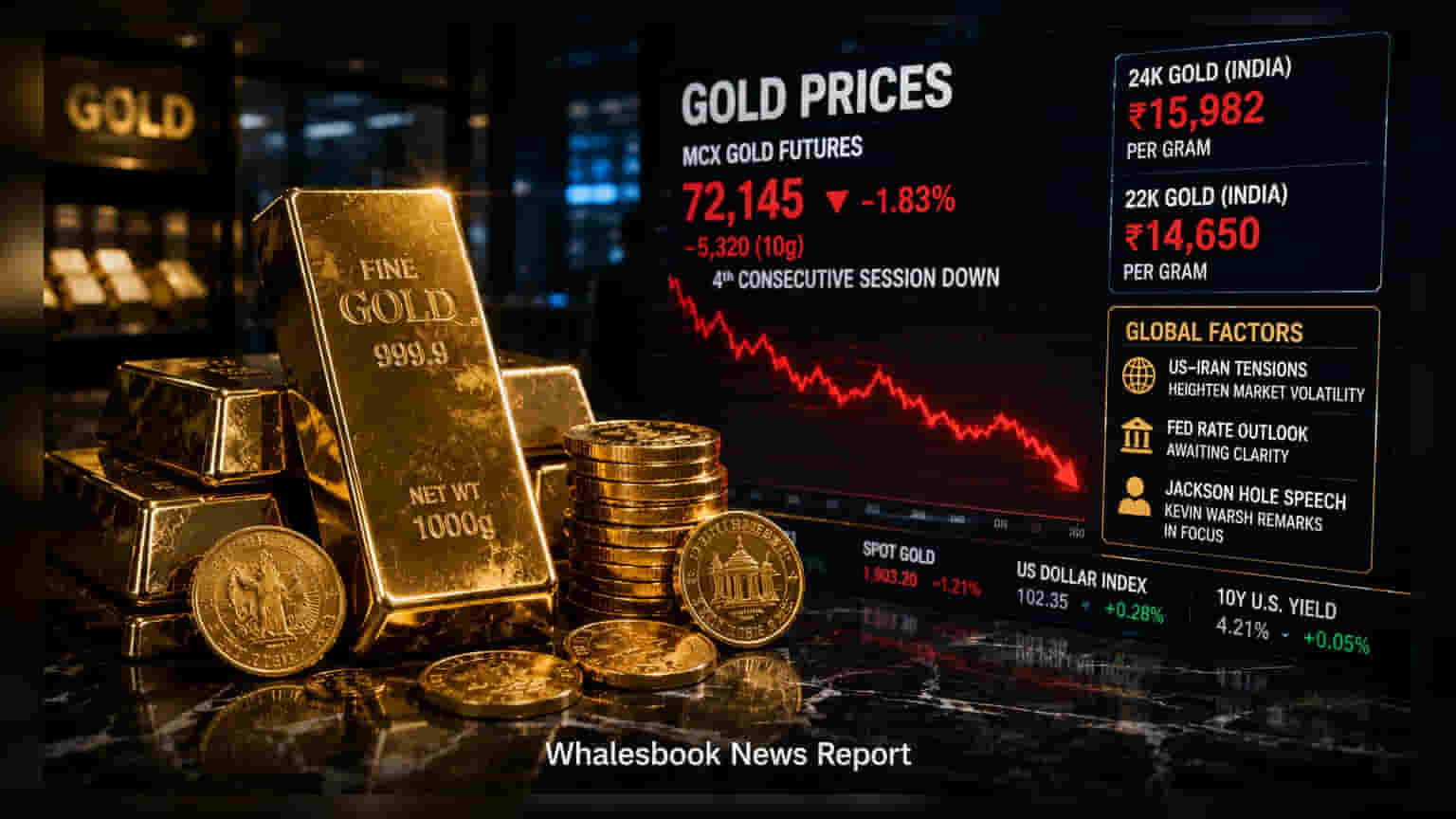
Gold prices in India declined significantly on August 28, 2026, with MCX futures recording a four-day slump. The drop is driven by international market sensitivity to ongoing US-Iran geopolitical tensions and uncertainty surrounding upcoming US Federal Reserve policy signals.
Gold prices in India witnessed a sharp correction on August 28, 2026, tracking a broader downward trend in global commodity markets. The price of 24-carat gold settled at approximately ₹15,982 per gram, while 22-carat gold traded near ₹14,650 per gram. This price movement follows a consistent decline on the Multi Commodity Exchange (MCX), where gold futures have now fallen for four consecutive trading sessions.
Investors tracking the bullion market observed that gold futures on the MCX dropped by over ₹5,300 per 10 grams during this four-day period. This pullback highlights the direct impact of international factors on domestic gold valuations, which often react quickly to shifts in global risk sentiment.
The current price pressure is primarily linked to global market developments. Heightened geopolitical tensions between the US and Iran have contributed to increased market volatility, influencing how investors perceive risk. Furthermore, global participants are awaiting clarity on the US Federal Reserve’s future interest rate path. Investors are particularly focused on upcoming remarks by Federal Reserve Chair Kevin Warsh at the Jackson Hole symposium, as these comments are expected to provide insights into potential changes in monetary policy.
For gold investors and consumers in India, this period of volatility underscores how sensitive the metal has become to macroeconomic news and central bank policy. While gold often serves as a traditional hedge against uncertainty, the current market dynamic—driven by both geopolitical headlines and potential shifts in US interest rates—has led to wider daily price swings.
The next phase of price movement will likely depend on how international spot gold benchmarks react to further global developments. For those tracking the commodity, the key areas to watch include updates on US interest rate policies and the stability of the geopolitical situation in the Middle East, as these factors remain the primary drivers of current market sentiment.