 Whalesbook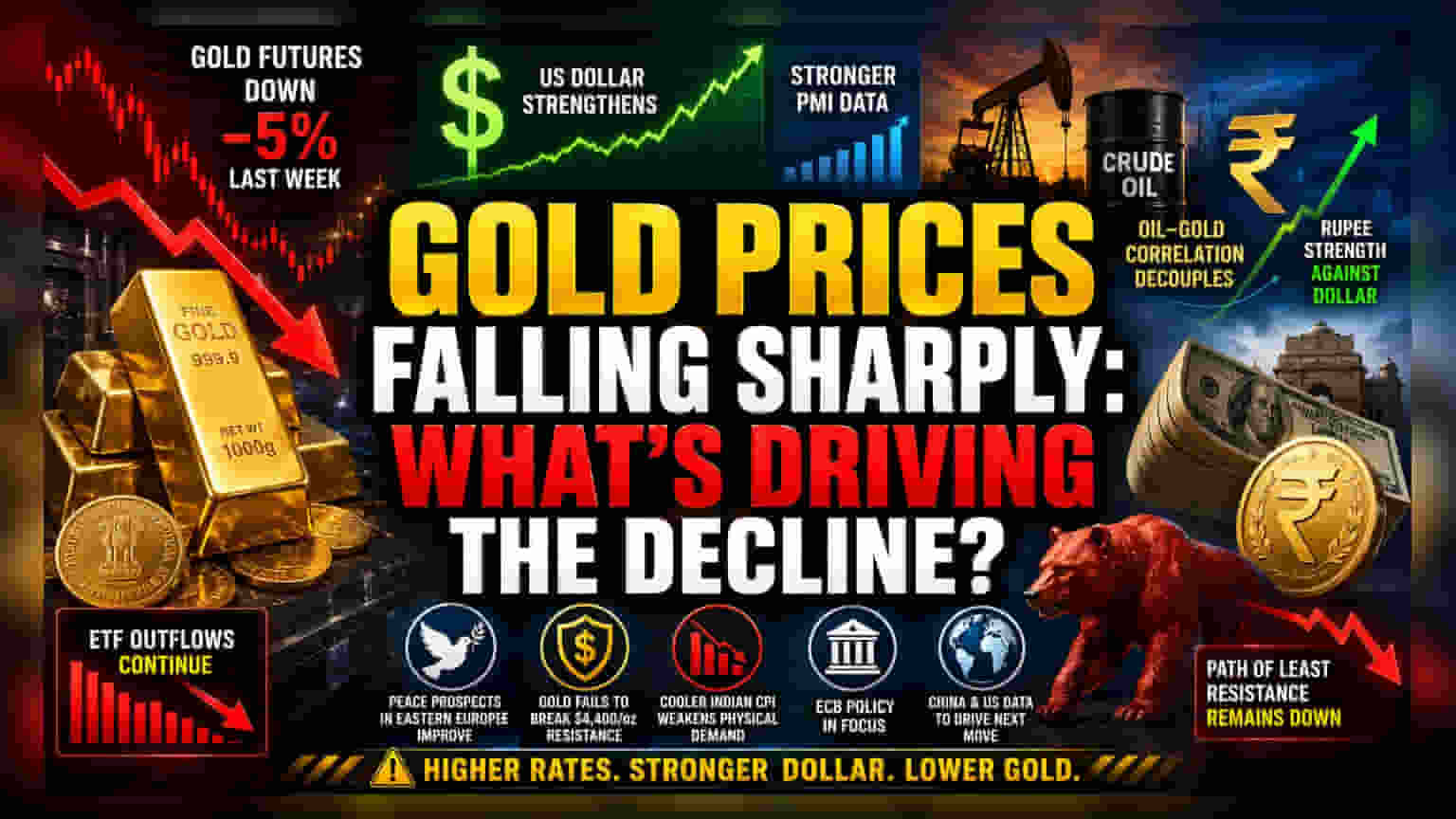


The Valuation Gap
Recent price action indicates a decisive shift in how capital perceives precious metals. The sharp 5% contraction in Comex gold futures last week confirms that speculative long positions are being liquidated in favor of assets that better reflect the current interest rate environment. Rather than acting as an inflation hedge, bullion is currently behaving like a high-beta asset, hypersensitive to the US Dollar Index. When the dollar firms alongside stronger-than-anticipated PMI figures, the opportunity cost of holding non-yielding gold becomes increasingly difficult for institutional investors to justify.
Sectoral Divergence and Global Indicators
The correlation between crude oil and gold has decoupled in recent sessions, creating a vacuum that has been swiftly filled by currency fluctuations. In the Indian market, the rupee's relative strength against the dollar has compounded the decline, stripping away the cushioning effect typically seen during domestic price corrections. As the European Central Bank prepares to signal its policy trajectory, the focus is shifting from simple inflation tracking to a broader assessment of global liquidity. The market is currently pricing in a scenario where higher-for-longer interest rates in the US outweigh the traditional safe-haven demand generated by regional conflicts.
The Forensic Bear Case
The prevailing optimism regarding gold as an evergreen portfolio stabilizer ignores significant structural risks. Exchange-traded funds have recorded sustained outflows, suggesting that retail and institutional participants are moving toward risk-on assets as peace prospects in Eastern Europe gain traction. From a technical standpoint, the inability of bullion to clear the $4,400 per ounce threshold acts as a psychological barrier that encourages short-selling. Furthermore, if Indian CPI data comes in cooler than projected, it will likely reduce the internal demand for physical gold, adding a secondary layer of downward pressure to domestic premiums that have already been eroded by recent futures volatility.
Forward Trajectory
Market participants are now fixated on the upcoming economic prints from China and the US, which serve as the final determinants for the next major price move. Unless the European Central Bank introduces a surprise dovish pivot or geopolitical events in West Asia escalate beyond current localized frictions, the path of least resistance for precious metals remains to the downside. Traders are maintaining a cautious stance, expecting consolidation within a lower range as the market digests the reality of an environment where inflation hedges are currently out of favor.