

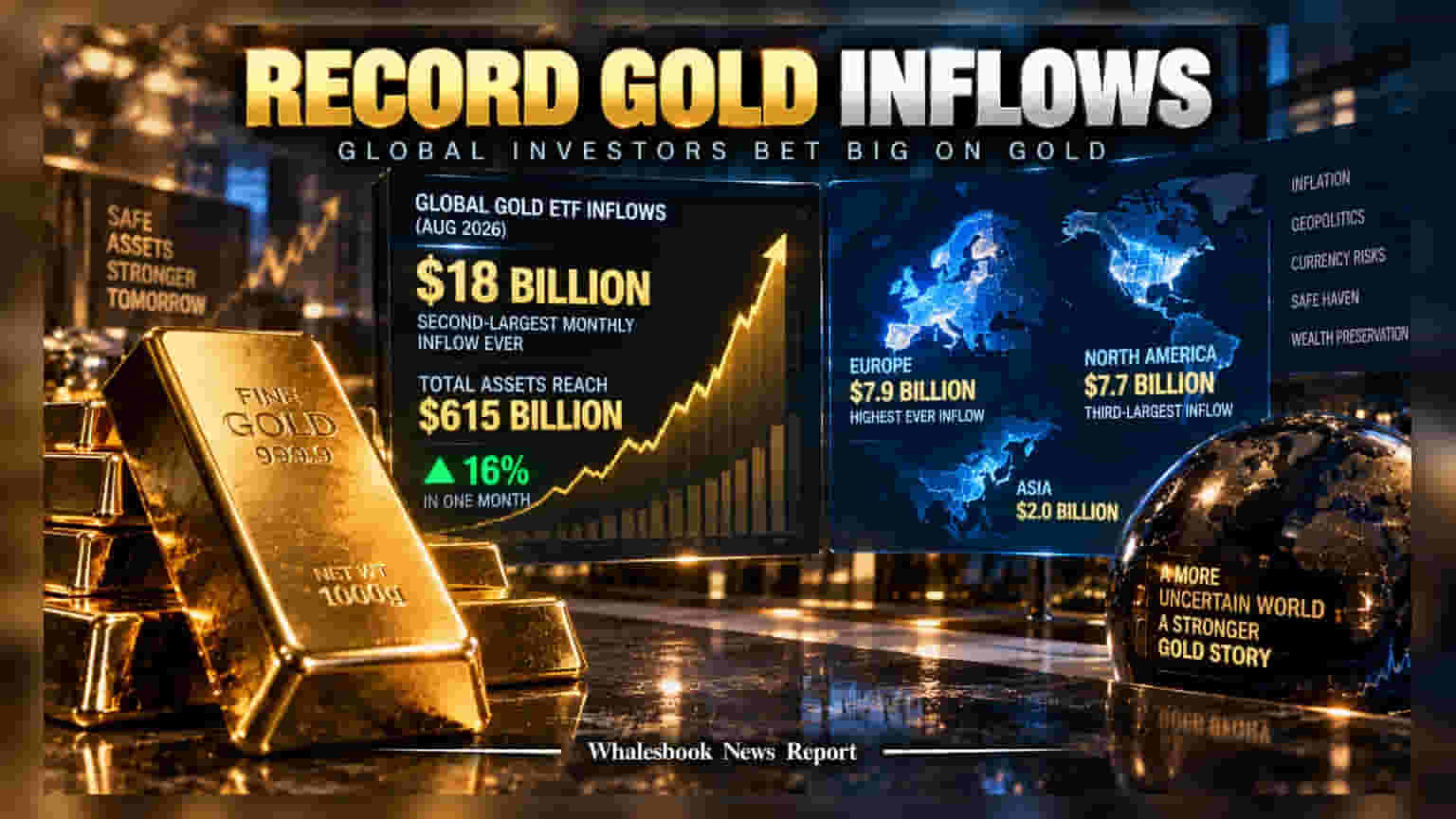
Investors poured $18 billion into global gold-backed ETFs during August 2026, marking the second-largest monthly jump in history. Total assets under management climbed to $615 billion, driven by strong demand in Europe and North America as market participants sought safety amid fiscal uncertainties and shifting interest rate expectations.
Global investors moved aggressively into gold-backed exchange-traded funds in August 2026, adding $18 billion to their holdings. This surge represents the second-largest monthly accumulation of the metal ever recorded. The buying activity pushed the total value of assets managed by these global funds to a record peak of $615 billion, reflecting a 16 percent increase in the total value of held assets during the month.
Europe acted as the primary driver for this activity, recording its highest-ever monthly inflow of $7.9 billion. Investors in the United Kingdom were particularly active, with a $4.4 billion contribution, while French funds saw a record $1.5 billion increase. North American funds were not far behind, attracting $7.7 billion in new capital, marking that region's third-largest monthly inflow on record. Asian markets also played a role, contributing $2 billion to the total, largely supported by a recovery in local gold prices in China.
This massive capital movement suggests that investors are increasingly worried about global fiscal conditions. Rising costs for government borrowing and concerns over fiscal sustainability in Europe appear to have pushed capital toward gold, which is traditionally used as a hedge to protect wealth during uncertain times. North American demand intensified during the third week of August, as investors responded to shifting long-term interest rates and efforts by authorities to stabilize currency markets.
Despite the strong institutional demand, gold prices have struggled to break firmly above the $4,500 per ounce level on the COMEX exchange. The market remains highly sensitive to inflation data and potential policy moves by the US Federal Reserve. A key risk for investors is that gold does not pay interest or dividends. If the Federal Reserve maintains or increases interest rates to combat persistent inflation, the opportunity cost of holding non-yielding assets like gold increases, which can create downward pressure on prices.
From a technical perspective, the gold market is currently showing signs of hesitation. With the Relative Strength Index hovering near a neutral level, traders are watching the $4,400 price mark closely. Market analysts note that if gold fails to maintain this support level, prices could pull back toward $4,300. Investors will now be tracking upcoming inflation reports and central bank commentary to determine if this heavy buying trend can sustain current prices or if the metal will face further technical corrections.