 Whalesbook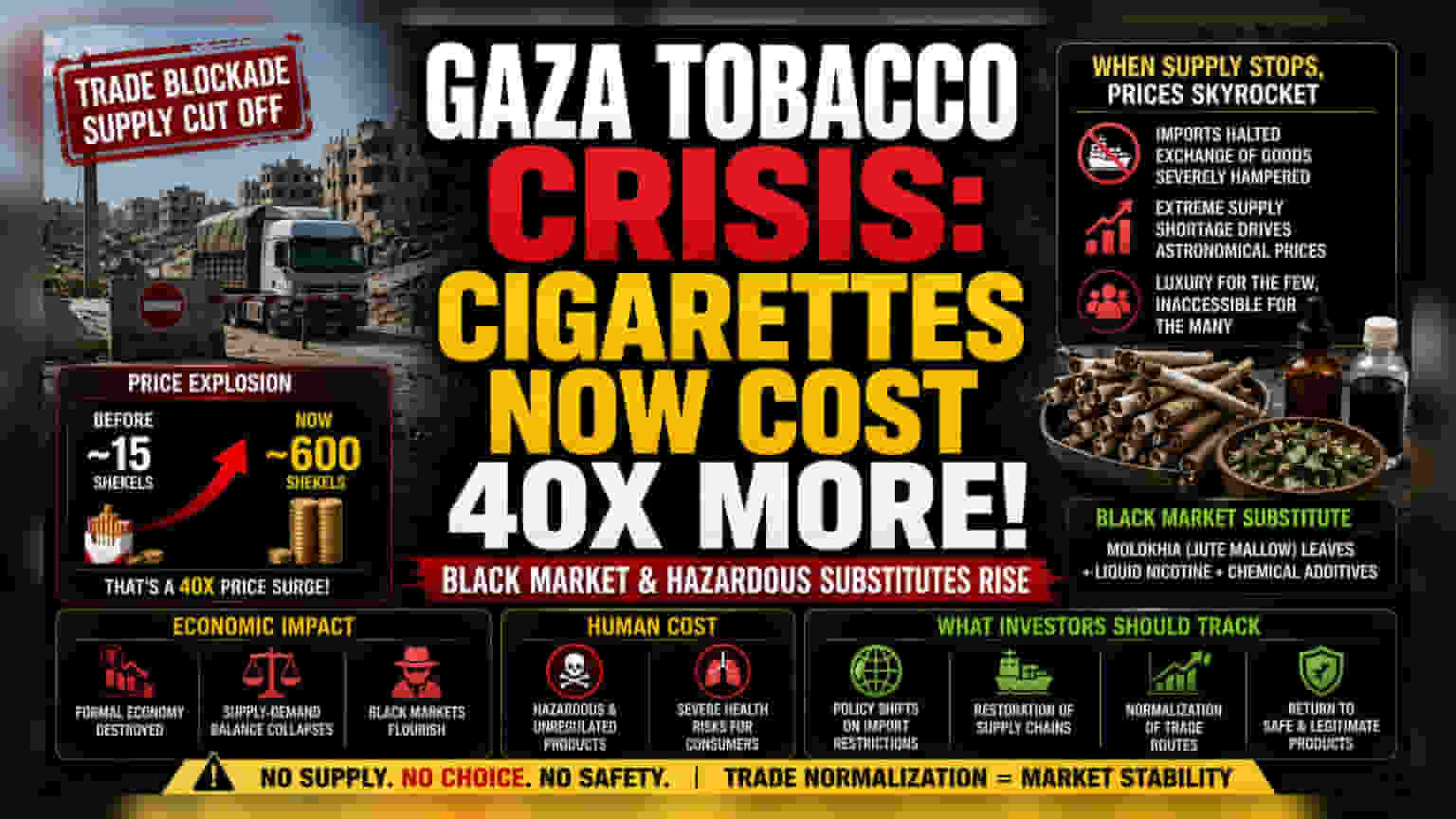


Severe trade and import restrictions in the Gaza Strip have triggered a massive shortage of tobacco, causing prices to soar significantly. This disruption has forced consumers toward dangerous, unregulated substitutes, serving as a stark example of how severe supply chain failures can completely break normal market dynamics.
What Happened
Ongoing trade and import restrictions in the Gaza Strip have effectively cut off the supply of standard tobacco products, leading to a severe commodity crisis. Exchange of goods has been severely hampered, resulting in a dramatic price surge for remaining stock. Reports indicate that the cost of a single pack of cigarettes has risen from approximately 15 shekels to as high as 600 shekels, making the product largely inaccessible to the general public. In response to this extreme scarcity, a black market has emerged where consumers are turning to makeshift substitutes made from dried jute mallow leaves, known as molokhia, combined with liquid nicotine and various chemical additives.
The Economic Impact of Supply Chain Failure
The situation in Gaza highlights the extreme economic consequences when a local supply chain is completely severed. When access to basic consumer goods is blocked, markets do not simply pause; they often become distorted. The astronomical price increase observed in the tobacco market is a direct result of supply-demand imbalance, where an essential commodity is no longer being imported, leaving existing inventories to be sold at massive premiums. This scenario is a classic, albeit extreme, illustration of how trade restrictions can destroy the formal economy and create dangerous, unregulated alternatives.
How Markets React to Extreme Scarcity
In functional market conditions, high prices usually trigger increased production or imports to balance the market. However, in an environment of total trade blockade or severe geopolitical conflict, this self-correcting mechanism fails. The emergence of 'molokhia cigarettes'—which combine plant leaves with industrial chemicals—shows how extreme economic hardship forces consumers to prioritize immediate habit satisfaction over safety. For investors and market analysts, this demonstrates that when supply chains are fundamentally broken, normal pricing models, competitive analysis, and consumer behavior patterns cease to apply.
Understanding the Commodity Disruption
This crisis is an example of a total breakdown in the commodity flow. While the product in question is a consumer good, the underlying principle applies to all sectors. When vital raw materials or finished goods are prevented from reaching a market, the resulting vacuum is filled by illicit or hazardous alternatives. This creates a secondary market that operates entirely outside of regulatory oversight, safety standards, and quality control. The humanitarian reality is that such disruptions lead to severe health consequences, while the economic reality is a market where price discovery is driven purely by survival rather than standard supply and demand fundamentals.
What Investors Should Track
The situation remains volatile, and for those observing global commodity trends or regional stability, the focus must remain on the potential for trade normalization. The key monitorable is any shift in import and export policy that might allow for the restoration of supply lines. As long as trade routes remain closed or heavily restricted, the market will likely remain distorted, with pricing remaining disconnected from reality. Any future easing of restrictions would be the primary catalyst for market stabilization, though the restoration of consumer trust in legitimate products will depend on the speed and consistency of supply restoration.