

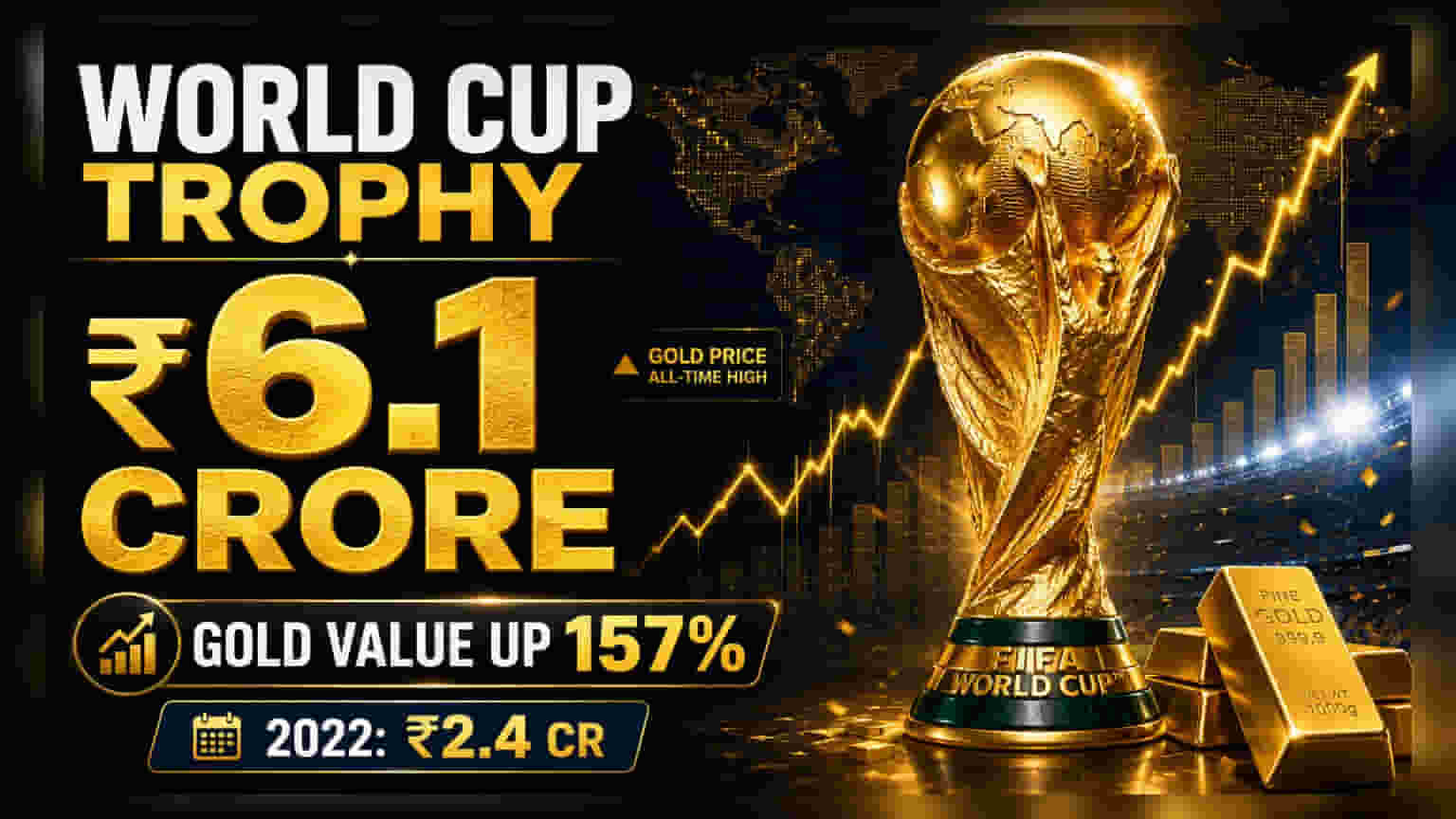
The FIFA World Cup trophy's gold content is now valued at ₹6.1 crore, marking a 157% increase since the 2022 tournament. This surge reflects a major rally in global gold prices, which investors often use as a safe-haven asset during times of economic and geopolitical uncertainty.
What Happened
The gold value of the FIFA World Cup trophy has reached approximately ₹6.1 crore. This figure represents the current melt value of the precious metal used to craft the trophy. This valuation is a sharp rise from the ₹2.4 crore estimated when Argentina won the tournament in 2022, reflecting a 157% increase in the value of the gold composition over the last three and a half years.
The Gold Market Rally
This significant jump in value is tied to the broader rise in gold prices globally. Gold is frequently sought by investors as a safe-haven asset, especially when there is market turbulence, geopolitical tension, or economic uncertainty. Since the 2022 tournament, the price of the precious metal has consistently climbed, outperforming many other asset classes. When the trophy was first introduced in 1974, its gold content was valued at approximately ₹21.5 lakh, illustrating the long-term price appreciation of the metal.
How It Compares With Other Trophies
The FIFA World Cup trophy is unique among major sporting awards due to its 18-karat gold composition. Other prestigious sporting trophies are primarily made of sterling silver, which generally holds a lower market value than gold. For instance, the UEFA Champions League and Europa League trophies have estimated melt values of roughly ₹14.6 lakh and ₹19.4 lakh, respectively. In American sports, the Borg-Warner Trophy for the Indianapolis 500 is valued at approximately ₹1.34 crore, and the Vince Lombardi Trophy has an estimated melt value of around ₹6.2 lakh.
What Investors Should Track
The rising value of the trophy serves as a practical example of how precious metals can hold and grow their value over time. For investors interested in the commodities market, the trophy’s appreciation highlights the impact of macroeconomic factors on gold prices. Important factors to watch for gold price trends include central bank buying, global inflation rates, currency fluctuations, and geopolitical stability. As the 2026 World Cup approaches with its expanded format of 48 teams and 104 matches, the tournament remains a major global event, though the trophy's value will continue to fluctuate primarily based on the international gold market rather than sporting outcomes.