

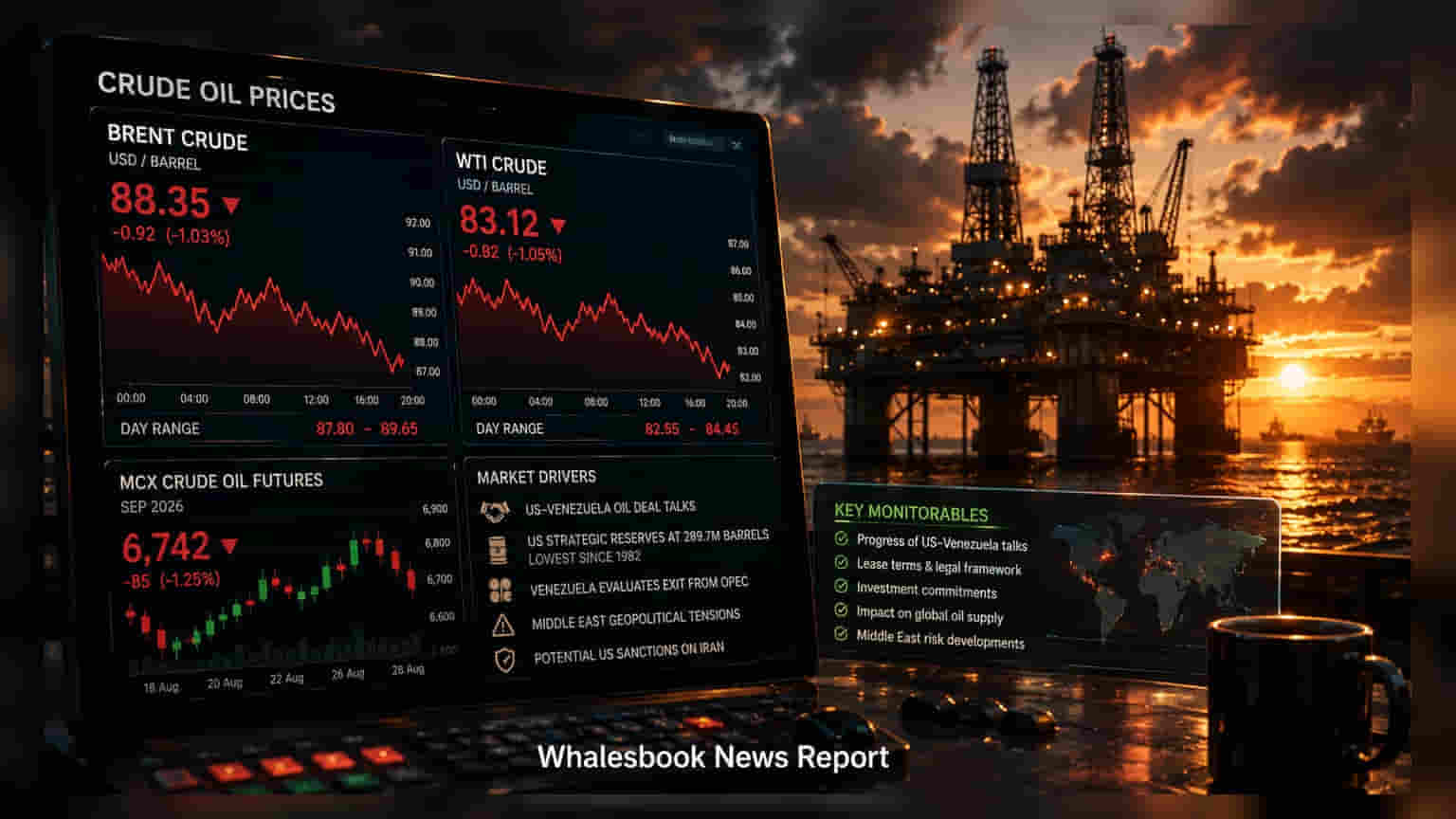
Crude oil prices retreated on August 28, 2026, as markets reacted to reports of potential US-Venezuela talks regarding long-term ownership stakes in Venezuelan oil fields. The potential deal, which includes discussions of a 100-year lease, comes as the US seeks to rebuild its Strategic Petroleum Reserves, which have hit their lowest levels since 1982.
Crude oil prices saw a decline during trading on Friday, August 28, 2026, as investors assessed potential changes in global energy supply dynamics. Brent crude futures were trading in the $88-$89 per barrel range, while West Texas Intermediate (WTI) hovered around $83 per barrel. On the domestic front, Multi Commodity Exchange (MCX) crude futures also showed a downward trend.
The market’s focus shifted toward reports of advanced negotiations between the United States and Venezuela’s interim government. These discussions reportedly involve the potential for US firms to secure long-term equity or ownership stakes in more than a dozen Venezuelan oil fields. Some reports suggest these talks may involve a 100-year lease arrangement, aimed at securing energy supplies for the long term.
This strategic interest from the US arrives at a time when its own Strategic Petroleum Reserves have fallen to approximately 289.7 million barrels as of August 2026, marking the lowest level since 1982. With internal reserves depleted, the US government appears to be exploring external partnerships to ensure future energy security. However, investors are cautious, as these potential deals face significant hurdles. Reports indicate that major US oil companies have encountered difficulties in negotiations with Venezuela due to disagreements over fiscal terms and a lack of clear legal safeguards.
Adding to the uncertainty is the news that Venezuela is evaluating a possible withdrawal from the Organization of Petroleum Exporting Countries (OPEC). While analysts note that an exit might not cause an immediate shock to global supply—given Venezuela's current production levels—it creates long-term questions regarding the cartel's ability to control global output and maintain influence. If Venezuela were to leave, it could signal a shift in regional energy trade dynamics.
Beyond these specific developments, the market continues to face persistent supply-side risks. Tensions in the Middle East, particularly the ongoing deadlock in the Strait of Hormuz and the anticipation of potential new US sanctions on Iran, keep supply disruption risks elevated. Furthermore, even if a deal for Venezuelan oil fields is finalized, analysts point out that it would require massive capital investment to revive the country's decayed oil infrastructure. Without significant spending on maintenance and technology, the immediate impact on global production capacity may remain limited.
For investors, the key monitorables will be the progress of these high-level talks, any official confirmation regarding the lease terms, and updates on the legal and fiscal frameworks that would be required to attract foreign investment into Venezuela’s energy sector. The market will also continue to watch how these potential long-term agreements interact with broader geopolitical risks in the Middle East.