

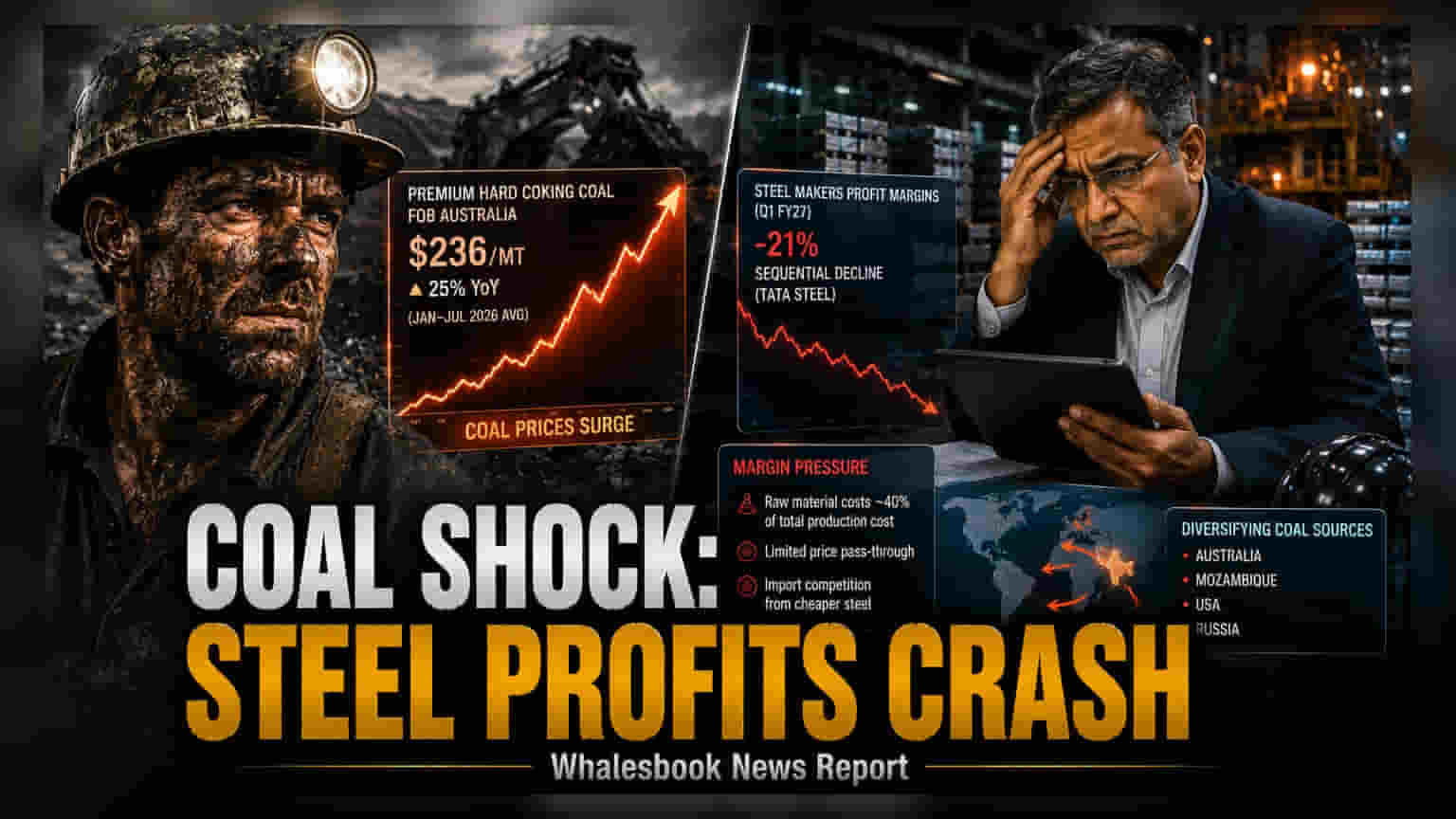
Rising global coking coal prices, up 25% this year, are putting significant pressure on the profit margins of Indian steel producers. With the country importing 95% of its coking coal needs, high input costs are complicating profitability. Investors are watching to see if companies can manage these expenses while balancing capacity expansion plans against competition from cheaper imports.
Indian steel producers are currently facing a difficult balancing act as global coking coal prices remain elevated. With these raw material costs accounting for nearly 40% of total production expenses, the recent price trend is directly impacting the profitability of the domestic steel sector.
Market data shows that premium hard coking coal prices, measured on an FOB Australia basis, averaged $236 per metric ton during the first seven months of 2026. This represents a 25% year-on-year increase. The arithmetic of steel production is sensitive to these fluctuations; for every $10 per ton rise in coking coal prices, steelmaking costs typically increase by $7 to $9 per ton. This added burden is placing immediate strain on the bottom lines of domestic manufacturers.
The impact of these rising costs has already started appearing in financial statements. For instance, Tata Steel reported a 21% sequential decline in consolidated net profit for the quarter ended June 2026, with the company noting that elevated raw material costs were a primary factor behind the margin compression.
A key challenge for Indian steel mills is the limited ability to pass these higher costs on to customers. The domestic market remains price-sensitive, and local producers continue to face competitive pressure from lower-priced imported steel. This dynamic leaves manufacturers with little room to hike prices without risking market share, forcing them to absorb a larger portion of the cost increase.
To manage this exposure, major industry players, including Steel Authority of India (SAIL) and JSW Steel, are actively seeking to diversify their import sources. While Australia remains the primary supplier, companies are working to increase sourcing from regions like Mozambique, the United States, and Russia to mitigate supply chain risks. These efforts to optimize supply chains are ongoing, though logistics and geopolitical tensions continue to present hurdles.
Looking ahead, the sustained pressure on profit margins could lead to a re-evaluation of planned capital spending. Many steelmakers have been aggressive with investment to meet robust domestic demand driven by infrastructure projects, but if margins remain squeezed, there is a risk that some companies may delay or slow down their capacity expansion timelines.
The key monitorables for investors in the coming quarters will be the trend in global coking coal prices, management commentary on cost-optimization strategies, and any updates regarding CAPEX execution. The ability of these firms to maintain operational efficiency while navigating input price volatility will be a crucial factor in their financial performance.