

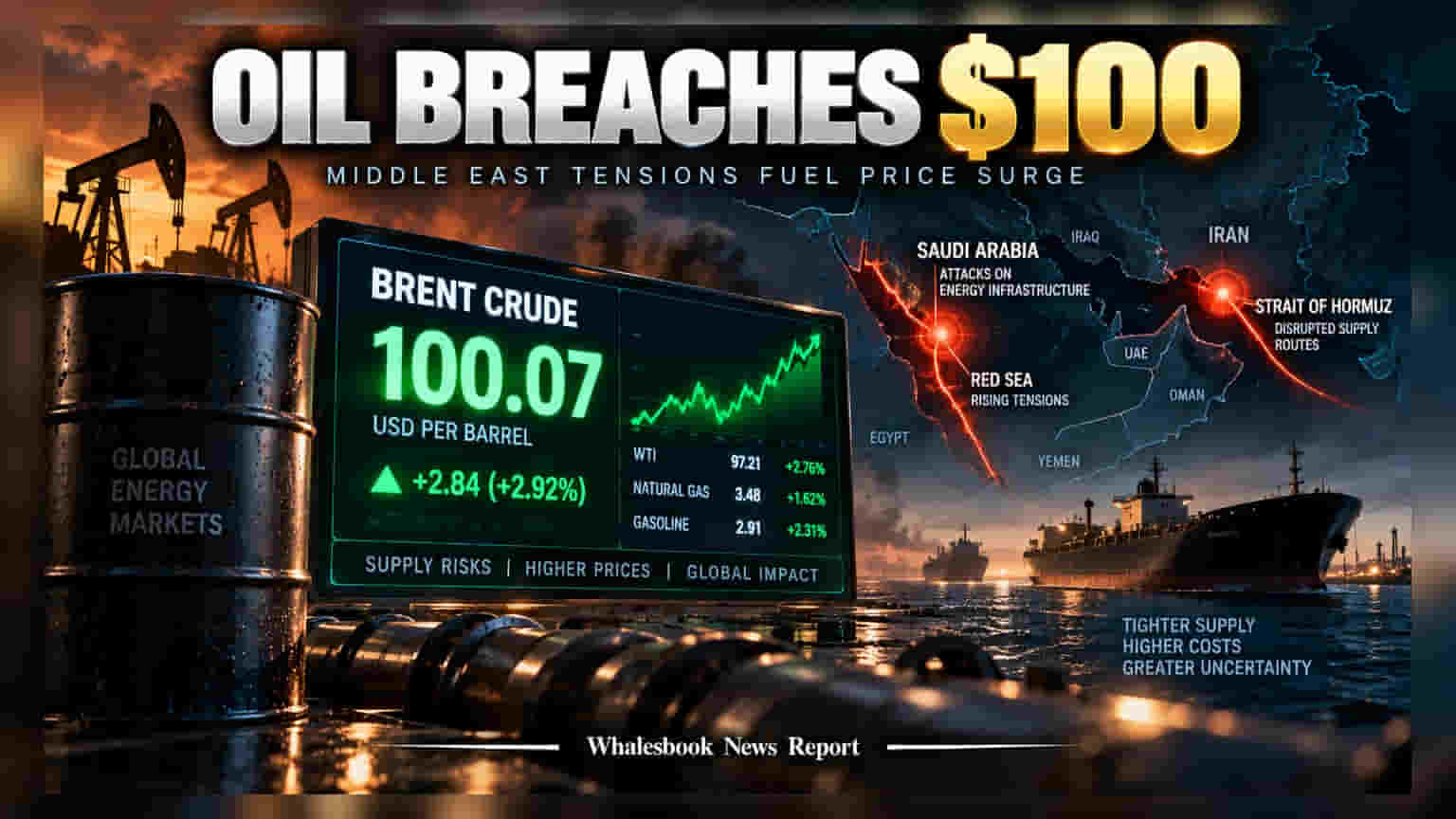
Brent crude oil has surpassed the $100 per barrel mark for the first time since July following fresh attacks on Saudi energy facilities. With global supplies tightening, major financial institutions are revising price forecasts upward. For Indian investors, this rally creates potential pressure on domestic inflation, currency stability, and the profit margins of fuel-dependent sectors.
Brent crude oil prices have surged past the $100 per barrel threshold for the first time since July 2026, driven by an escalation in geopolitical hostilities in the Middle East. Recent attacks on Saudi Arabian energy infrastructure have rattled global energy markets, heightening fears of long-term supply shortages.
The price spike comes as global energy transit routes face severe disruption. The Strait of Hormuz, a critical artery for global oil transport, has seen throughput drop significantly from its peak of 9 million barrels per day to under 2 million barrels per day in recent assessments. With additional threats to the Red Sea, global supply chains are struggling to adapt. Analysts now estimate a global supply contraction of approximately 4.3 million barrels per day, creating a structural deficit that is keeping prices high.
Global financial institutions, including Goldman Sachs, HSBC, and Bank of America, have responded by updating their price forecasts to account for these risks. The market is currently factoring in a period of sustained volatility as diplomatic solutions appear difficult to achieve in the immediate future.
For the Indian economy, the rise in crude prices serves as a critical macro headwind. Since India imports approximately 85% of its crude oil requirements, a jump in global prices directly impacts the country’s import bill and can exert pressure on the Indian Rupee.
From an investor perspective, the impact is uneven across different sectors. Companies that rely heavily on fuel as a raw material or for logistics—such as airlines, paint manufacturers, and tyre companies—may see their profit margins come under pressure due to higher input costs. If sustained, these costs can trickle down to the consumer, fueling domestic inflation, which is a factor the Reserve Bank of India closely monitors when setting interest rates.
Conversely, domestic upstream oil companies, such as ONGC and Oil India, may see better realizations on their crude sales. Meanwhile, Oil Marketing Companies (OMCs) like Indian Oil, HPCL, and BPCL face a delicate balancing act; they must manage the spread between global crude costs and the retail prices of petrol and diesel in India, which can influence their quarterly profitability.
Investors should monitor how long these supply disruptions persist and whether they lead to a sustained period of higher energy prices. The next important data points to track will be official trade balance reports, currency fluctuations, and management commentary from companies in the aviation and manufacturing sectors regarding their ability to pass on these increased costs to consumers.