

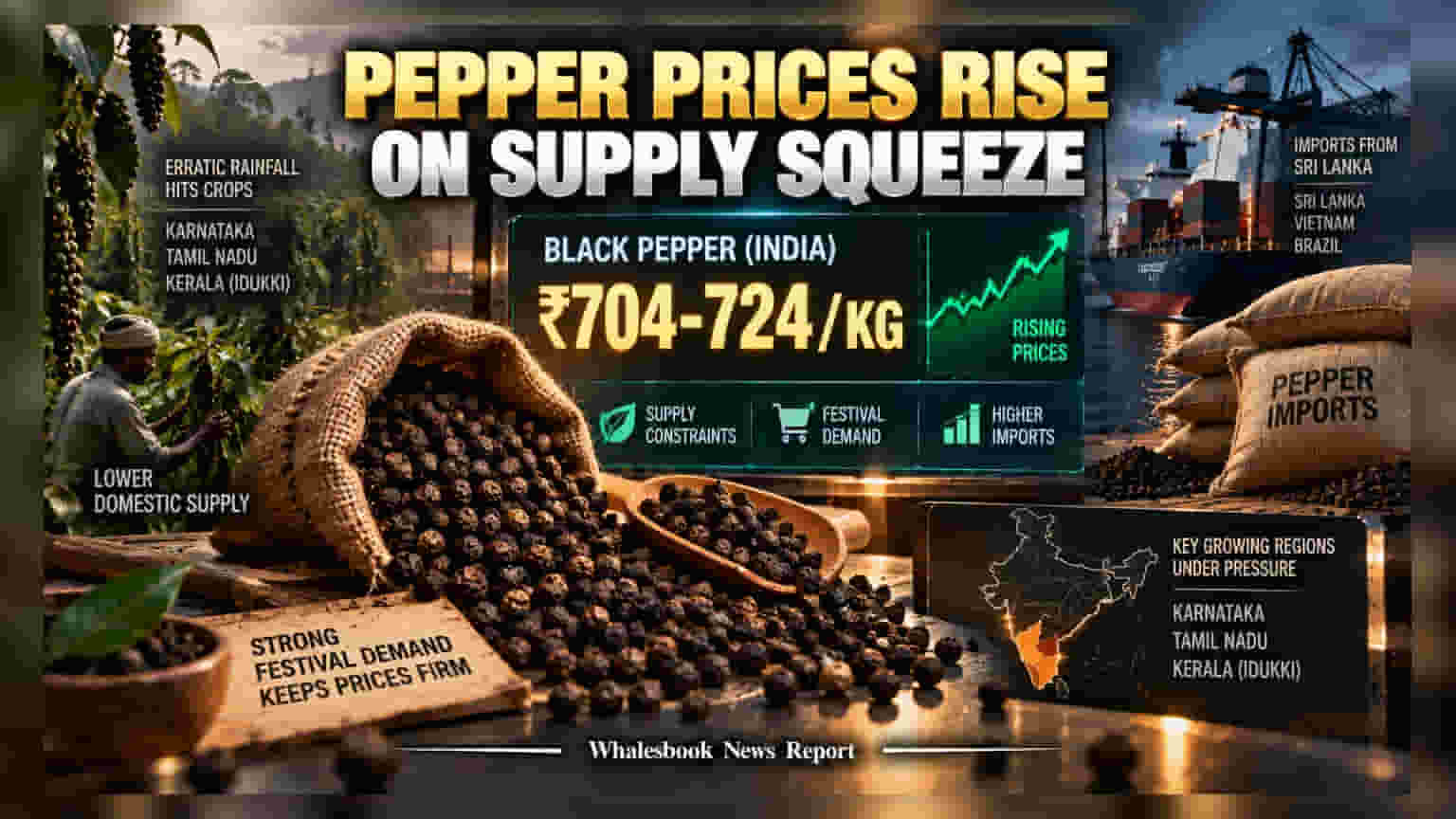
Black pepper prices have reached ₹704–₹724 per kg, driven by strong festive demand and reduced Indian output due to poor weather. To bridge the domestic supply gap, traders are increasing imports from Sri Lanka, where prices are more competitive. This trend highlights potential margin pressure for spice processors and a structural shift in domestic farming habits.
Black pepper prices in India are holding firm, with ungarbled varieties trading near ₹704 a kg and garbled pepper reaching approximately ₹724 a kg. This price support is being driven by a combination of strong festival-season demand and a shortage of domestic supply, forcing the market to look toward international sources.
Impact of Weather on Domestic Output
The domestic supply crunch is largely attributed to adverse weather conditions affecting key growing regions. Major pepper-producing states, including Karnataka, Tamil Nadu, and the Idukki region in Kerala, have faced erratic rainfall. These climate-related challenges have damaged crop prospects for the 2026 harvest season, leading to lower yields than what was previously expected.
Industry estimates had initially targeted a domestic harvest between 65,000 and 75,000 tonnes. However, local traders and industry bodies note that the actual output is likely to fall short of these targets due to the impact of El Niño-related weather patterns. This tightening of supply comes at a critical time as demand from upcountry markets increases ahead of the festival season.
Increased Reliance on Imports
To manage the shortage, Indian buyers are increasingly relying on international suppliers, with Sri Lanka emerging as a preferred partner. There is a significant price gap between the two markets, which is incentivizing imports. Sri Lankan pepper is currently quoted at approximately $6,900 a tonne, which is considerably cheaper than the domestic Indian pepper price of roughly $7,800 a tonne.
While imports are helping to fill the immediate supply gap, the cost of these imports has also risen due to currency fluctuations and strong purchasing interest. Beyond Sri Lanka, Vietnam and Brazil also remain potential supply sources, with quoted prices near $6,000 and $5,800 a tonne, respectively. The heavy reliance on imports is a factor that spice traders and processors must manage to maintain their supply chains.
Structural Risks and Farming Shifts
A critical development for investors and industry observers is the potential shift in land use by farmers. In regions like Idukki, there are indications that some growers are moving acreage away from pepper cultivation toward cardamom. This shift is driven by the relative economics of the two crops, as cardamom prices have strengthened following production issues in Guatemala. If this trend of switching crops continues, it could pose a structural risk to future domestic pepper production levels, potentially keeping the market more dependent on imports in the long term.
For companies in the spice and food processing sector, this environment creates a complex scenario. Higher raw material costs often lead to profit margin pressure unless companies can effectively pass these price increases on to consumers. Investors may monitor how companies manage these procurement costs and whether the reliance on imported pepper impacts their overall cost structures and profitability in the coming quarters.