

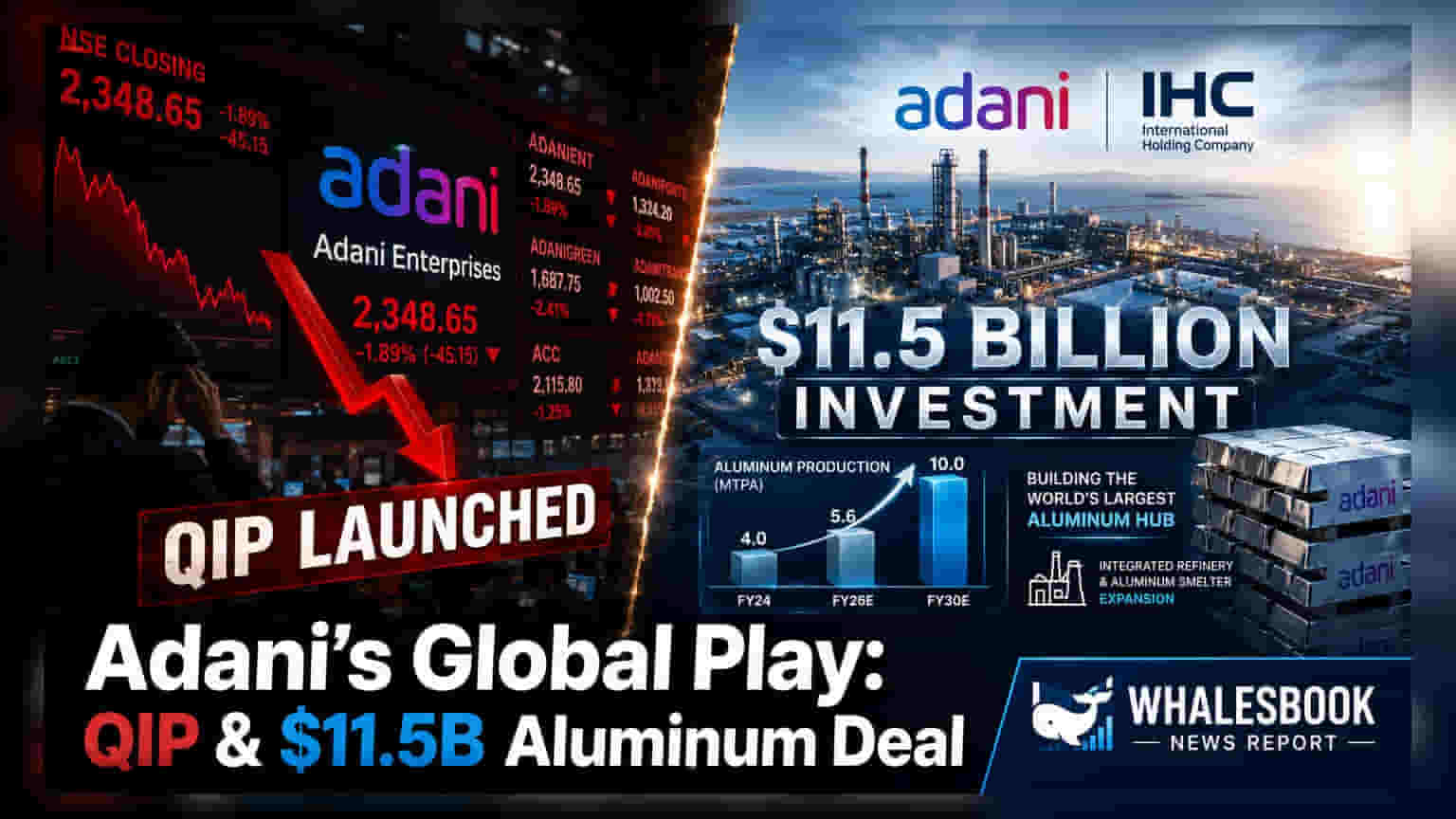
Adani Enterprises has opened its Qualified Institutional Placement (QIP) with a floor price of ₹3,034.68 per share. Additionally, the company revealed a $11.5 billion joint venture with Abu Dhabi’s IHC to set up a massive aluminum complex in Odisha. These moves signal a major push to expand the group's manufacturing footprint and raise fresh capital.
What Happened
Adani Enterprises has taken two major steps to expand its business. First, the company launched a Qualified Institutional Placement (QIP) on July 2, 2026. This process allows the company to raise money by selling shares directly to large institutional investors like banks, mutual funds, and insurance companies. The company has set a floor price (the minimum price it is willing to accept) of ₹3,034.68 per share.
Simultaneously, the company announced a significant partnership with Abu Dhabi-based International Holding Company (IHC). The two companies have agreed to form a 50:50 joint venture to build a large aluminum complex in Odisha. This project involves a massive investment of $11.5 billion, which aims to produce both alumina and finished aluminum, including downstream products.
The QIP Explained
A QIP is a method for listed companies to raise capital from qualified institutional buyers. By issuing new shares, the company increases its cash balance. While this provides the company with capital for growth or debt reduction, it also results in the dilution of existing shareholders, meaning the earnings per share are spread over a larger number of total shares. Investors typically watch the issue price to see if it is at a significant discount to the current market price.
The Aluminum Venture Details
The proposed aluminum complex in Odisha is a massive undertaking. The plan includes a refinery, a smelter, a captive power plant, and facilities to make finished products. The target capacity is 4 million tons of alumina and 2 million tons of aluminum annually. This venture marks a strategic move for Adani Enterprises, which is currently focused on expanding its presence in the metals and mining sector. While the group already manages copper operations, aluminum is a new and capital-intensive area for them.
Risks And Execution Challenges
Investing $11.5 billion is a major financial commitment. For a project of this size, there are several inherent risks that investors should understand. First is the execution risk; large-scale industrial projects in India often face delays due to land acquisition, environmental clearances, and infrastructure bottlenecks. Any delay can lead to cost increases.
Second, the aluminum sector is cyclical. Global aluminum prices can be volatile based on demand from sectors like construction and automotive. If prices remain low, it can hurt profit margins. Finally, this project will likely require significant borrowing or further capital, which may put pressure on the company’s balance sheet depending on how the debt is structured and managed.
Peer And Sector Context
The Indian aluminum market is dominated by established players like Hindalco Industries and Vedanta. These companies have years of experience in smelting, refining, and manufacturing. The entry of Adani Group into this space, backed by a massive investment and a global partner like IHC, is likely to change the competitive dynamics over the next few years. Investors will want to see how quickly the company can move from the planning stage to actual production compared to these experienced incumbents.
What To Watch Next
Investors should keep a close eye on the final pricing and subscription levels of the QIP, as this will show how much appetite big institutional investors have for the company’s current expansion plans. For the aluminum project, the key monitorables include the timeline for land acquisition, environmental approvals, and the specific funding structure for the $11.5 billion investment. Updates on these items will be critical to understanding the impact on the company’s financial health and long-term growth.