

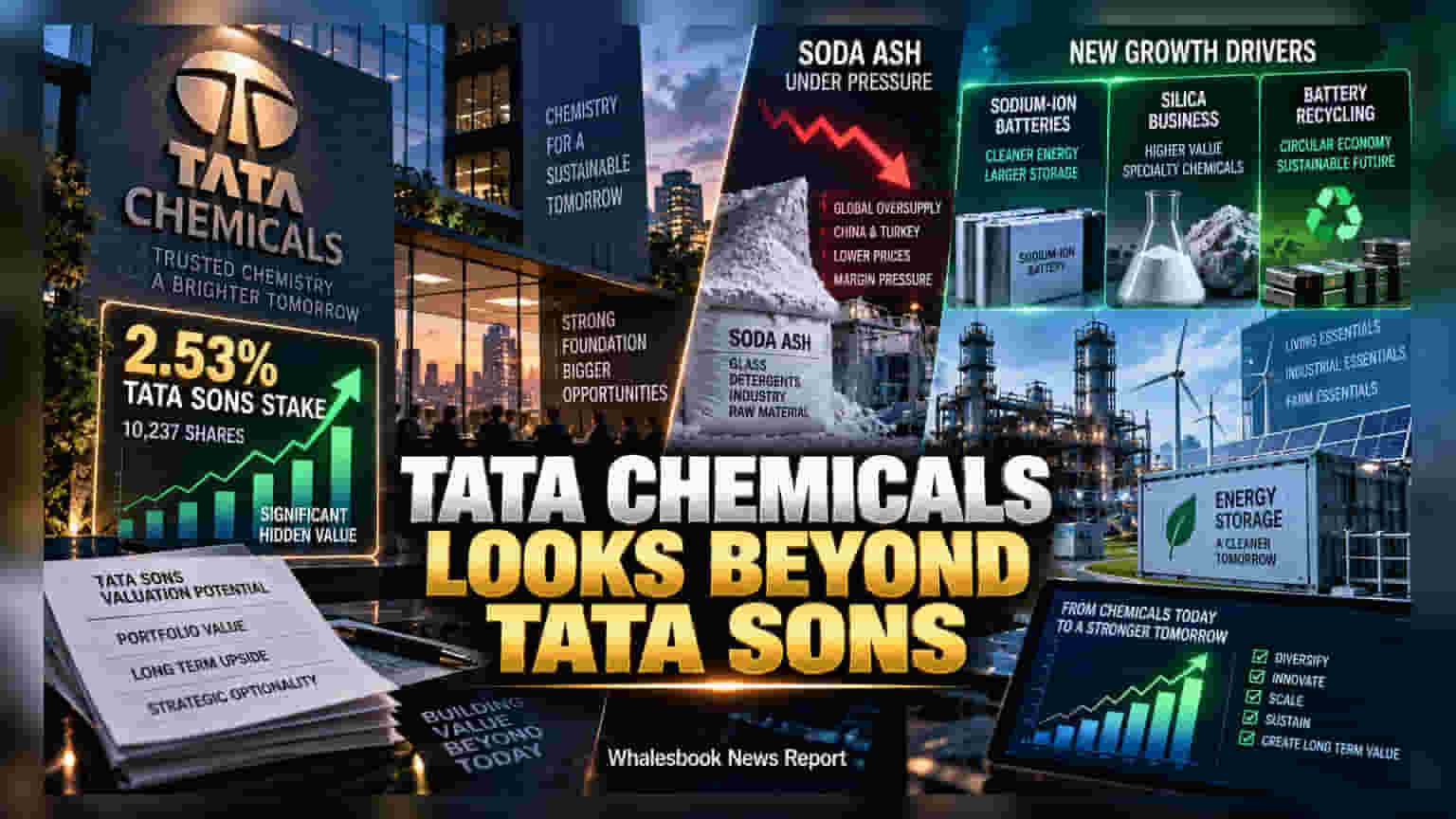
Tata Chemicals holds a 2.53% stake in Tata Sons, creating significant hidden value speculation. However, the company's real-world performance is currently pressured by weak global soda ash prices and high operational costs. Investors are increasingly balancing this potential holding-company value against the slower, capital-intensive transition toward new battery and specialty chemical technologies.
Tata Chemicals presents a dual story for investors. On one side, it acts as a holding company with a valuable 2.53% stake in Tata Sons, representing 10,237 shares. Because these shares are carried on the balance sheet at book value, market participants often debate the potential hidden value if the parent company were to list on stock exchanges. When expectations around a potential Tata Sons listing rise, the stock often moves significantly.
However, the operational reality of the business remains heavily tied to the global chemical cycle. The company’s core profit engine is soda ash, a commodity used in glass and detergent manufacturing. This segment is currently facing pressure from global oversupply, particularly from producers in China and Turkey. Lower market prices for soda ash directly impact the company’s profit margins, making it difficult for the stock to rely solely on the value of its Tata Sons stake. This operational struggle is reflected in the stock’s performance, which has declined about 30% over the past year.
To move away from this cyclical dependency, management has been reorganizing the business into three buckets: living essentials, industrial essentials, and farm essentials. The goal is to shift toward segments with better customer retention and more stable pricing. While Rallis India handles the farm essentials, the company is betting heavily on new industrial projects. These include silica production and advanced energy storage solutions.
The company is currently testing sodium-ion battery technology, which is designed for renewable energy storage and data center applications. Furthermore, it is exploring lithium iron phosphate battery recycling in partnership with automotive firms. These are strategic long-term plays. Soda ash is a key raw material for the cathode in sodium-ion batteries, creating a potential vertical integration advantage. However, these technologies are still in the pilot or testing phase. Commercial success depends on completing testing protocols by late 2026 and scaling production effectively.
For investors, the primary risk is execution. The transition to high-value chemicals and battery technology requires significant capital spending. This can put pressure on the balance sheet and cash flow, especially if the core soda ash business continues to face pricing headwinds. Unlike the passive value of the Tata Sons stake, these new projects carry the real-world risk of project delays, cost overruns, and the challenge of establishing market share against established global competitors.
The most important monitorables for the coming quarters will be the trend in global soda ash pricing and the progress on pilot projects for battery technology. Investors will be watching to see if management can generate steady cash flow from its existing businesses to fund its future-focused expansion without adding excessive debt pressure.