 Whalesbook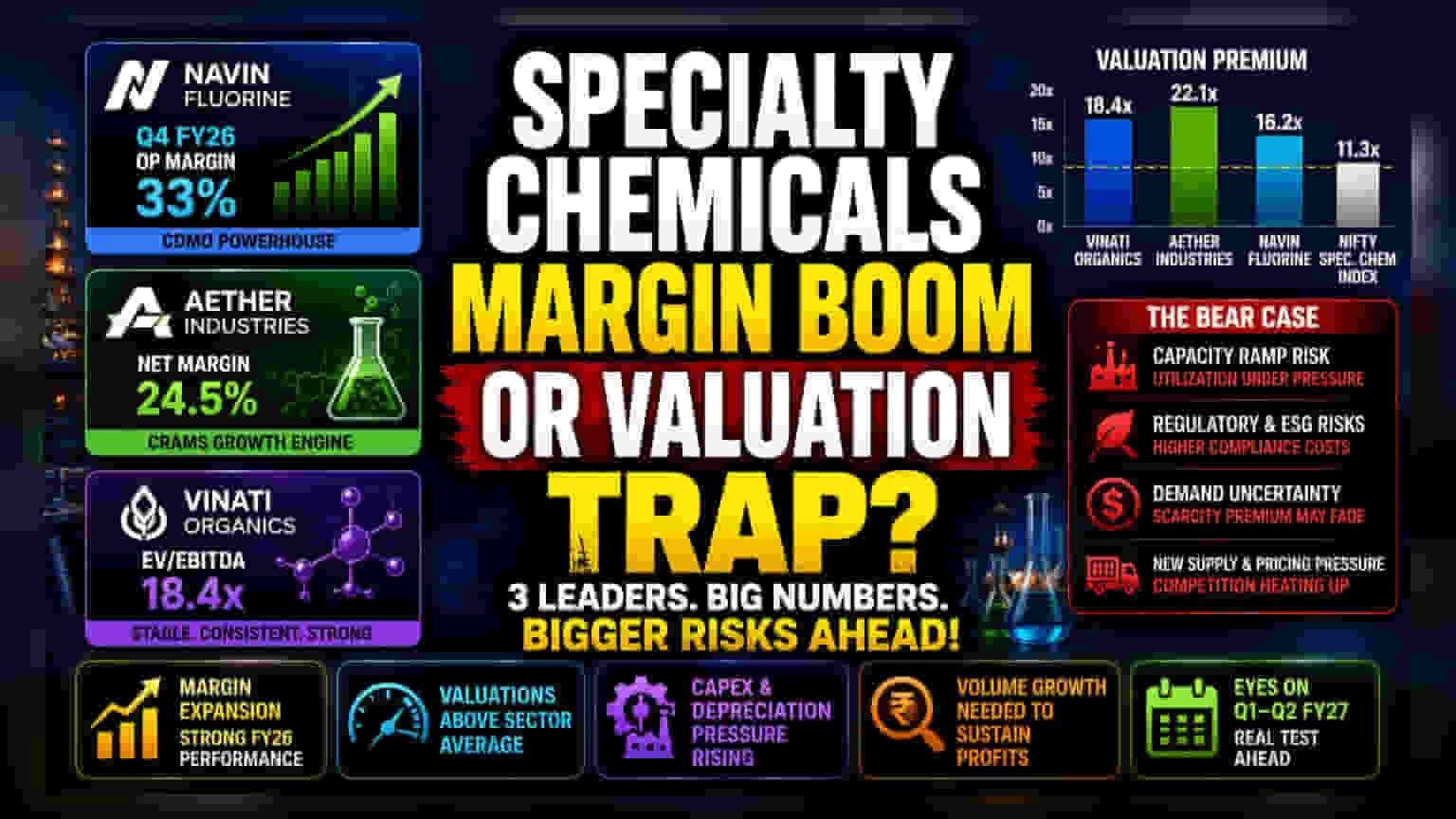


The Valuation Gap
While the headline figures for Navin Fluorine, Aether Industries, and Vinati Organics highlight successful margin reclamation, the market reaction remains bifurcated. Investors are pricing in a recovery that assumes historical peak demand levels, yet the current macroeconomic environment suggests a different reality. Navin Fluorine’s 33% operating profit margin, while impressive, relies heavily on the continued success of its high-barrier CDMO projects. Unlike commodity-linked peers that remain tethered to the volatility of crude oil and feedstock pricing, these entities have attempted to decouple themselves through specialized product portfolios. However, as global supply chains stabilize, the 'scarcity premium' these firms currently enjoy may diminish as competitors bring new supply online.
Sector Benchmarking and Competitive Dynamics
When compared to the broader Nifty Specialty Chemicals index, these three firms currently trade at a significant valuation premium. Vinati Organics, with its EV/EBITDA multiple of approximately 18.4x, represents the stable-but-mature end of the spectrum, while Aether Industries occupies the growth-at-any-cost segment. Aether's aggressive push into R&D-heavy CRAMS represents a defensive move to insulate against the cyclical nature of its core chemical business. Conversely, the industry is seeing a rise in smaller, leaner players utilizing lower-cost manufacturing hubs, creating a pricing floor that may eventually pressure the double-digit margin expansion seen over the last fiscal year.
The Forensic Bear Case
Underneath the growth narrative lies a precarious dependency on capital expenditure. Aether Industries, for instance, faces intense pressure to achieve full capacity utilization at its Site 5 project to justify its recent valuation. If global demand for niche chemicals does not hit forecasted targets in late 2026, the resulting idle capacity will drag on margins. Furthermore, regulatory scrutiny regarding environmental compliance in the Indian specialty chemical cluster has increased. Any disruption or necessary pivot in manufacturing processes to meet stricter ESG standards could necessitate unplanned, heavy investment. Finally, while management has successfully navigated the recent cycle, the historical tendency of the sector to over-supply during periods of high profitability remains a structural risk that cannot be ignored.
Future Outlook
Guidance across the board suggests a cautious optimism for FY27. The sector is currently trading on the expectation that volume growth will replace the pricing-led margin gains of the last twelve months. If institutional investors determine that the margin expansion has peaked, the current earnings multiples may face downward correction. The focus now shifts to Q1 and Q2 performance, where the impact of higher capacity-related depreciation costs will test whether these firms can maintain their current profitability levels under normalized operating conditions.