

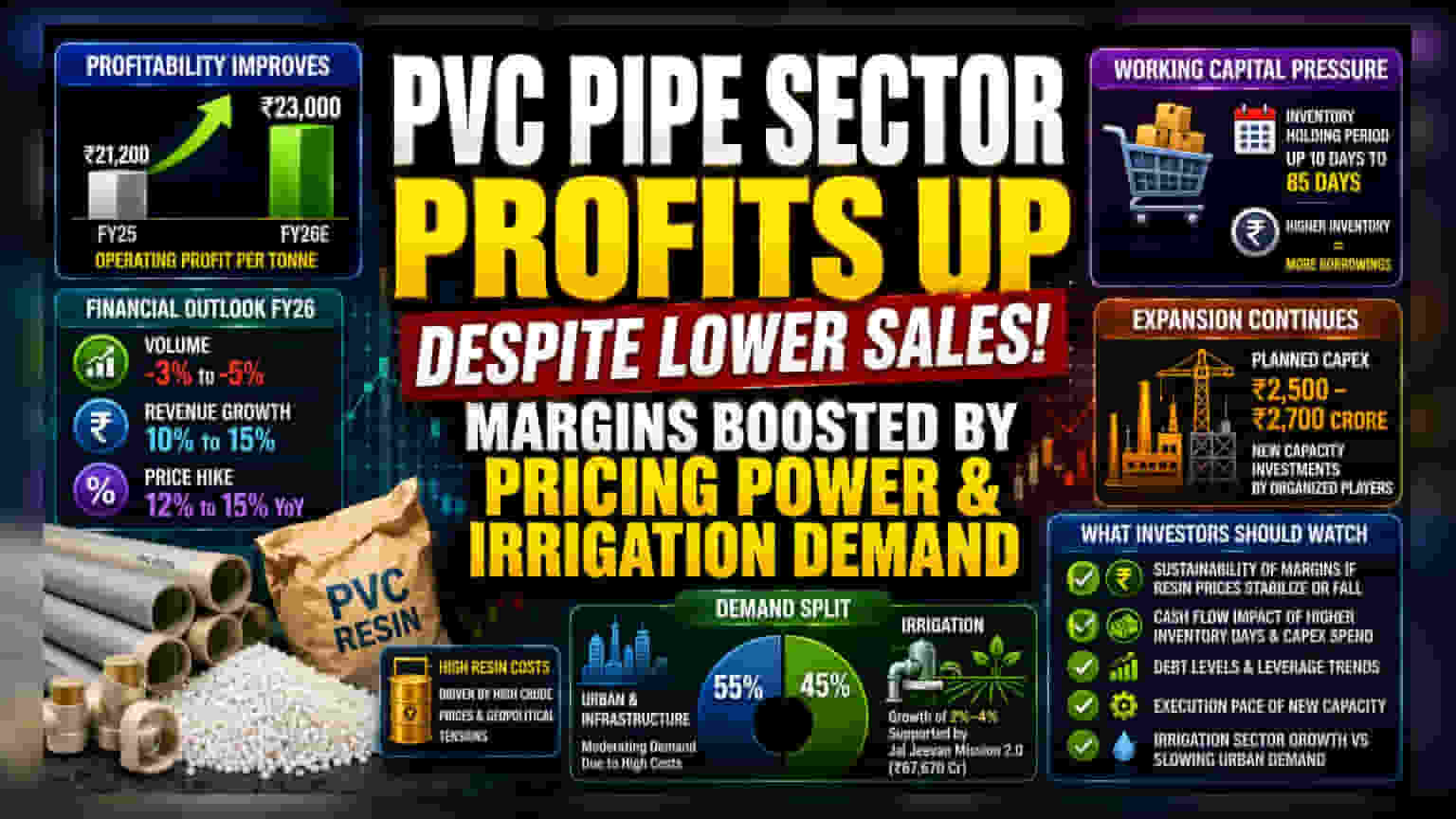
Organized PVC pipe manufacturers expect their operating profit per tonne to rise to Rs 23,000 this fiscal year. While high resin costs allow for price increases, an expected 3-5% drop in sales volume due to urban demand slowdown remains a key risk. Investors should monitor rising inventory levels and debt needs amid ongoing capacity expansion.
What Happened
Organized players in the Indian PVC pipe and fittings sector are preparing for a potential improvement in profitability this fiscal year, according to a recent assessment by Crisil Ratings. Despite an anticipated decline in sales volume, companies are expected to report higher operating profit per tonne, reaching approximately Rs 23,000 compared to Rs 21,200 in the previous year. This trend is driven by manufacturers’ ability to pass on the increased costs of resin—the primary raw material—to end customers, thereby protecting their margins.
Why Profits Are Rising Despite Lower Sales
The profitability improvement stems largely from pricing power. PVC resin prices are currently high, partly due to increased crude oil costs linked to geopolitical tensions. Since roughly two-thirds of the resin used in India is imported, cost volatility is significant. However, organized manufacturers have successfully raised selling prices by an estimated 12-15% year-on-year. This price adjustment, combined with relatively stable fixed costs, is expected to drive an overall revenue growth of 10-15% for the industry, even as the actual volume of pipes sold is projected to fall by 3-5%.
The Demand Split: Irrigation Versus Urban
The market faces a divergence in demand sources. The urban real estate and infrastructure sector, which accounts for about 55% of the market, is showing signs of moderation. High costs and general inflationary pressures have constrained demand in this segment, leading to the overall volume decline.
On the other hand, the irrigation sector, representing about 45% of demand, remains a stabilizing force. This segment is expected to see a modest growth of 2-4%. Support for this growth comes from the irrigation requirements for the 2026 agricultural season and the government’s continued allocation for the Jal Jeevan Mission 2.0, which has a budgeted spend of Rs 67,670 crore.
Working Capital And Expansion Risks
Investors should pay attention to the rising working capital requirements. Higher resin costs have pushed manufacturers to stock more inventory, with the holding period expected to increase by 10 days to reach 85 days. This tie-up of funds necessitates greater reliance on borrowings, which can impact cash flow if not managed carefully.
Simultaneously, organized players are continuing to invest in expansion, with planned investments in new capacity estimated at Rs 2,500-2,700 crore. While this reflects long-term growth confidence, it adds to the financial commitment of these companies.
What Investors Should Track Next
For investors, the key monitorables will be whether companies can maintain their profit margins if resin prices stabilize or fall. Furthermore, it is important to watch if the expected revenue growth translates into strong cash flow, or if the increased inventory days and expansion spending lead to higher debt levels. The pace of execution for new capacity and the actual performance of the irrigation segment compared to the slowing urban market will also be critical indicators of business health.