 Whalesbook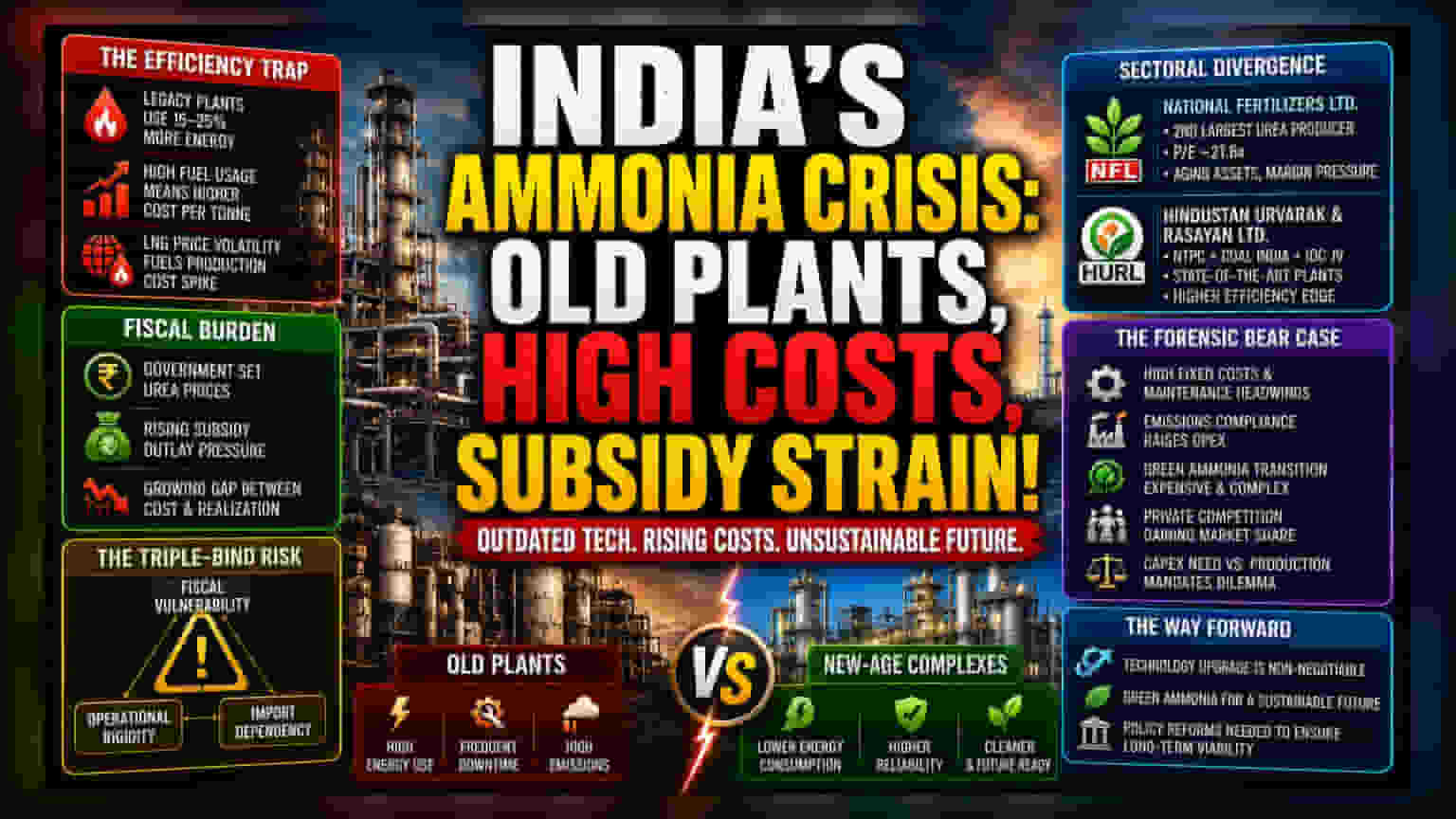


The structural stability of India’s agricultural backbone is being challenged by an outdated ammonia production fleet. While the industry has made gains in emissions reduction, the underlying hardware in many of the country's 36 ammonia facilities reflects technology cycles from up to five decades ago. This technological debt now serves as a significant drag on operational efficiency at a time when domestic fertilizer production is critical to buffering the economy against volatile global energy markets.
The Efficiency Trap
Ammonia production remains an energy-intensive process, and the specific energy consumption of legacy plants is significantly higher than modern best-available-technology (BAT) standards. While newer facilities have optimized feedstocks, a substantial portion of India's capacity still struggles with high fuel usage, which translates directly into higher production costs per tonne. With the fertilizer sector now classified under 'Priority Sector-2' for natural gas supply, domestic producers are insulated from immediate fuel shortages, yet this status does not shield them from the high costs of imported liquefied natural gas (LNG). As global energy prices fluctuate, the disparity between production costs in aging plants and the state-regulated retail price of urea necessitates an increasingly unsustainable subsidy outlay from the Union Budget.
Sectoral Divergence
National Fertilizers Limited (NFL), a major central public sector undertaking, continues to play a pivotal role as the second-largest urea producer in India. Despite recent modernization efforts, companies like NFL navigate a valuation landscape that reflects the heavy asset intensity of the industry. NFL trades at a price-to-earnings (P/E) ratio of approximately 21.6x, underscoring investor caution regarding margin compression and the capital-intensive nature of upgrading aging brownfield sites. In contrast, new entrants like Hindustan Urvarak & Rasayan Limited (HURL)—a joint venture between NTPC, Coal India, and Indian Oil—have deployed state-of-the-art complexes, highlighting a growing performance gap between government-backed greenfield projects and legacy assets that require extensive retrofitting.
The Forensic Bear Case
From a risk perspective, the industry is caught in a triple-bind of fiscal vulnerability, operational rigidity, and import dependency. The transition to green ammonia remains the long-term solution to decouple production from fossil gas price volatility, but the path is obstructed by high incremental costs and the technical complexities of integrating renewable energy into existing ammonia synthesis loops. Furthermore, competitive pressure is rising as private entities like Matix Fertilisers & Chemicals continue to expand market share in Eastern India, utilizing more efficient production profiles. For older public sector units, the combination of high fixed costs, maintenance-related downtime, and the regulatory burden of emissions compliance creates a fragile financial outlook. Management teams at these legacy firms face the difficult challenge of balancing necessary capital expenditure for upgrades with the ongoing requirement to maintain high capacity utilization rates to satisfy government production mandates.