 Whalesbook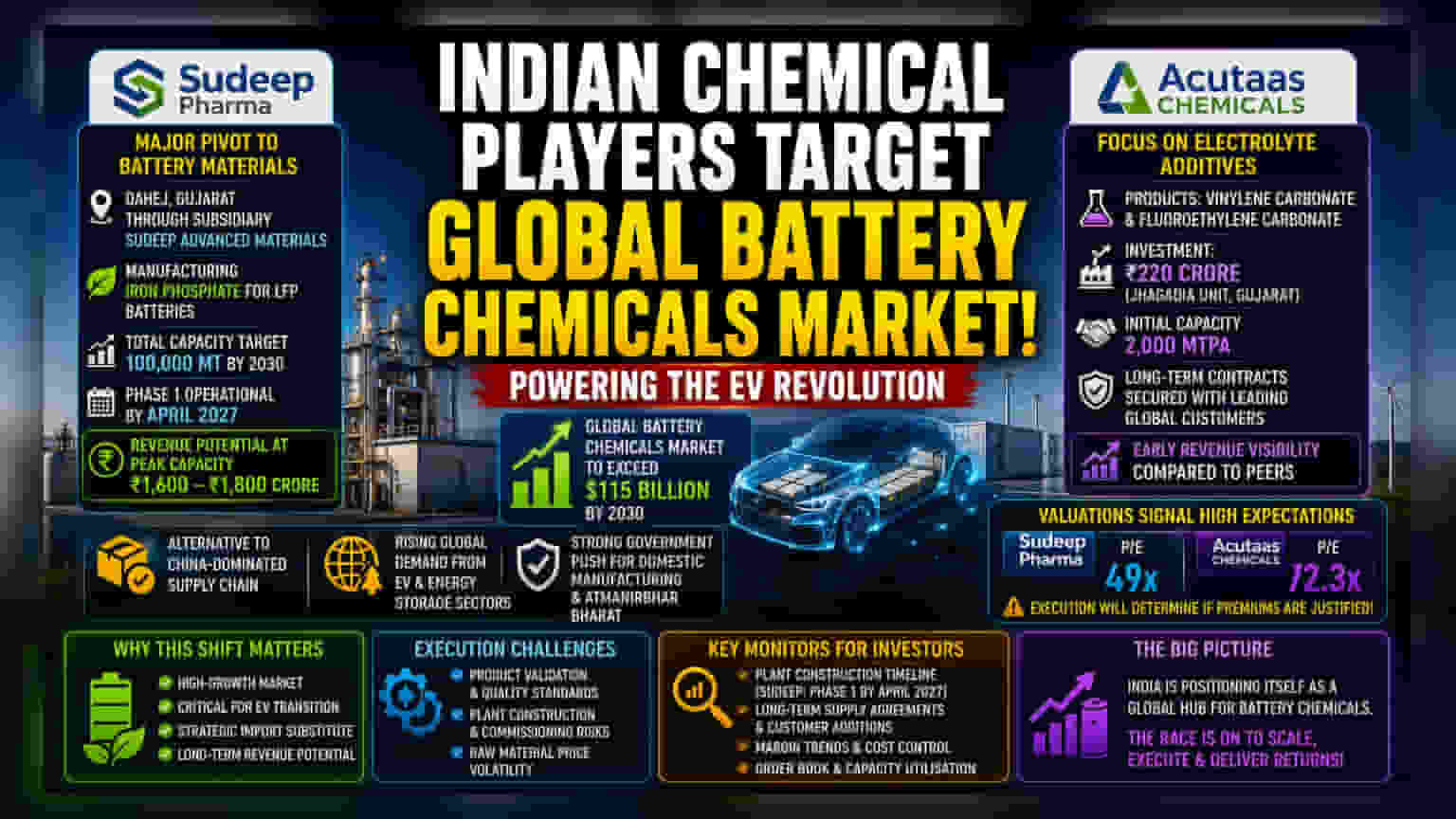


Sudeep Pharma and Acutaas Chemicals are pivoting toward battery materials to capture global demand and challenge Chinese dominance. With significant investments in new facilities, these companies aim to become key players in the EV supply chain. Investors are balancing this growth potential against execution risks, high valuations, and the complexity of entering a new industrial sector.
What Happened
Indian chemical and pharmaceutical companies are shifting their focus to capture a share of the global battery chemicals market. This sector, which supplies critical materials for electric vehicles (EVs) and energy storage systems, is projected to grow significantly to over $115 billion by 2030. Sudeep Pharma and Acutaas Chemicals are leading this transition, announcing major investments to build new production facilities. The move is strategically designed to provide global customers with supply chain alternatives to China, which currently dominates the production of battery-grade materials.
The Strategic Pivot
For these companies, the move into battery materials represents a significant business transformation. Sudeep Pharma is setting up a large facility in Dahej, Gujarat, through its subsidiary, Sudeep Advanced Materials. The company plans to manufacture iron phosphate, a key material for Lithium Iron Phosphate (LFP) batteries. The project is ambitious, with a total planned capacity of 100,000 metric tons by 2030, to be built in four phases. The first phase is expected to be operational by April 2027. Sudeep Pharma aims for this segment to significantly boost its revenue, targeting a potential of 1,600 to 1,800 crore at peak capacity.
Acutaas Chemicals is taking a different approach by focusing on electrolyte additives, such as vinylene carbonate and fluoroethylene carbonate. The company is investing 220 crore in its Jhagadia unit in Gujarat to increase production capacity. Unlike companies still in the validation phase, Acutaas has stated that its initial capacity of 2,000 metric tons per annum is already secured by long-term contracts with industry-leading customers. This suggests an earlier path to revenue generation compared to projects that are still building their client base.
The Valuation and Financial Context
Both companies are currently trading at valuations that suggest high market expectations. Sudeep Pharma trades at a price-to-earnings (P/E) multiple of 49x, while Acutaas Chemicals trades at 72.3x. A high P/E ratio generally indicates that investors are paying a premium for the company’s future growth potential. Whether these valuations are justified will depend on the companies' ability to successfully execute their plans and convert their technical capabilities into profitable revenue.
The Execution and Demand Challenge
While the market opportunity is large, investors should be aware of the challenges involved in such a transition. Entering the battery chemicals space is not just about building a factory. It requires rigorous product validation and consistent quality standards to meet the demands of global EV manufacturers. Sudeep Pharma has already demonstrated its product chemistry to 42 customers, with six having completed validation. This is a critical step, but moving from validation to large-scale commercial production involves risks, including potential delays in construction or technical hurdles during the setup of new processes.
Furthermore, the success of these ventures is tied to the growth of the EV market. If the adoption of electric vehicles slows down globally, or if there is an oversupply of battery materials, it could put pressure on pricing and profit margins. Companies in this space also face the risk of volatile raw material prices, which can significantly affect the cost of production.
What Investors Should Track
Investors may want to monitor several key factors as these companies move forward. The primary monitorable is the construction timeline for the new plants, particularly the commissioning of Sudeep Pharma's first phase in April 2027. Additionally, the ability of both companies to secure and maintain long-term supply agreements will be a strong indicator of their business stability. Finally, shareholders will likely watch for updates on profit margins, as the cost of setting up these high-tech facilities and the competitive nature of the global market may influence how much profit these new segments contribute to the bottom line.