

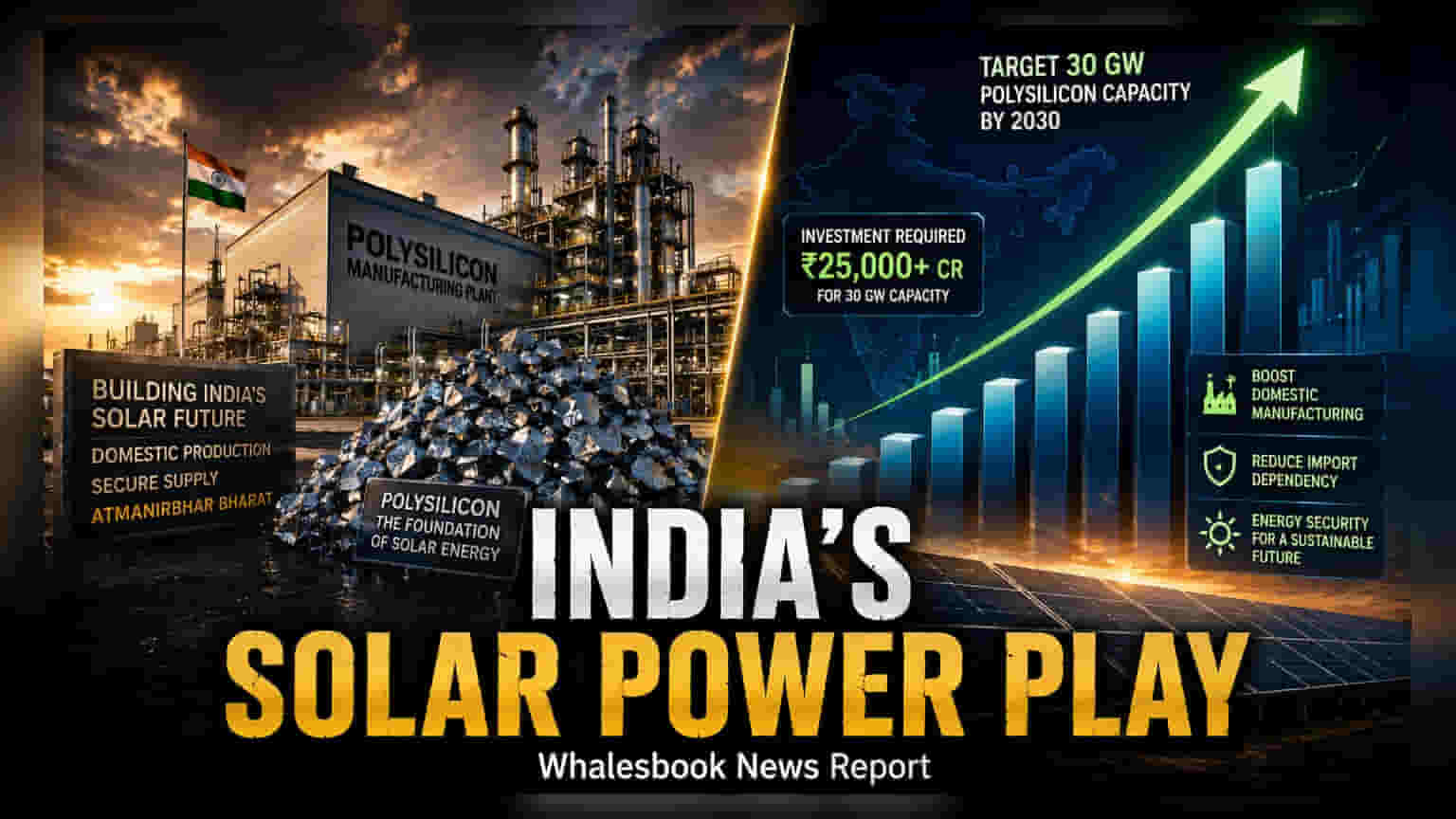
The Ministry of New & Renewable Energy plans a new subsidy to boost domestic polysilicon production, aiming for 30 GW capacity by 2030. With each gigawatt requiring roughly ₹850 crore in capital spending, the move aims to reduce heavy reliance on solar component imports. Investors may track policy details as the government shifts focus toward strengthening the upstream solar supply chain.
The Ministry of New & Renewable Energy (MNRE) is working on a new subsidy program to encourage domestic manufacturing of polysilicon. This material is a critical raw material for solar cells and modules. Currently, India depends entirely on imports, primarily from China, to meet its polysilicon needs. This total reliance on global supply chains has prompted the government to seek a more secure domestic alternative.
The Scale of Investment
Setting up a polysilicon plant is a capital-heavy business. The government estimates that building just one gigawatt (GW) of capacity requires approximately ₹850 crore. To reach the ambitious target of 30 GW by 2030, the industry would need a massive total investment of over ₹25,000 crore. Because of these high costs, the government is considering this new subsidy mechanism to make domestic production financially viable for companies. This initiative is designed to be different from previous Production Linked Incentive (PLI) schemes, which often focused more on the downstream assembly of solar modules rather than the high-cost upstream manufacturing of raw materials.
Strategic Shift in Solar Policy
For years, India’s solar manufacturing strategy has focused on the assembly phase, such as converting cells into modules. However, recent trends show that without a strong foundation in raw materials like polysilicon, wafers, and ingots, the entire solar manufacturing sector remains vulnerable to price swings in the global market. Niti Aayog has recommended long-term policy clarity to support this shift. This includes potential measures such as basic customs duties on imported materials and incentives for manufacturers who can set up fully integrated facilities.
Challenges and Investor Monitorables
The move faces several practical hurdles. Aside from the high capital requirement, the technology involved is complex, and the industry has seen a limited response to earlier incentives aimed at upstream manufacturing. Execution risk remains high because these projects require not only huge initial funding but also years of operational stability to become profitable. Unlike module assembly, which has faster turnaround times, setting up polysilicon manufacturing is a long-term play that requires significant electricity and technical expertise.
Investors should watch for the official release of the subsidy guidelines. These documents will clarify the structure of the financial support, the eligibility criteria for companies, and the timeline for project implementation. The key to success for this sector will be whether the government can lower the barrier to entry enough to attract serious corporate interest, balancing the need for domestic manufacturing against the high cost of production compared to global rivals.