

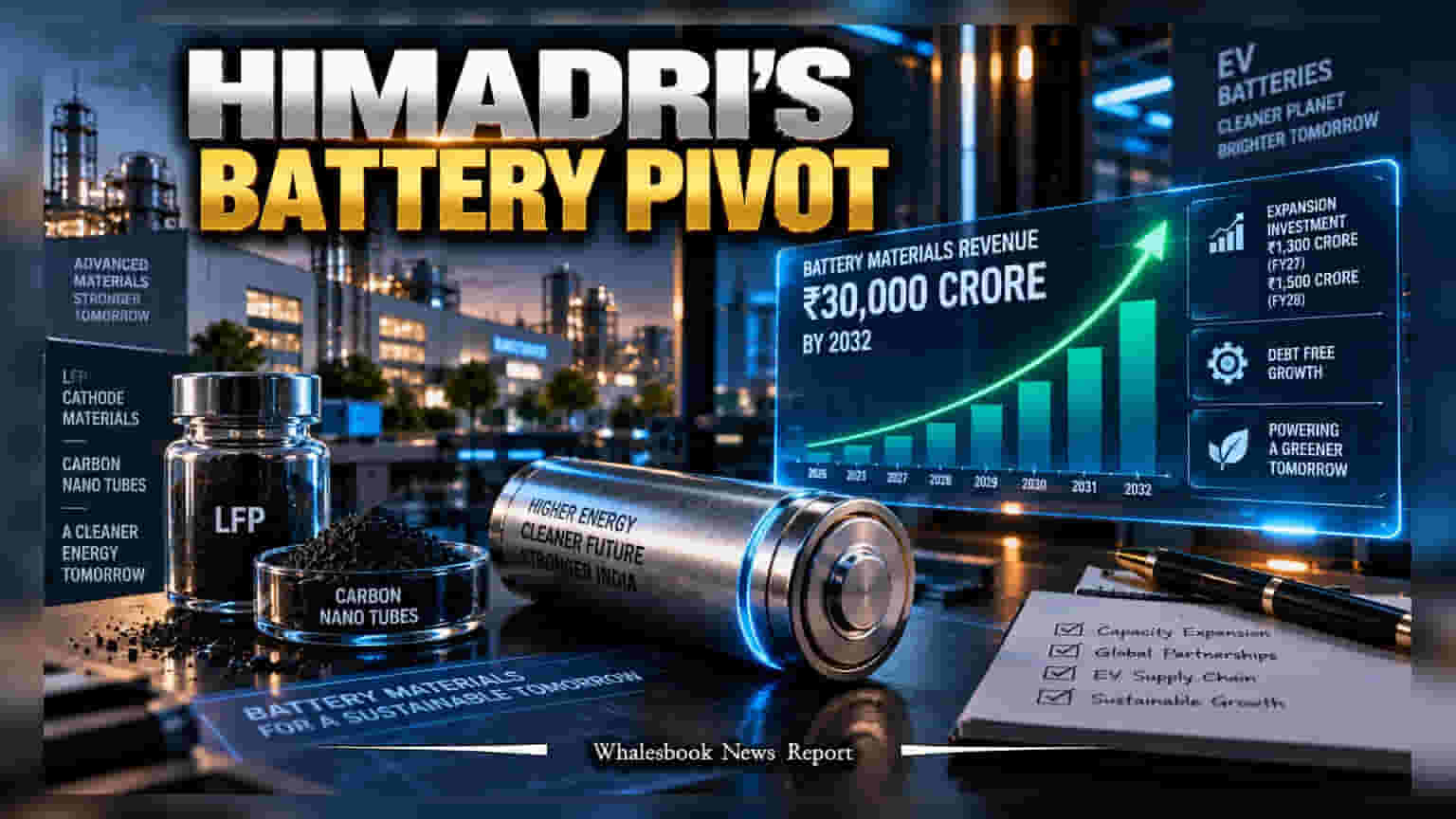
Himadri Speciality Chemical has unveiled a roadmap to generate ₹30,000 crore in revenue from its battery materials business by 2032. To fund this transition into advanced cathode and anode technologies, the company is committing ₹2,800 crore in capital spending over the next two years using internal cash. Investors are focusing on how the company executes this pivot from traditional carbon black to energy storage components.
Himadri Speciality Chemical Ltd (HSCL) has announced a significant strategic shift, setting an ambitious revenue target of ₹30,000 crore for its battery materials division by 2032. The company, traditionally a major player in carbon black and industrial chemicals, is aggressively transitioning toward the high-growth energy storage sector, specifically focusing on materials like Lithium Iron Phosphate (LFP) cathode and Carbon Nano Tubes.
To support this growth, the management has outlined a significant capital investment cycle. The company plans to deploy ₹1,300 crore in FY27, followed by another ₹1,500 crore in FY28. A key point for investors is the funding strategy; the company is utilizing its internal cash flows to finance these projects, maintaining a healthy balance sheet without adding new debt. This approach provides financial flexibility as the company scales its production facilities.
Beyond domestic manufacturing, the firm is strengthening its international reach. It has established a wholly-owned subsidiary, Ardent Impex FZCO, in Dubai to streamline the global trading of petrochemicals and industrial materials. Furthermore, the company has deepened its technological collaborations by increasing its stake in the US-based International Battery Company (IBC) to 20.47% and expanding its partnership with the Australian firm Sicona Battery Technologies. These moves are designed to help the company secure technology and global supply chain access early in the EV battery value chain.
Financial performance remains a core metric for shareholders. In the first quarter of FY27, the company reported consolidated revenue of ₹1,432 crore, a 28% increase year-on-year, with an EBITDA of ₹313 crore. This record performance provides the financial foundation for its ongoing investments.
However, the strategy comes with clear business risks. The transition involves scaling complex new technologies, such as LFP and carbon nanotubes, to commercial volumes, which carries inherent execution risks. Additionally, the battery materials sector is tied to the global electric vehicle (EV) demand cycle, which can be volatile due to government policies and consumer adoption rates. Competitive pressure is also rising as multiple players across the globe ramp up production capacities for the same battery components.
The most important monitorable for investors will be the company’s ability to successfully commission these new capacities on time and the speed at which it can secure long-term purchase contracts from major global battery manufacturers. Tracking the progress of technology validation at the IBC facility and the overall margin profile as the company moves into high-value battery products will be crucial in the coming quarters.