

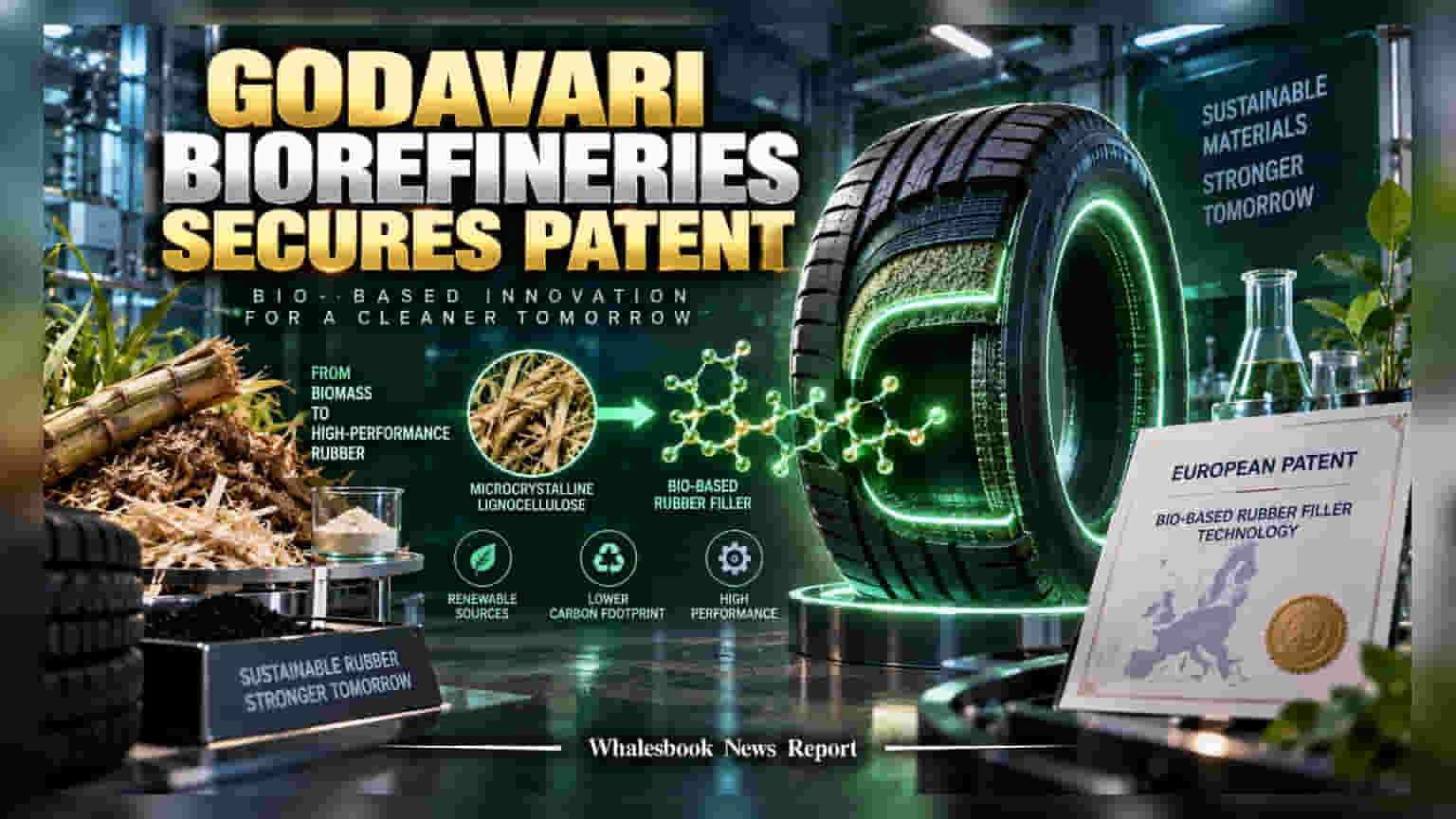
Godavari Biorefineries has received a European patent for a bio-based rubber filler designed to replace carbon black. While this innovation marks a technical milestone, investors are monitoring the company’s financial stability after it reported a consolidated net loss of Rs 19.32 crore for the quarter ended June 2026.
Godavari Biorefineries has been granted a European patent for its proprietary bio-based rubber filler, a technology developed to serve as a sustainable alternative to conventional carbon black in rubber manufacturing. The company officially disclosed the development to the stock exchanges, confirming that the patent for this innovation was granted in August 2026. This technology allows for the use of microcrystalline lignocellulose, derived from biomass, in the production of tires, footwear, and industrial rubber components.
Financial Context and Market Position
While the securing of intellectual property is a positive development for the company’s product portfolio, its financial performance remains a primary point of focus for investors. In the most recent financial results for the quarter ended June 2026, the company reported a consolidated net loss of Rs 19.32 crore. This result highlights the pressure on the company to manage high operational costs and research expenses while attempting to grow its revenue base. The company currently holds a market capitalization in the range of Rs 1,226 crore to Rs 1,253 crore, with its shares recently trading near the Rs 240 mark. The company is operating in a competitive landscape where smaller players must prove their financial viability alongside their technological capabilities.
Industry Challenges and Commercial Scaling
The rubber and tire industry is currently facing significant pressure to reduce its carbon footprint and dependency on petroleum-based inputs like carbon black. By offering a renewable alternative, Godavari Biorefineries aims to cater to the growing demand for sustainable industrial inputs. However, moving from a patented technology to industrial-scale commercial production carries inherent risks. The company must demonstrate that its bio-filler can meet the rigorous performance, durability, and cost requirements expected by large-scale tire and rubber manufacturers.
Execution remains a critical factor. Scaling new technology requires significant capital and operational focus, which can affect cash flows. Furthermore, the company is susceptible to fluctuations in raw material costs, particularly for inputs like sugar, molasses, and other biomass sources. These price changes can directly affect the profitability of its core operations.
Investors may monitor the company’s ability to move this patent into actual commercial agreements. The success of this innovation will depend on whether the company can establish partnerships with major manufacturers and produce the filler at a price point that competes with traditional materials. Future updates regarding supply contracts, operational cost management, and progress toward turning around its quarterly losses will be the key items for shareholders to track.