

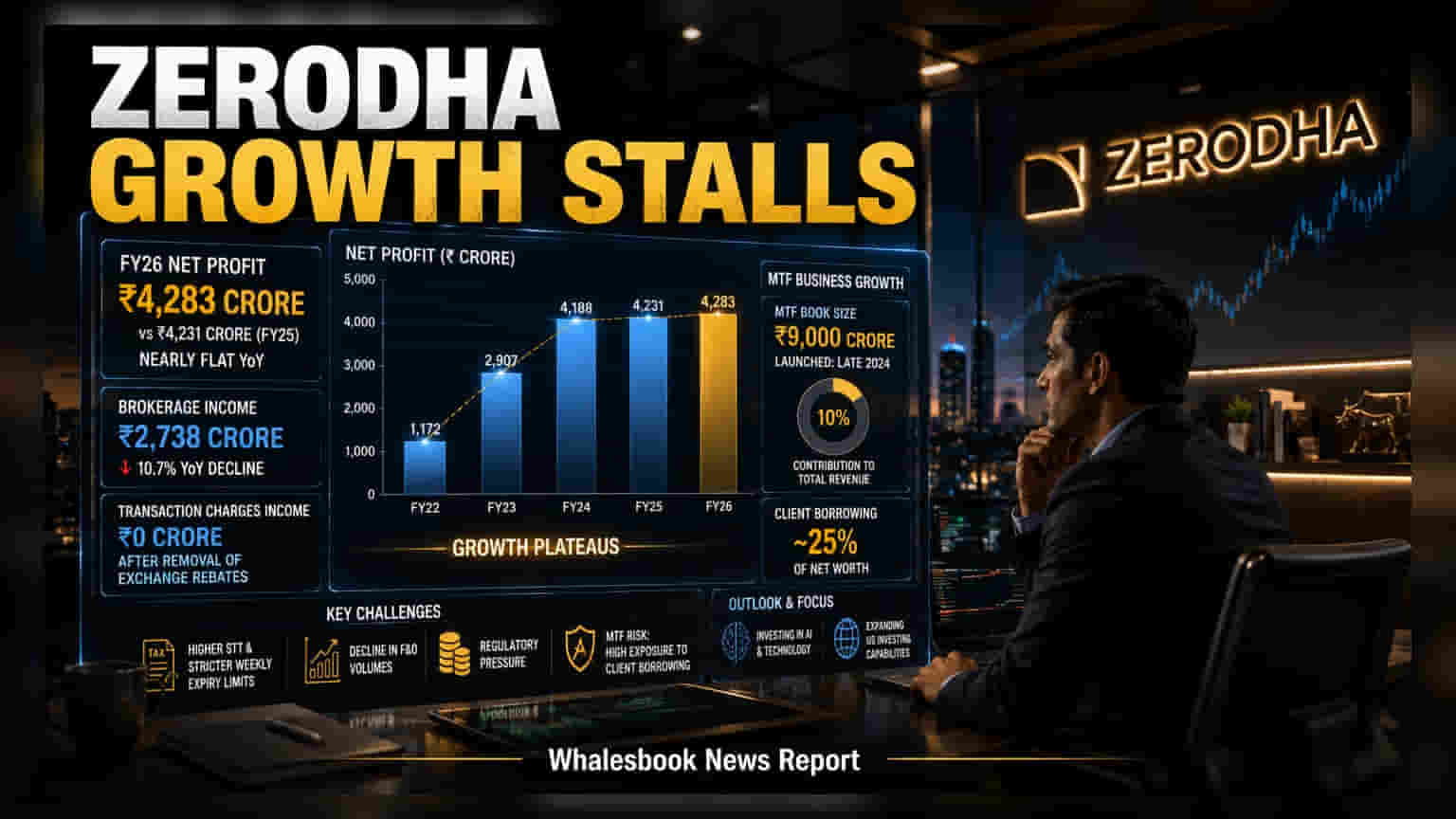
India’s largest brokerage, Zerodha, reported a nearly flat net profit of ₹4,283 crore for FY26 as regulatory shifts hit trading volumes. The private company saw a 10.7% decline in core brokerage income. To adapt, the firm is pivoting toward its Margin Trading Facility, though management has highlighted risks linked to high client borrowing levels.
Zerodha has reported a challenging year for FY26, with the brokerage firm witnessing a plateau in its financial growth. The company, which remains a private, unlisted entity and is not available for trading on the NSE or BSE, posted a net profit of ₹4,283 crore. This is nearly flat compared to the ₹4,231 crore reported in the previous fiscal year, signaling a departure from its high-growth trajectory.
The primary pressure on earnings has been the regulatory environment surrounding the Indian stock market. Zerodha, which traditionally relied heavily on Futures and Options (F&O) trading for income, has faced a difficult period due to higher Securities Transaction Tax (STT) and stricter limits on weekly expiry contracts. These policy changes, aimed at curbing speculative trading, have directly led to a decline in overall market volumes. Furthermore, the company’s net income from transaction charges dropped to zero following the removal of exchange rebates, a significant revenue stream that is no longer available.
The Shift to Margin Trading
To counter the slowdown in its core brokerage business—which saw income fall by 10.7% to ₹2,738 crore—Zerodha is increasingly focusing on its Margin Trading Facility (MTF). In simple terms, this facility allows the brokerage to lend money to clients so they can hold stocks for a longer period. This segment has grown quickly since its launch in late 2024, reaching a book size of ₹9,000 crore and now contributing roughly 10% of the firm's total revenue.
While this new business line offers a way to generate interest income, it introduces a different set of risks. Management has noted that client borrowing within this facility is now approximately 25% of the firm’s net worth. This concentration of risk means that if market conditions become volatile or if clients face liquidity issues, the brokerage could face potential financial stress.
Competitive Landscape and Outlook
Zerodha continues to hold its position as the largest brokerage by revenue. However, the competitive environment has intensified. While Zerodha has seen its core growth plateau, publicly traded peers like Angel One and Groww have maintained momentum, highlighting a shifting market share dynamic where newer or more aggressive firms are gaining ground during periods of market contraction.
Looking ahead, Zerodha is banking on product innovation to navigate this period of regulatory uncertainty. The company is investing in artificial intelligence to improve user experience and is looking to expand its capabilities in areas like US investing. For the firm, the immediate focus remains on managing the risks associated with its MTF business while trying to maintain its market lead without relying solely on the volatile F&O trading volume that defined its past success.