

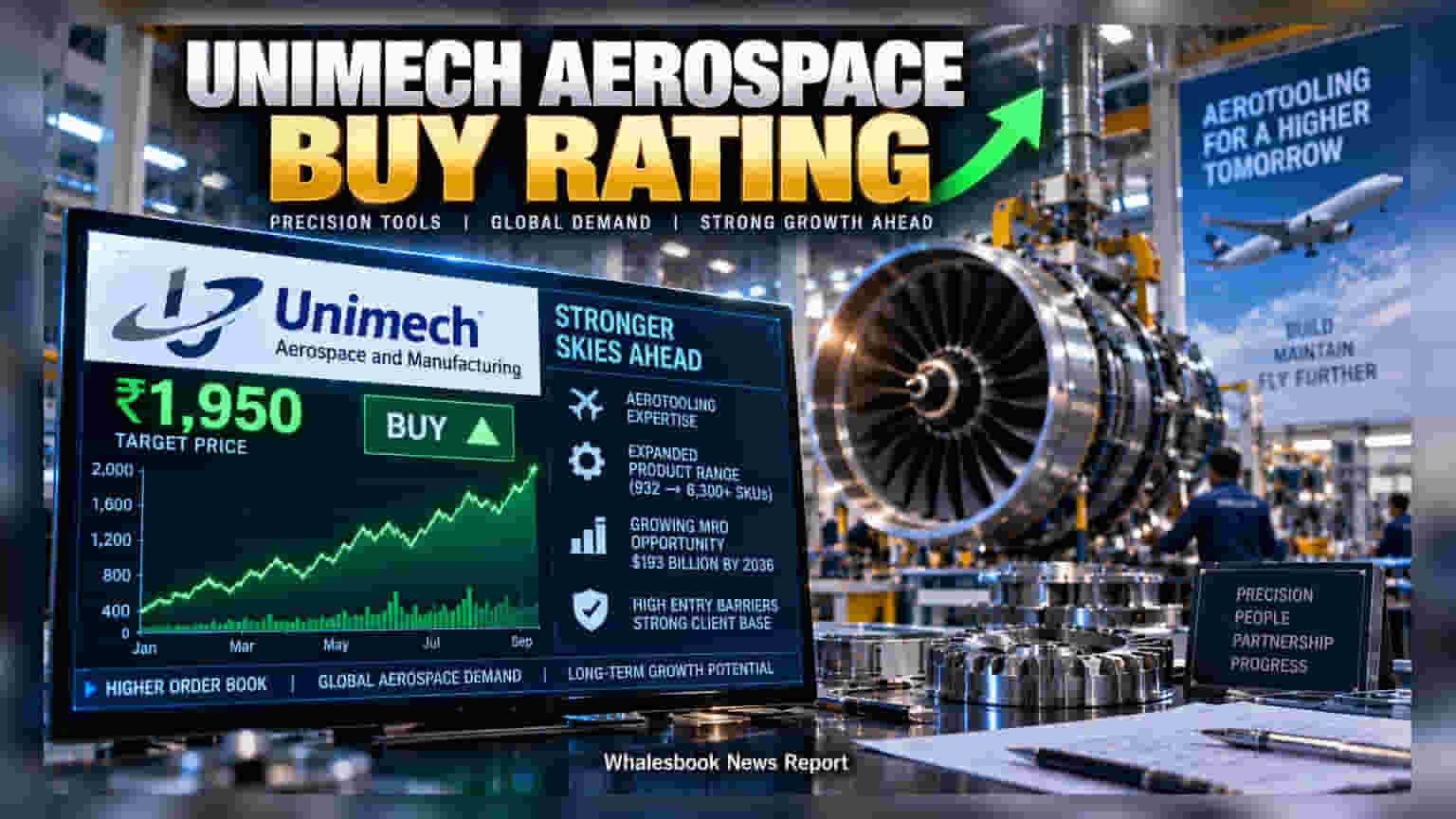
Choice Institutional Equities has initiated coverage on Unimech Aerospace and Manufacturing with a target price of ₹1,950. The brokerage highlights the company’s growing role in global aerospace tooling and the rising demand for aviation maintenance services as key growth drivers. Investors may monitor the firm’s ability to convert tooling contracts into long-term production and service revenue.
Unimech Aerospace and Manufacturing has received its initial coverage from Choice Institutional Equities, which issued a target price of ₹1,950 for the stock. The brokerage’s outlook is based on the company’s strategic position within the aerospace supply chain, specifically its expertise in aerotooling—the specialized tools used to manufacture and assemble aircraft components.
The brokerage firm used two valuation methods to arrive at its price target: a discounted cash flow model and a calculation based on earnings multiples for the 2028-2029 period. Both methods pointed to a valuation near the ₹1,950 mark, suggesting that analysts expect the company to scale its operations significantly over the next few years.
Central to the company's business model is a focus on precision tooling. According to company data, the firm has rapidly increased its range of qualified stock-keeping units, moving from 932 in the 2022 fiscal year to over 6,300 today. This expansion suggests a focused effort to capture more market share by offering a broader array of components and tools to aerospace original equipment manufacturers and tier-one suppliers.
The aerospace industry is currently seeing a surge in demand, driven by a global backlog of approximately 17,000 aircraft. As these aircraft enter service, the need for maintenance, repair, and overhaul services—often referred to as MRO—is expected to grow. The brokerage noted that the global MRO market could reach $193 billion by 2036. By focusing on specialized tooling, Unimech aims to secure a stable revenue stream, as airlines and manufacturers require consistent support to keep fleets operational.
Investors looking at this sector should understand the nature of aerospace manufacturing. These projects involve high-entry barriers, as companies must obtain and maintain complex safety certifications and quality standards to work with global aviation giants. This serves as a business advantage by limiting competition, but it also means that the company depends heavily on maintaining these rigorous standards and keeping key client relationships.
Because the aerospace industry operates on long production and maintenance cycles, growth is not always linear. Future performance will depend on the company’s ability to execute its expansion plans without significant delays or cost overruns. Monitoring the growth of the company’s order book, its success in converting tooling contracts into recurring production cycles, and its ability to handle capital spending requirements will be important for tracking the company's progress.