 Whalesbook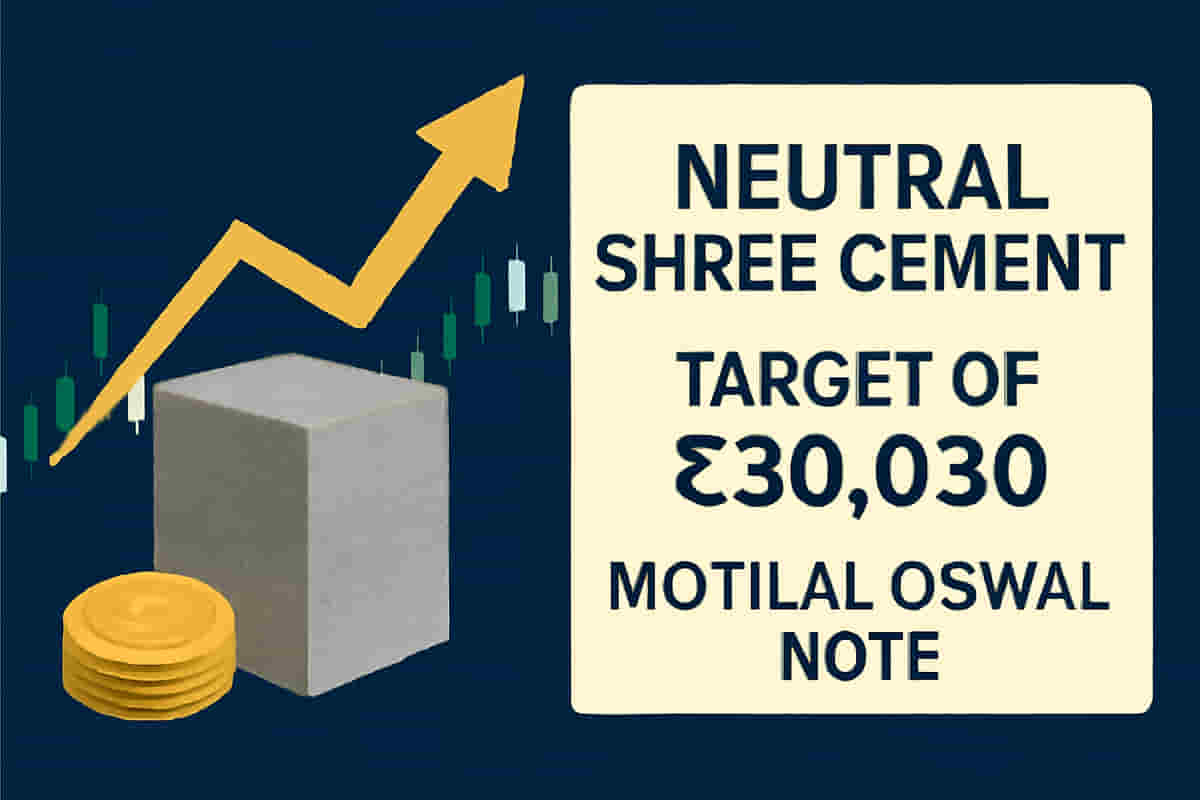
Motilal Oswal's latest research report on Shree Cement (SRCM) points out that the company has been relatively slow in expanding its capacity in the crucial North Indian market compared to its competitors. This has resulted in a decline in Shree Cement's market share in the region, which fell to approximately 22% in FY25 from a peak of about 24% in FY19. Projections suggest this share could further decrease to around 19% by FY28E, driven by aggressive expansion from peers.
The report estimates Shree Cement's capacity Compound Annual Growth Rate (CAGR) at about 10% for FY25-28E, which is higher than its projected volume CAGR of around 6% during the same period. Capacity utilization rates are reportedly below optimal levels, even during periods of low capital expenditure, due to a lack of regional diversification and shifts in marketing strategies towards 'value' over volume.
In the past two years, Shree Cement has implemented initiatives to enhance its brand equity and increase its share of premium cement sales. Its premium cement share has risen to about 21% of trade sales volume in 2QFY26, up from 15% in 2QFY25 and 9% in 1QFY24. However, this is still lower than the share held by competitors like Ultratech Cement (UTCEM) and ACC Limited (ACEM), who reported around 37% and 35% respectively in 2QFY26.
Outlook
Motilal Oswal forecasts revenue, EBITDA, and PAT CAGRs of approximately 8%, 12%, and 13% respectively for Shree Cement over FY26-28. The blended EBITDA per tonne is estimated at INR1,320 for FY27E and INR1,385 for FY28E, an increase from INR1,250 for FY26E, though the average EBITDA per tonne was INR1,205 from FY21-25. The stock is currently trading at 17x and 15x FY27E and FY28E EV/EBITDA. This valuation is considered fair given the moderate earnings growth prospects, limited cost-saving potential, and low return ratios (RoE/RoCE estimated at around 10% in FY28E).
The brokerage firm reiterates its 'Neutral' rating on Shree Cement, valuing it at 18x Sep’27E EV/EBITDA, which leads to a price target of INR 30,030.
Impact
This news provides key insights into the competitive positioning and growth prospects of Shree Cement within the Indian cement sector. Investors in Shree Cement may need to monitor its market share dynamics and expansion plans closely. The report's neutral stance suggests limited immediate upside potential, influencing investor sentiment towards the stock and sector. The rating is 6/10 for its impact on specific investors and the sector outlook.
Difficult Terms Explained:
CAGR (Compound Annual Growth Rate): The average annual growth rate of an investment over a specified period longer than one year. It smooths out volatility.
EBITDA: Earnings Before Interest, Taxes, Depreciation, and Amortization. It is a measure of a company's operating performance.
PAT (Profit After Tax): The profit that remains after all expenses and taxes have been deducted.
EV/EBITDA (Enterprise Value to EBITDA): A valuation metric used to compare companies within the same industry. It represents the total value of a company (market cap plus debt, minus cash) divided by its earnings before interest, taxes, depreciation, and amortization.
RoE (Return on Equity): A profitability ratio that measures how effectively a company uses shareholder investments to generate profits. Calculated as Net Income / Shareholders' Equity.
RoCE (Return on Capital Employed): A profitability ratio that measures how efficiently a company uses its capital to generate profits. Calculated as Net Operating Profit After Tax / Capital Employed.