

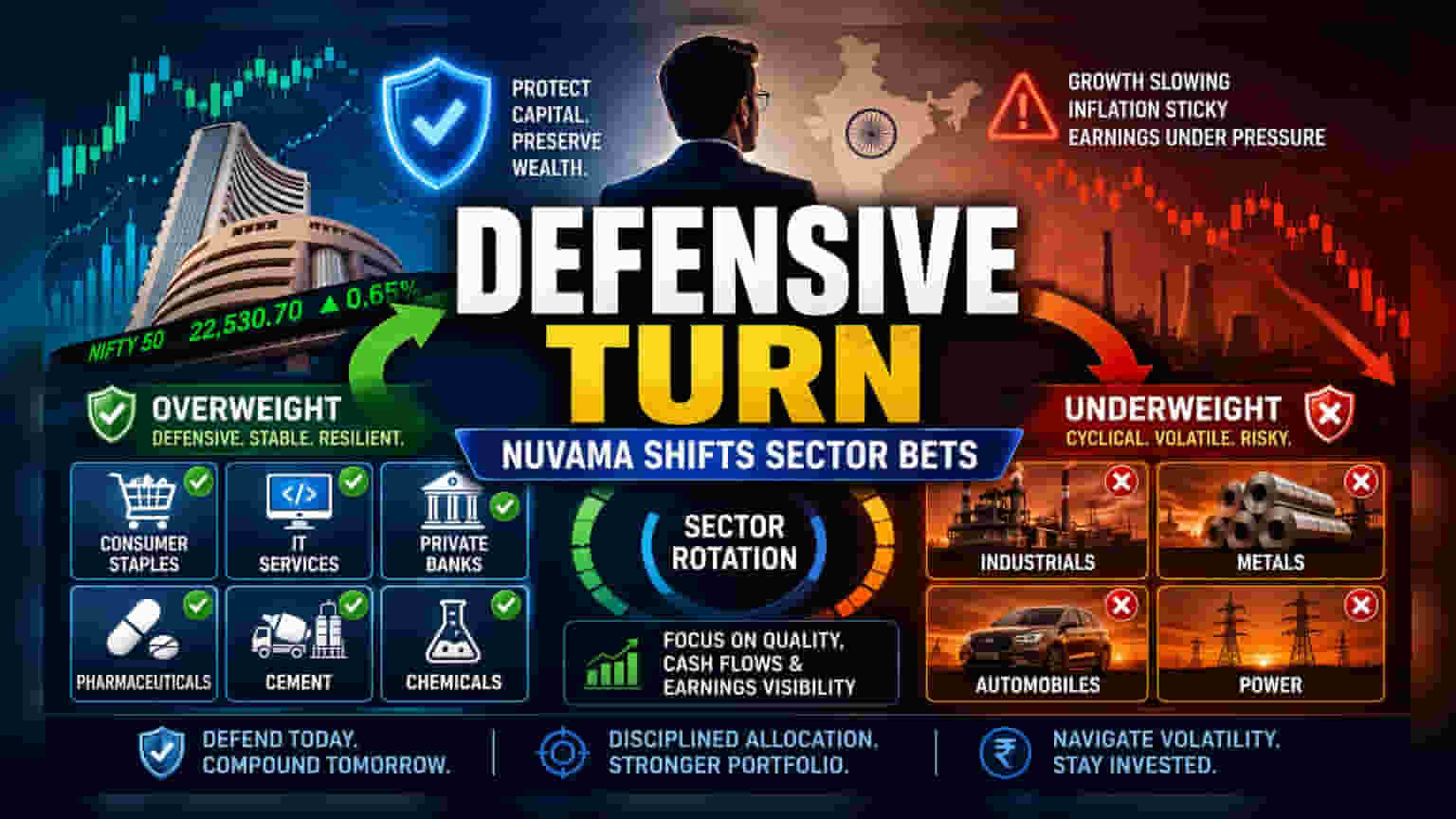
Nuvama Wealth & Securities has pivoted its investment strategy toward defensive sectors like consumer goods, IT, and pharmaceuticals. This shift aims to lower risk in response to concerns about slowing economic growth, a weak monsoon, and softening demand.
What Happened
Nuvama Wealth & Securities has officially updated its market outlook, moving toward a defensive investment stance. The brokerage has reclassified several sectors, preferring those that typically remain stable during periods of economic uncertainty. In its latest strategy update, the firm has increased its exposure—or 'Overweight' position—to consumer-facing businesses, information technology (IT), private banks, pharmaceuticals, cement, and chemicals. At the same time, it has reduced its exposure—or 'Underweight' position—to industrials, metals, automobiles, and power companies.
Why the Strategy Shift Matters
The brokerage’s pivot is largely driven by growing concerns over the health of the economy. Market analysts have highlighted significant headwinds for the fiscal year, including a sluggish start to the monsoon, potential El Niño impacts on agriculture, and signs of softening income growth. With economic growth projections moderating to around 6.6% for FY27, there is a clear sentiment among some market experts that demand may face pressure. By shifting to defensive sectors, the firm aims to protect portfolios from the volatility often seen in cyclical businesses, which are more sensitive to these economic slowdowns.
Understanding the Defensive Pivot
In market terms, 'defensive' sectors are businesses that sell essential goods or services that people continue to buy, regardless of whether the economy is doing well or poorly. For example, consumer staples, healthcare, and IT services are often classified as defensive because their demand is less tied to economic booms and busts.
In contrast, 'cyclical' sectors—such as metals, industrials, and automobiles—are heavily dependent on strong economic growth. When the economy slows, companies in these sectors often see their profits drop more sharply. By reducing exposure to these cyclical areas, the brokerage is essentially betting that market stability will be more valuable than aggressive growth in the coming months.
The Trade-Off and Risks
While a defensive strategy is designed to provide a safety net, it comes with its own set of risks. If the economy recovers faster than expected or if the market enters a strong bull phase, defensive stocks may not rise as rapidly as cyclical stocks. Furthermore, defensive stocks can sometimes become expensive if too many investors flock to them for safety, potentially leading to stretched valuations. Additionally, while these sectors are considered 'safer,' they are not immune to issues; for example, IT companies still face global demand fluctuations, and pharmaceutical companies deal with their own regulatory and pricing challenges.
What Investors Should Track
For investors observing this sector rotation, the key monitorables will be the actual performance of the monsoon and its impact on rural consumption. Continued volatility in global energy prices and inflation data will also be critical, as these factors directly influence corporate margins. Investors may watch how companies in the consumer and IT spaces manage their cash flows and dividends, as these metrics often define the success of a defensive portfolio strategy during slower economic periods.