

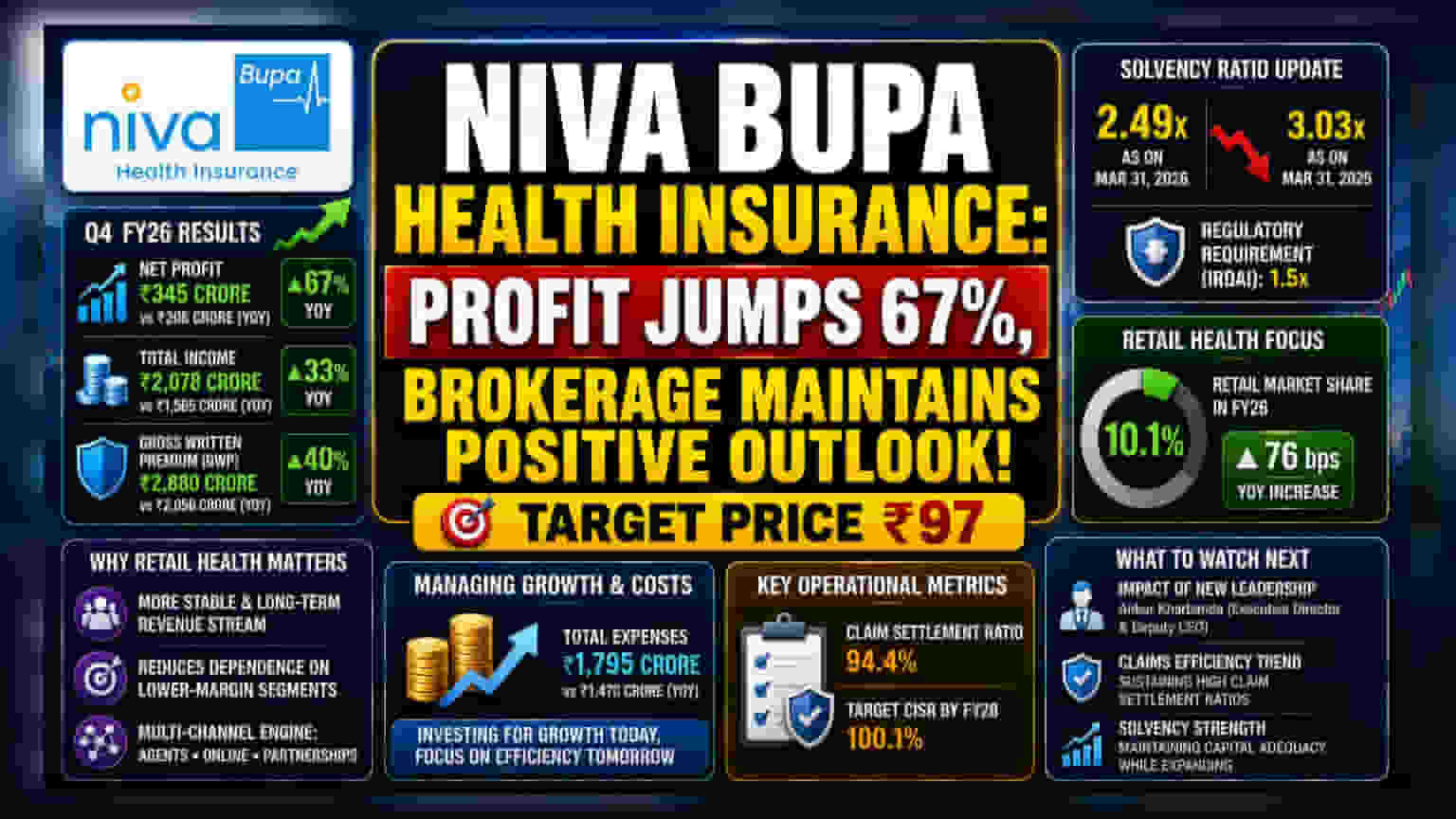
Motilal Oswal has maintained a positive outlook on Niva Bupa with a target price of ₹97 per share. The company reported a 67% increase in Q4 net profit to ₹345 crore, fueled by market share gains in retail health insurance. Investors are weighing this performance against the company's rising operational expenses and a decline in its solvency ratio.
What Happened
Brokerage firm Motilal Oswal Securities (MOSL) has reaffirmed its positive stance on Niva Bupa Health Insurance, maintaining a constructive outlook with a target price of ₹97 per share. This update follows the company’s recent March quarter (Q4) financial results, where the insurer reported a significant 67% jump in net profit. The brokerage highlighted Niva Bupa's strategy of expanding its retail health insurance footprint, which has helped it capture a larger slice of the market.
Quarterly Performance Highlights
Niva Bupa’s latest financial results show strong topline and bottom-line growth. The company reported a net profit of ₹345 crore for the March quarter, compared to ₹206 crore in the same period last year. Total income grew to ₹2,078 crore, up from ₹1,565 crore a year ago. Additionally, the Gross Written Premium (GWP)—a key metric for insurance growth—rose to ₹2,880 crore, demonstrating increased business volume.
Understanding The Solvency Ratio
While the company showed profit growth, investors often look at the solvency ratio to gauge an insurer's financial health. Niva Bupa’s solvency ratio stood at 2.49 as of March 31, 2026, down from 3.03 a year prior. It is important to note that the regulatory requirement set by the IRDAI for insurance companies is 1.5. While the ratio has declined, the company remains comfortably above the mandatory threshold, indicating it is still well-capitalized to meet its claims obligations.
Why The Focus On Retail Health
Niva Bupa is positioning itself as a specialist in the retail health insurance sector. Retail health policies are generally seen as more stable and long-term sources of revenue compared to corporate group insurance. By growing its retail market share to 10.1% in FY26—a 76 basis point increase—the company is aiming to reduce dependence on lower-margin business segments. The brokerage noted that the company is building a multi-channel engine, which allows it to reach customers through various sources, such as agents, online platforms, and partnerships.
Risks And Operational Costs
Scaling a health insurance business comes with significant costs. The company's total expenses rose to ₹1,795 crore during the quarter, up from ₹1,470 crore in the previous year. This is common for insurance companies in an aggressive growth phase, as they spend heavily on customer acquisition, commissions, and technology infrastructure. The long-term test for the company will be its ability to keep these costs in check as it scales, as reflected in the target Combined Insurance Service Ratio (CISR) of 100.1% by FY28.
What To Watch Next
Investors may monitor a few key areas to assess the company’s progress. First, the impact of the newly appointed leadership, including Ankur Kharbanda as Executive Director and Deputy CEO, on operational strategy. Second, the trend in claims efficiency; while the claim settlement ratio improved to 94.4%, maintaining or improving this while growing the customer base will be essential. Finally, keeping an eye on whether the company can maintain its solvency levels while continuing its aggressive expansion will be important for long-term stability.