

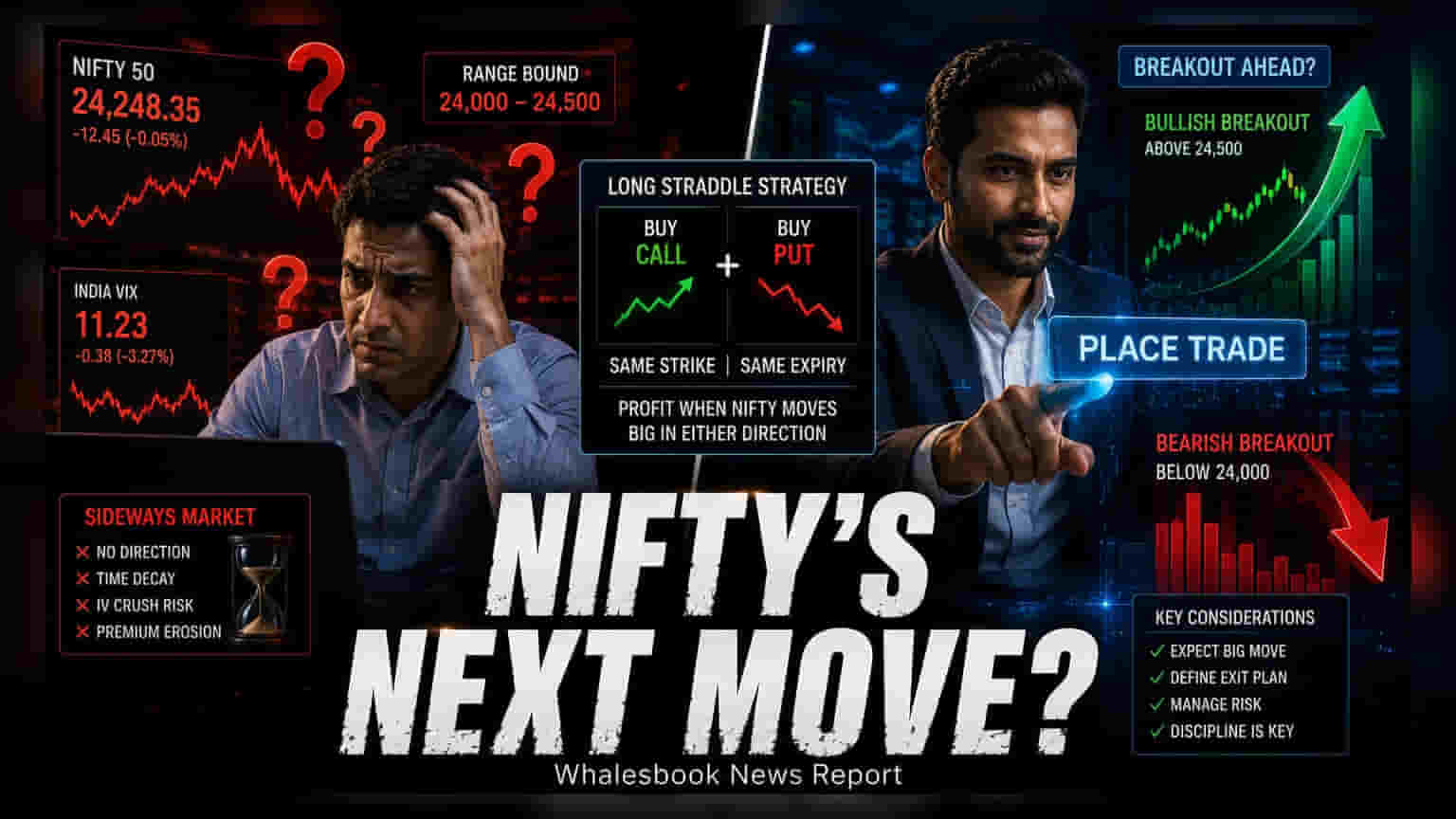
The Nifty 50 index remains in a tight consolidation phase near 24,250 with low market volatility. As some traders consider 'long straddle' options strategies to benefit from a potential breakout, it is essential to understand the risks of time decay and loss of premiums if the market fails to make a decisive move.
The Nifty 50 index has been trading in a constrained range, hovering near the 24,250 mark over the past few weeks. This sideways movement, where the index neither rises significantly nor falls sharply, has created a quiet period for the markets. With the India VIX, a tool that measures market fear and expected volatility, currently sitting around 11.23, investors are seeing lower costs for options premiums.
Understanding the Straddle Strategy
In this environment, some market observers are discussing the 'long straddle' strategy. This is an options trading approach used when a trader expects the market to make a sharp move but is unsure of the direction. To execute this, a trader buys both a 'call' option and a 'put' option at the same price (the strike price) and the same expiry date. A call option gains value if the market rises, while a put option gains value if the market falls.
By holding both, the trader aims to profit if the Nifty breaks out of its current tight range in either direction. The strategy does not rely on guessing whether the market will go up or down; it only requires the market to move significantly enough to cover the cost of buying both options.
The Hidden Risks
While the strategy sounds like a way to capture a move in either direction, it is not without risks. The primary challenge is 'time decay,' also known as theta. Every day that the Nifty remains stuck in its current range, the value of the options held decreases. If the index does not make a large move before the expiry date, the premiums paid for both the call and put options can erode, potentially leading to a total loss of the capital invested in the trade.
Additionally, investors face the risk of an 'IV crush.' If the expected volatility fails to materialize or drops further, the prices of the options (premiums) can fall significantly, even if the index eventually starts to move. This means a trader could be right about the volatility but still lose money because the premiums were overvalued when the trade started.
Strategic Considerations
This approach is a speculative trading method rather than a long-term investment strategy. It is typically employed when the market is mature in its consolidation and a breakout is anticipated. Traders often set strict exit plans—such as closing the position if no movement occurs within a few days—to avoid unnecessary losses from time decay.
Investors tracking these market movements should focus on whether the Nifty manages to break out of the current 24,250 range decisively or continues its consolidation. If the index remains stagnant, the cost of holding options will continue to weigh on the strategy's viability. Those unfamiliar with the complexities of options trading may find it safer to wait for the market to establish a clear trend before making any decisions.