

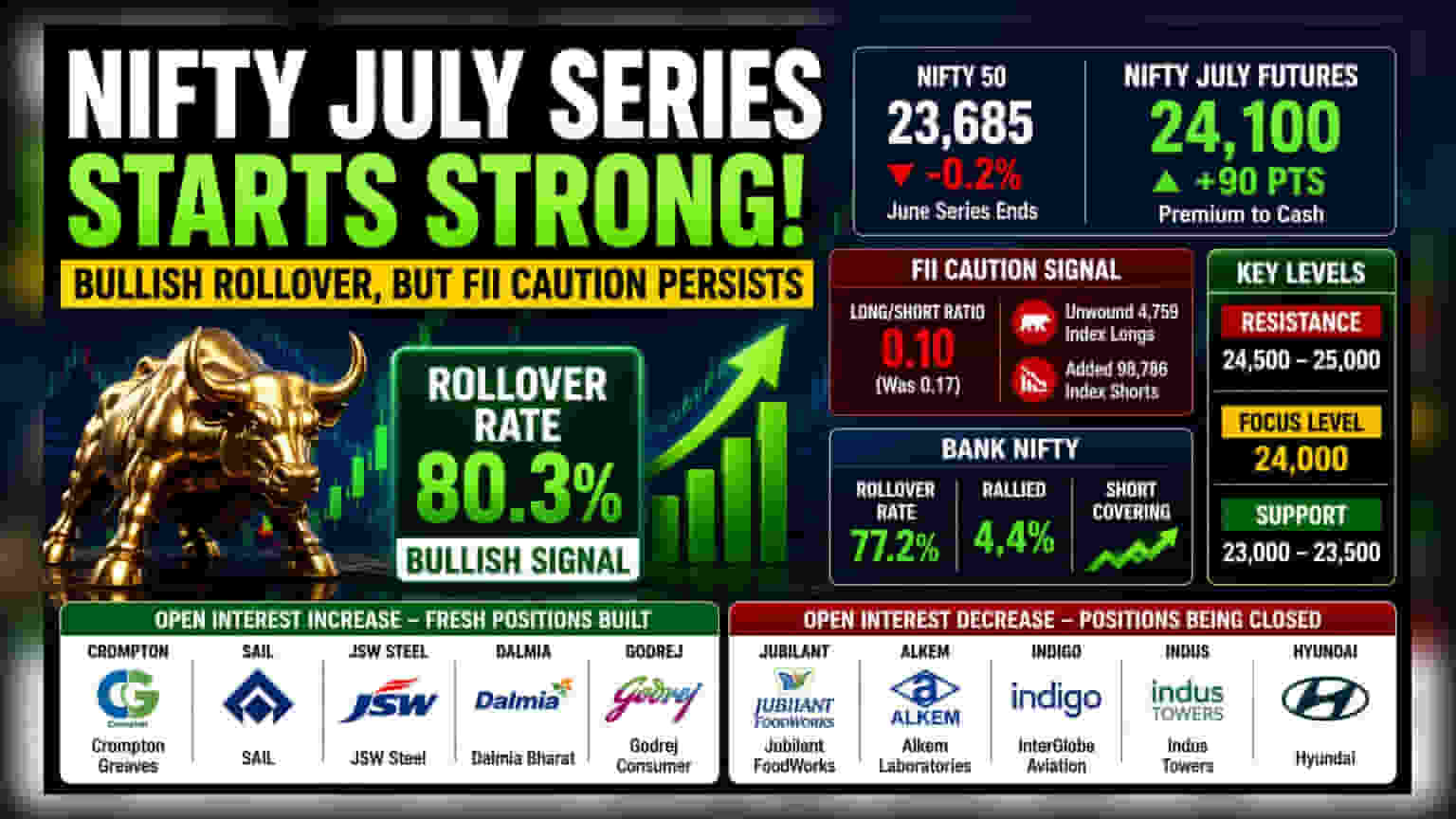
Nifty finished the June derivatives series at 23,685, down 0.2%, but investors have carried over positions into July at a high rate of 80.3%. While rollover data points to bullish conviction, Foreign Institutional Investors have increased short positions, signaling a cautious approach. The market is expected to trade between 23,000 and 24,500 in the coming month.
What Happened
The Nifty 50 index concluded its June futures and options series on a muted note, closing at 23,685 with a notional loss of 0.2%. This marks the second consecutive series ending in negative territory. However, the July series has commenced on a more optimistic footing, with Nifty futures opening at 24,100, trading at a 90-point premium to the cash market.
The Bullish Rollover Signal
In derivatives trading, a "rollover" occurs when traders carry forward their open positions from the expiring month to the next. The Nifty recorded a rollover rate of 80.3% for the June-to-July transition. This figure is higher than recent averages and suggests that a large number of investors are maintaining their positions, indicating a level of bullish conviction as the market enters the new month.
Why FII Caution Matters
While rollover data suggests optimism, Foreign Institutional Investors (FIIs) are sending a different signal. Data shows that the FIIs' long-to-short ratio in index futures has declined to 0.10 from 0.17 in the previous expiry. They unwound approximately 4,759 index long positions while adding nearly 98,786 short positions. This shift indicates that despite the bullish rollover trends, institutional investors are hedging their bets and building bearish exposure, which may introduce volatility in the coming weeks.
Bank Nifty and Short-Covering
Bank Nifty showed resilience during the transition, with a rollover rate of 77.2%, which outperformed its semi-annual average. The index rallied 4.4% in the lead-up to the expiry, shedding 1.8 lakh shares in open interest. This movement is a classic sign of "short-covering," where traders who had previously bet against the index were forced to buy back shares to close their positions as the price rose, further fueling the upward move.
Key Trading Levels
Analysts expect the market to operate within a consolidation range of 23,000 to 24,500. Derivatives data shows strong resistance between 24,500 and 25,000, where substantial call option interest is concentrated. Conversely, the 23,000 to 23,500 zones are identified as critical support levels. The 24,000 mark has become a focal point for traders due to the high concentration of open interest.
Stocks With Active Interest
Changes in open interest can signal where the next price moves might originate. Stocks that saw an increase in open interest, suggesting fresh positions being built, include Crompton Greaves, SAIL, JSW Steel, Dalmia Bharat, and Godrej Consumer Products. On the other hand, stocks that saw a decrease in open interest, suggesting investors are closing out their positions, include Jubilant FoodWorks, Alkem Laboratories, InterGlobe Aviation, Indus Towers, and Hyundai.