

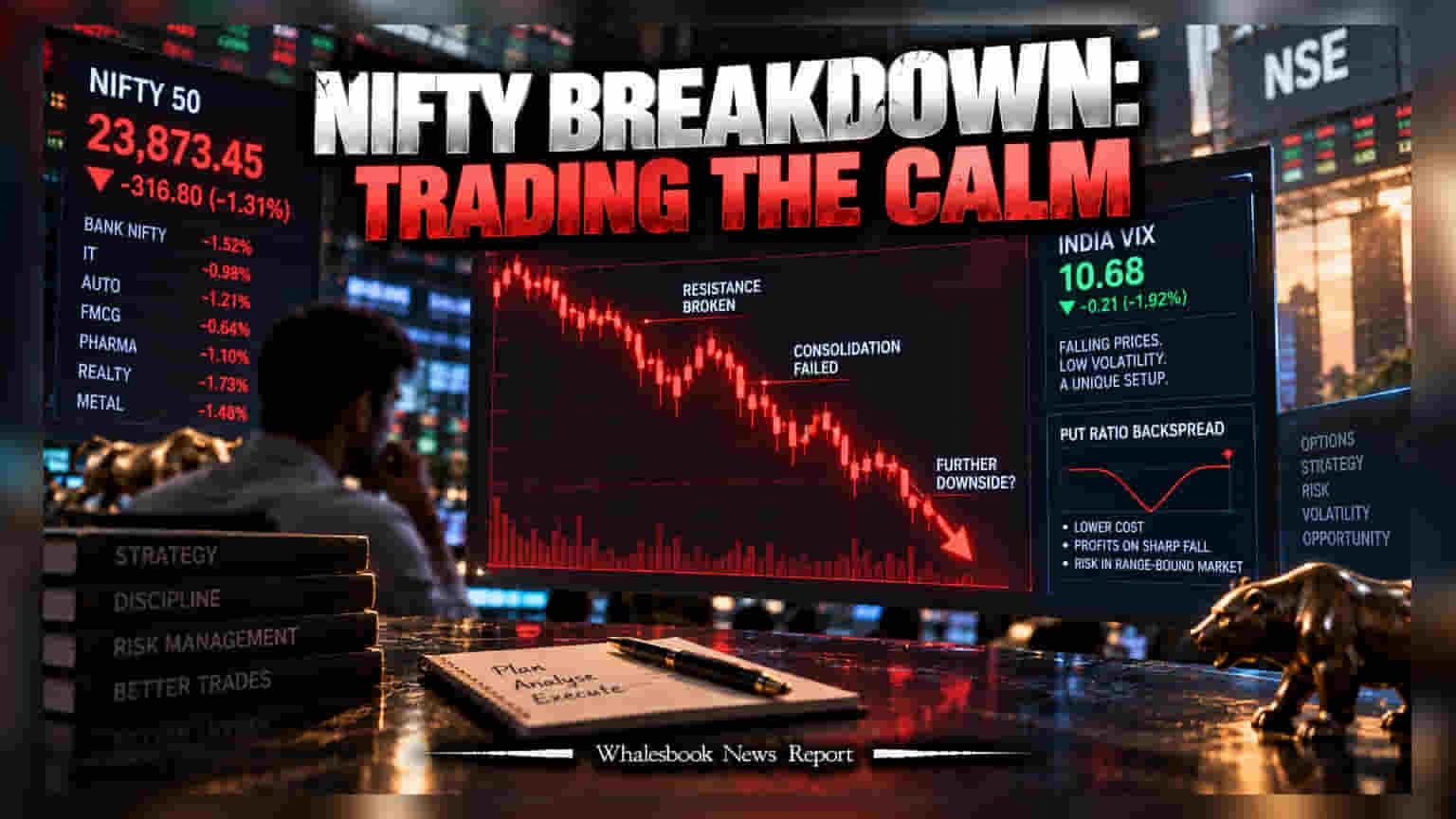
The Nifty index has slipped to 23,873.45, yet the India VIX remains subdued at 10.68, showing a lack of market panic. Traders are discussing the Put Ratio Backspread strategy to prepare for a possible sharp decline while keeping costs low. This approach allows them to benefit from a potential fall, but it comes with specific risks if the market stays stable.
The Nifty 50 index has recently breached key consolidation levels, closing at 23,873.45. In a typical market breakdown, one would expect a spike in the India VIX, which measures market fear or volatility. However, the VIX is currently hovering at a relatively low 10.68, indicating that the broader market is not yet pricing in extreme panic or a major crash. This divergence between falling prices and low volatility is creating a unique environment for traders.
Understanding the Put Ratio Backspread
Given the current market setup, some traders are exploring a specific derivative structure known as the Put Ratio Backspread. In simple terms, this strategy is designed for times when a trader expects a potential downside move but wants to avoid paying high prices for protection. To set this up, a trader sells one put option near the current market price and uses the money (premium) received from that sale to help pay for two put options at a lower strike price.
By receiving money from the first leg, the cost of buying the two protection options is significantly reduced, sometimes even neutralized. This structure is intended to profit if the Nifty begins a sharp, rapid descent, as the two long put options would gain value quickly, potentially outweighing any losses on the short position.
Why the Strategy Carries Risks
While the strategy may seem efficient, it is not without significant pitfalls. The primary danger for the trader is a range-bound market. If the Nifty does not fall as expected and instead moves sideways or trends slightly higher, the strategy can lead to losses. Specifically, the structure has a defined loss zone—if the index stays between the strike prices at the time of expiration, the trader can lose the initial investment.
Furthermore, the strategy relies heavily on the behavior of the VIX. Because volatility is currently low, any sudden spike in the VIX—often caused by unexpected market events—could change the pricing of options dramatically, making it harder for the strategy to perform as planned. Unlike simple directional bets, this is a multi-leg position that requires precise timing.
What Traders Should Monitor
For those watching these market movements, the next few sessions are critical. The core factor to track is whether the expected momentum materializes. If the Nifty continues to drift lower, the strategy may function as intended. However, if the index recovers or enters a phase of consolidation, the cost of holding this position could increase. The success of this approach depends entirely on a clear, sharp move in one direction. Investors and traders often keep a close watch on the Nifty's support levels and the VIX index to assess whether the market environment remains suitable for such active hedging strategies.