 Whalesbook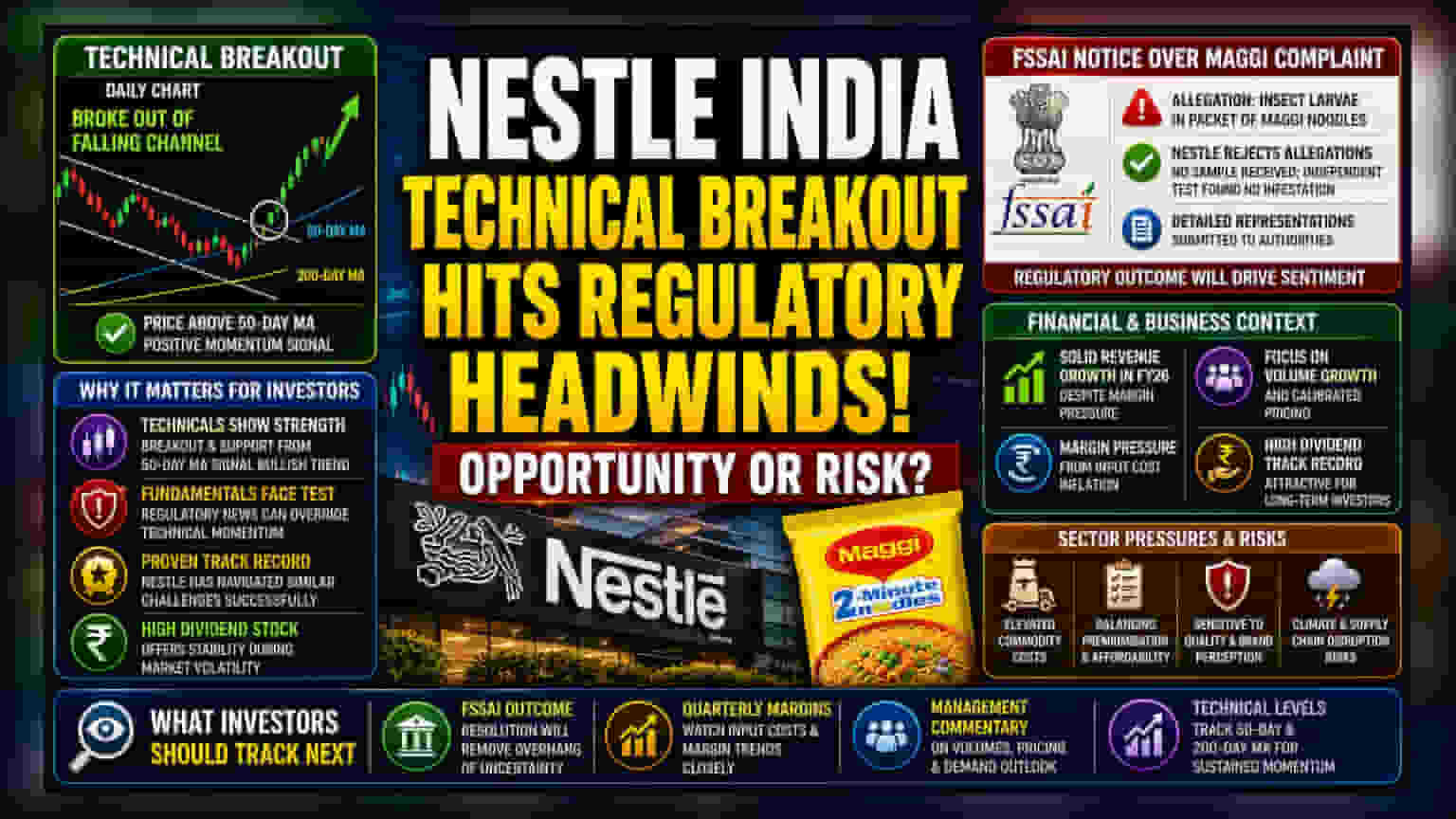


Nestle India's stock has shown signs of a technical breakout, but recent regulatory notices and social media allegations regarding product quality have added volatility to the counter. Investors are balancing bullish technical signals against fundamental sector pressures and news-driven price swings.
What Happened
Nestle India has recently become a focal point for investors due to conflicting signals. On the technical front, market analysts observed that the stock broke out of a falling channel on daily charts, a pattern often interpreted as a positive trend reversal. This movement, supported by indicators like the 50-day moving average, led some market participants to highlight a potential for upward momentum.
However, this optimism has been tested by external factors. The company recently faced a notice from the Food Safety and Standards Authority of India (FSSAI) regarding an alleged complaint about insect larvae in a packet of Maggi noodles. The news caused a sharp dip in the share price as investors reacted to the potential regulatory and brand-reputation risks. The company has officially rejected these allegations, stating that it has not received the complaint sample, and that an independent test of the specific batch found no infestation. The firm has submitted detailed representations to the authorities to clarify its position.
Why This Matters For Investors
The recent price action highlights the difference between technical indicators and fundamental risks. While technical analysts often focus on price patterns—such as the breakout mentioned by brokerages—fundamental investors monitor regulatory filings and brand strength. In this case, the stock's movement was interrupted by news flow, illustrating how sensitive high-valuation FMCG stocks can be to quality-related allegations, regardless of past technical performance.
For investors, the key lies in distinguishing between short-term noise and long-term business performance. The company has a history of navigating similar regulatory challenges, and the outcome of the current FSSAI review will likely be a more significant driver of sentiment than the recent technical breakout alone.
Financial and Business Context
Nestle India operates in a competitive FMCG sector that is currently dealing with complex dynamics, including shifting urban demand and the need for calibrated pricing strategies. Financially, the company has maintained steady growth. In the fiscal year ending March 2026, the company reported solid revenue performance, even as it navigated margin pressure caused by fluctuating input costs. The company remains a high-dividend-paying firm, which often provides a layer of stability for long-term shareholders during periods of market volatility.
Sector Pressure and Risks
The FMCG sector in India is experiencing a phase of structured growth rather than rapid expansion. Companies are facing the challenge of balancing premiumisation with the need to protect margins against elevated commodity prices. Furthermore, Nestle India’s reliance on strong brand equity makes it particularly sensitive to public sentiment. Any recurring issue regarding product quality—even if unverified or isolated—can create supply chain or distribution headwinds. Investors should be aware that regulatory notices, even if preliminary, can lead to increased scrutiny on operational documentation, kitchen hygiene, and waste management systems.
What Investors Should Track
Moving forward, the primary monitorable is the outcome of the company’s submission to the FSSAI. A resolution that clears the company of wrongdoing would likely reduce the overhang of uncertainty. Beyond this, investors should track the company’s quarterly profit margins, which are tied to the broader trend of input cost inflation in the food and beverage industry. Management's commentary on volume growth and their ability to pass on costs to consumers without impacting demand will also be crucial indicators for the coming quarters. Monitoring the stock's price behavior relative to its key moving averages, such as the 50-day and 200-day levels, will help in assessing if the technical momentum can sustain despite the recent volatility.