 Whalesbook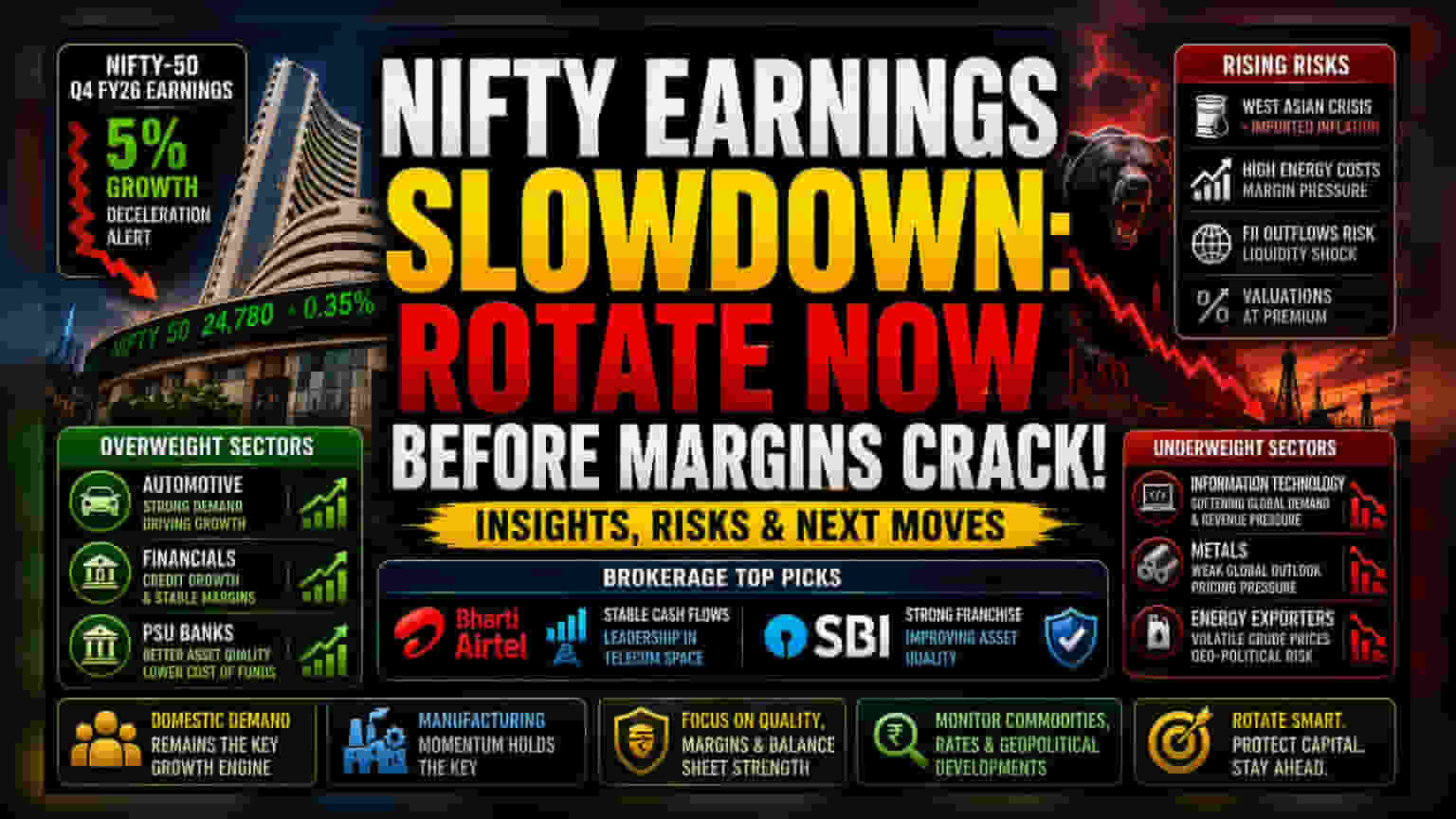


Earnings Fatigue and the EPS Reality
The fourth quarter of fiscal year 2026 revealed a sobering reality for Indian equities, as aggregate Nifty-50 earnings growth decelerated to a modest 5%. This performance shift marks a departure from the high-growth trajectory observed in previous cycles, suggesting that the era of effortless broad-market expansion is waning. Rather than relying on index-level momentum, institutional flows are increasingly migrating toward specific, resilient balance sheets. The divergence between realized earnings and forward-looking analyst revisions suggests that margin expansion is becoming increasingly difficult to achieve, particularly for companies reliant on global input pricing.
The Cyclical Rotation Strategy
Market participants are effectively pricing in a regime change that favors domestic consumption and industrial manufacturing over traditional export-oriented sectors. By favoring autos and diversified financials, the current institutional outlook bets on the resilience of the Indian middle class and continued credit expansion. Conversely, the underweight stance on information technology and metals acknowledges a softening global demand profile. Unlike the broad rally seen in early 2025, capital is now being funneled into state-owned banks, which currently benefit from improved asset quality and a lower cost of funds compared to their more leveraged private counterparts. This rotation is not merely tactical but appears to be a defensive maneuver against potential volatility in energy markets.
The Forensic Bear Case
The persistent reliance on domestic demand masks significant structural vulnerabilities, specifically the potential for imported inflation should the ongoing West Asian crisis disrupt crude oil supply chains. Increased energy costs act as a direct tax on corporate profitability, threatening to compress margins across the automotive and consumer discretionary sectors—ironically, the very sectors currently receiving brokerage favor. Furthermore, history indicates that during periods of extreme foreign institutional outflows, even high-quality domestic stocks suffer from liquidity-driven corrections. Investors should also note that the current valuation of Nifty-50 components is trading at a premium compared to long-term historical averages. This leaves little room for execution errors, meaning any miss in quarterly guidance could lead to sharp, localized sell-offs regardless of broader sector trends.
Forward Outlook and Sector Sensitivity
As the fiscal year progresses, the focus shifts to whether manufacturing capacity utilization can bridge the gap left by weakening export revenues. While brokerage consensus leans toward companies with high growth visibility, the primary risk remains the potential for monetary policy tightening if commodity prices sustain their current elevated levels. The tactical preference for entities like Bharti Airtel and State Bank of India reflects a broader search for stability in a market that is increasingly sensitive to interest rate volatility and geopolitical uncertainty.