

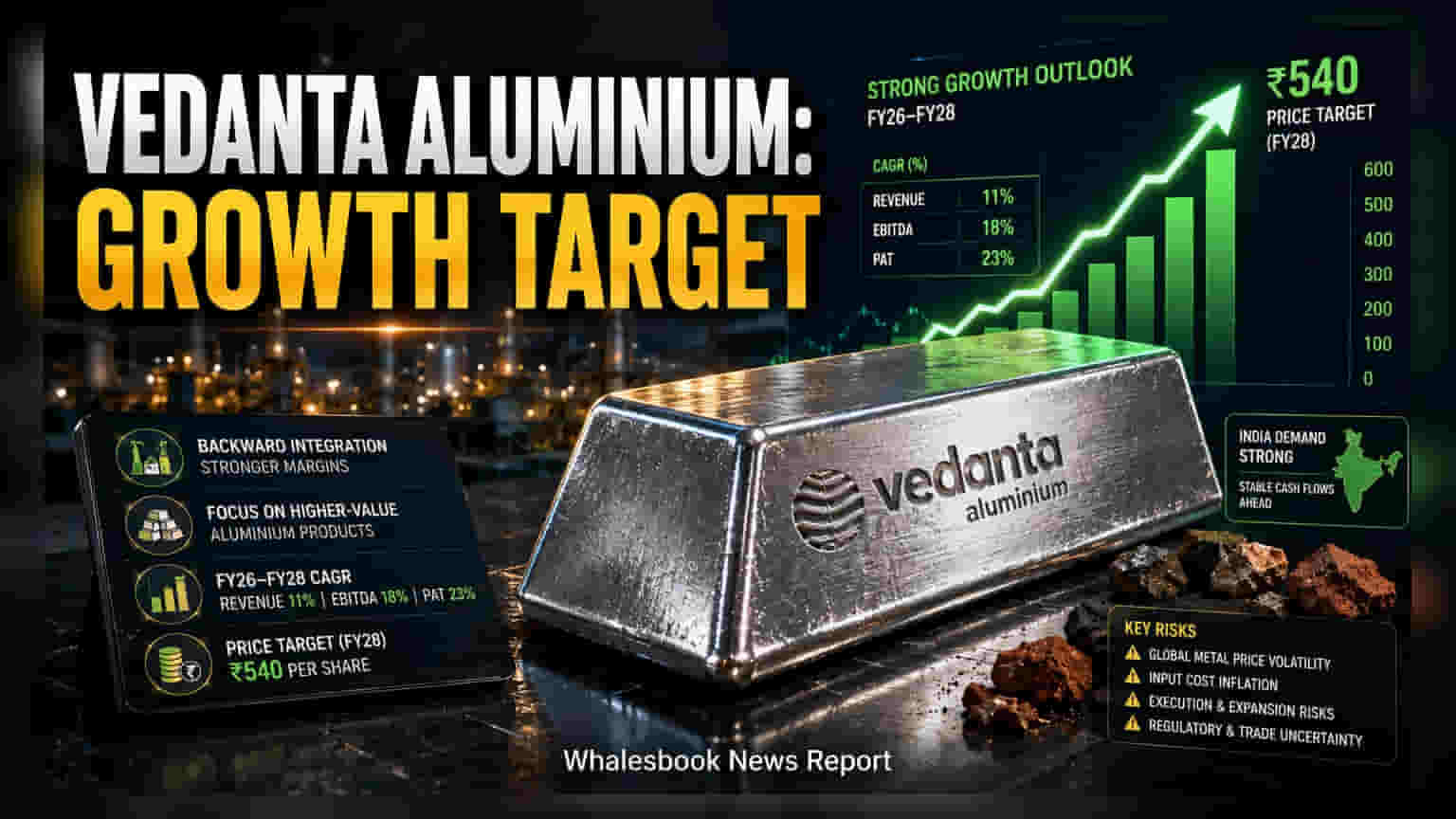
Motilal Oswal has maintained a 'Buy' rating on Vedanta Aluminium, projecting a target price of Rs 540 per share by FY28. The brokerage expects growth to be driven by strong domestic demand and better profit margins from backward integration. Investors should track project execution and input costs as key factors that could influence future performance.
Motilal Oswal Financial Services has reaffirmed its optimistic view on Vedanta Aluminium, issuing a price target of Rs 540 per share based on financial estimates for the fiscal year 2028. The brokerage highlights the company's strategy of backward integration—where a company owns the production of its own raw materials or power—as a crucial driver for protecting and expanding profit margins.
The investment case also centers on the company's shift toward higher-value products. These specialized aluminium offerings typically command better pricing compared to standard metal commodities, allowing for improved profitability. With robust demand for aluminium within India, the brokerage anticipates that the company is well-positioned to convert this market growth into stable cash flows.
Regarding future financial performance, the brokerage projects a positive trend over the next few years. It estimates that the company’s revenue, earnings before interest, taxes, depreciation, and amortization (EBITDA), and profit after tax will grow at a compound annual growth rate of roughly 11%, 18%, and 23%, respectively, between fiscal years 2026 and 2028. At current valuations, the stock is trading at approximately 5.3x to 5.4x its estimated FY28 EV/EBITDA, a metric used to measure the value of a company relative to its core operational earnings.
While the outlook is positive, the brokerage and the broader metal industry highlight several risks that investors should consider. Aluminium is an industrial commodity, and companies in this sector are inherently sensitive to global macroeconomic shifts and volatile international prices. Any sharp fluctuation in global metal prices can directly impact the company's revenue and profitability. Furthermore, the company faces execution risks, which refer to potential delays or cost increases in ongoing expansion and operational projects.
Additionally, input cost inflation remains a monitorable factor. Since the production of aluminium is energy and raw material intensive, any unexpected rise in the cost of coal, bauxite, or power could put pressure on margins. International trade policies and regulatory changes also pose potential challenges that could affect the company's domestic and export business.
Going forward, shareholders may focus on the progress of capacity expansion projects and the actual realization of cost savings from backward integration. Monitoring the company’s ability to manage its debt levels while funding these expansions will also be an important part of understanding its financial health in the coming quarters.