 Whalesbook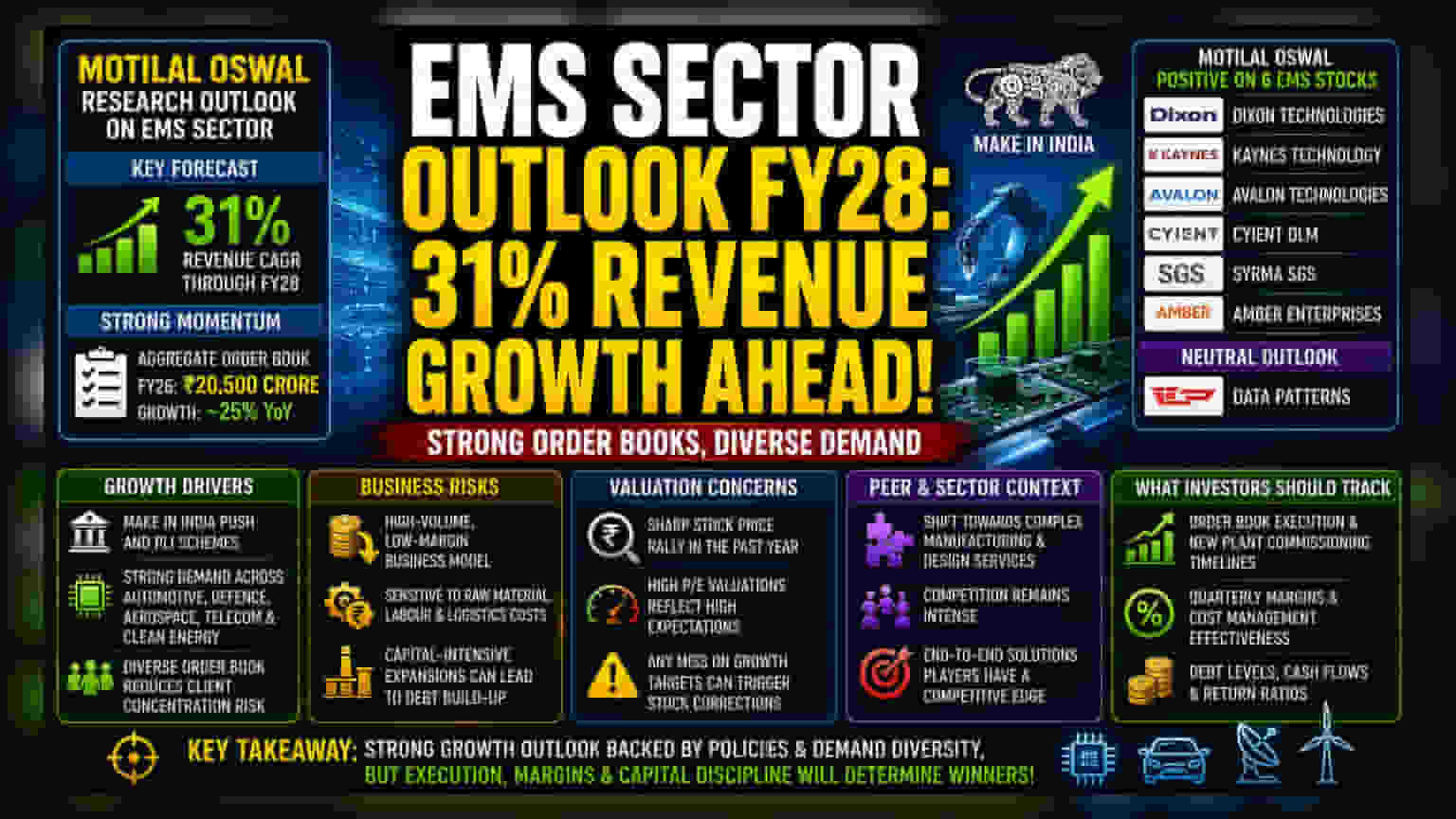


Motilal Oswal Financial Services has projected a 31% annual revenue growth for key electronics manufacturing services (EMS) companies through FY28. Driven by strong order books in defense, auto, and green energy, the sector remains in focus. However, investors should balance this optimism against high valuations, competitive pressures, and the execution risks inherent in the EMS business model.
What Happened
Motilal Oswal Financial Services has released a research outlook on the Electronics Manufacturing Services (EMS) sector in India, forecasting a strong 31% compound annual revenue growth for the companies under its coverage through FY28. The brokerage noted that the sector has experienced significant momentum, with aggregate order books for key players expanding by nearly 25% year-on-year in FY26 to reach Rs 20,500 crore. The brokerage reiterated positive ratings on six specific companies, including Dixon Technologies, Kaynes Technology, Avalon Technologies, Cyient DLM, Syrma SGS, and Amber Enterprises. The research also assigned a neutral outlook to Data Patterns.
The Growth Drivers
The optimism around the EMS sector is largely tied to India’s push for local manufacturing, commonly known as 'Make in India.' Several government initiatives, such as the Production Linked Incentive (PLI) schemes, have helped companies scale their manufacturing capabilities. The order books for these companies are now benefiting from diverse demand across industries, including automotive electronics, defense, aerospace, telecommunications, and clean energy. This diversification is seen as a key factor in reducing reliance on a single product category or client, which can provide more stability in revenue generation.
Understanding the Business Risks
While the growth forecast sounds positive, the EMS business model comes with specific challenges that investors should consider. EMS companies typically operate on high-volume, low-margin models. This means their profit margins are often thin and sensitive to changes in raw material costs, labor expenses, and logistics. Although companies have successfully passed on some increased costs to customers to protect their margins, any sudden spike in commodity prices or global supply chain disruption can create pressure on profitability.
Furthermore, the sector is capital-intensive. To win new orders and expand capacity, companies must spend significant capital on new facilities and machinery. This can lead to debt accumulation if not managed carefully. Investors should look beyond revenue growth and examine how much of this new capacity is actually being used, as unused plants can drag down return ratios.
The Valuation Question
Many stocks in the EMS sector have seen sharp price increases over the past year, reflecting market expectations for high future growth. This has led to high price-to-earnings (P/E) valuations for several players compared to broader market averages. When a stock trades at a premium valuation, the market typically expects near-perfect execution. If a company misses its growth targets or experiences project delays, the stock price can be sensitive to such corrections.
Peer and Sector Context
The Indian EMS landscape is evolving rapidly, with companies moving from simple assembly to more complex manufacturing and design services. This shift toward higher-value products is intended to improve margins over the long term. However, competition remains intense as both domestic and international players vie for market share. Companies that can provide end-to-end solutions, from design to assembly, are generally viewed as having a better business advantage compared to those only focused on basic assembly.
What Investors Should Track
Moving forward, the primary monitorables for shareholders include the actual execution of the order book and the timeline for commissioning new plants. Investors may also want to track quarterly profit margins to see if companies are successfully managing input costs and maintaining profitability despite potential pricing pressure. Finally, keeping an eye on debt levels and cash flow is crucial, as the heavy spending required for capacity expansion can strain a company's financial flexibility if market demand does not meet expectations.