

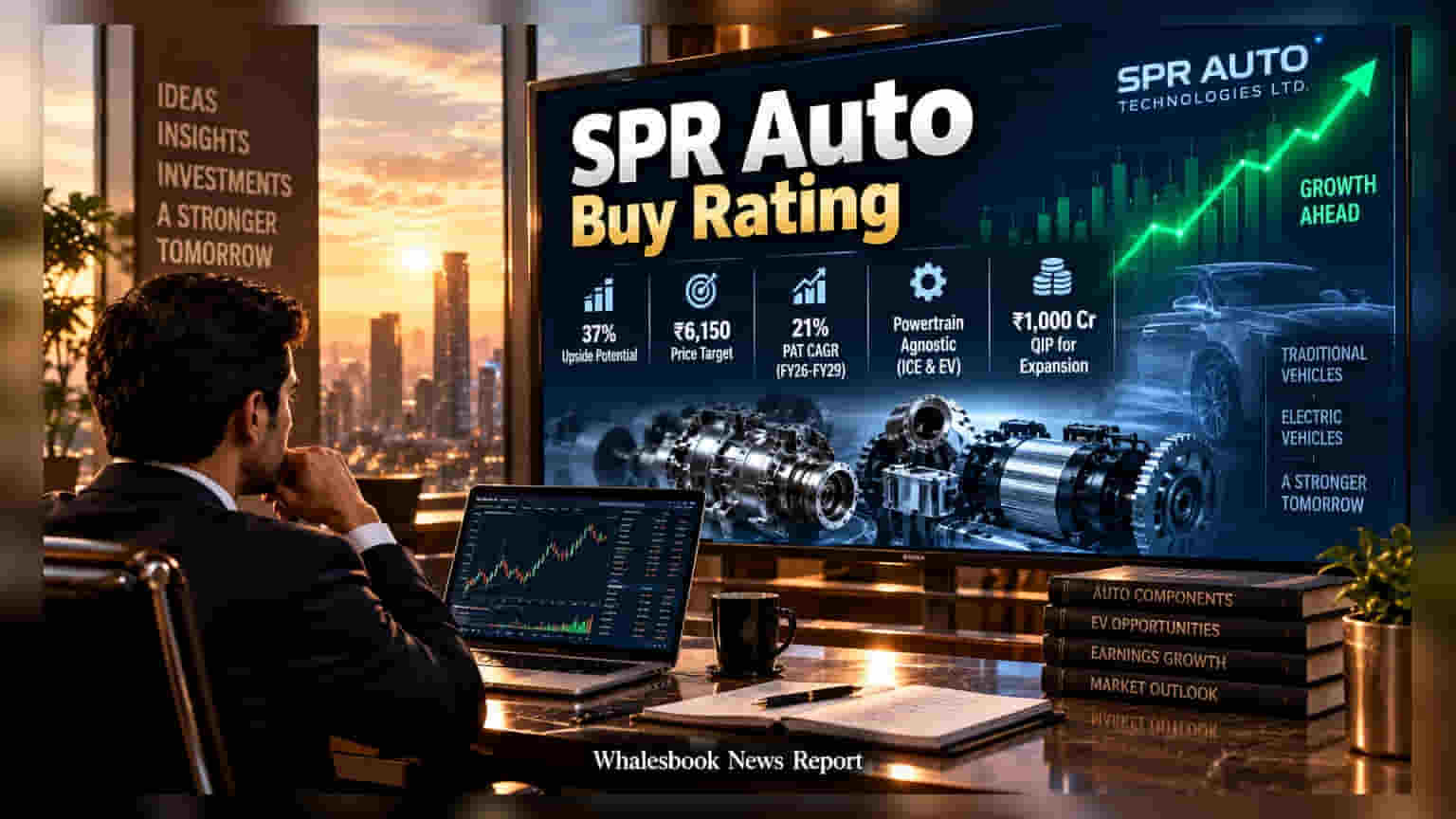
Motilal Oswal Financial Services has started coverage on auto component manufacturer SPR Auto Technologies with a 'Buy' rating and a target of Rs 6,150. The brokerage highlights the company's flexible manufacturing and recent Rs 1,000 crore capital raise as key growth drivers. Investors may watch how the firm manages competitive pressure and raw material costs in the coming years.
Motilal Oswal Financial Services has released a bullish research report on SPR Auto Technologies Ltd., initiating coverage on the stock with a 'Buy' rating. The brokerage has assigned a price target of Rs 6,150, which suggests a potential upside of approximately 37% from the recent price levels near Rs 4,494. The valuation is based on the brokerage's earnings projections for September 2028.
A central part of the investment case is the company's diversified business model. The brokerage points to the firm’s ability to remain relevant regardless of how the automobile industry evolves. SPR Auto follows a powertrain-agnostic strategy, meaning the parts it manufactures can be used in both traditional internal combustion engine vehicles and modern electric vehicles. This flexibility helps the company reduce risks associated with the industry's shift toward green energy.
The company recently raised Rs 1,000 crore through a Qualified Institutional Placement, or QIP. A QIP is a process where a company raises capital by issuing shares directly to institutional investors. This influx of cash is intended to fund both internal expansion and potential acquisitions. While this provides the necessary capital for growth, investors typically look to see if the company can effectively deploy these funds to generate higher profits, given that a QIP also increases the total number of shares, which can dilute earnings for existing shareholders.
Financial modeling from the brokerage projects a 21% compound annual growth rate in net profit through fiscal year 2029. Profitability, measured by the return on capital employed, is also expected to improve. Analysts estimate this metric will rise from 20% in fiscal year 2026 to 28% by fiscal year 2029. This improvement would be driven by rising profit margins and a focus on lowering capital spending intensity.
However, the report also outlines several risks that investors should consider. The auto component sector is highly competitive, and the company faces the constant challenge of volatile raw material costs, which can squeeze profit margins if the company cannot pass these costs to its customers. Additionally, there is a risk regarding the company's relationships with major original equipment manufacturers, or carmakers. If a major client decides to manufacture components in-house or chooses a different supplier, it could negatively impact revenue. Furthermore, rapid technological changes in the auto industry always carry the risk of certain products becoming obsolete.
The key to the company’s future performance will be how it executes its expansion plans using the new capital and whether it can maintain its market share against increasing competition. Investors should keep an eye on upcoming quarterly results, management updates regarding the deployment of the Rs 1,000 crore, and any commentary on profit margin trends.