

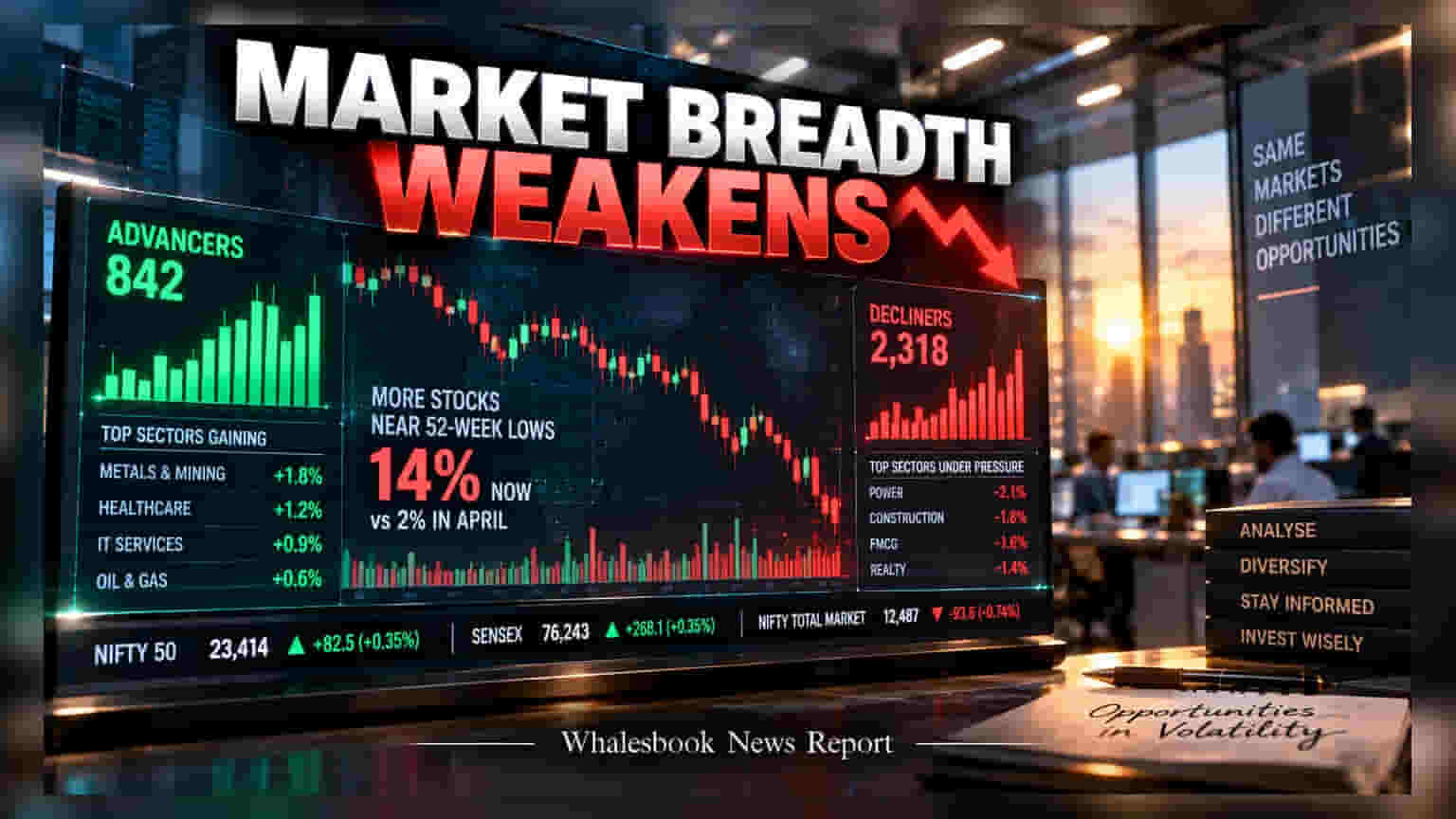
The number of Nifty Total Market stocks trading near 52-week lows has climbed to 14%, up from 2% in April. While this indicates cooling investor sentiment, it remains far below the stress levels seen during the March correction, suggesting a sector-specific price adjustment rather than a broad market collapse.
The Indian stock market is seeing a change in its internal health, often called market breadth. Market breadth essentially measures the participation of individual stocks in the market's price moves. Recent data shows that 14 percent of stocks in the Nifty Total Market universe are now trading within 5 percent of their 52-week lows. This is a noticeable shift from the 2 percent floor observed back in April, signalling that fewer stocks are participating in the market's upside and more are losing value.
Large Caps Show Defensive Strength
While the broader market is feeling the weight of this decline, large-cap companies are behaving differently. Within the Nifty 100 index, which tracks the largest listed companies in India, roughly 20 percent of stocks are hovering near their annual lows. However, the picture is not entirely negative. About 38 percent of Nifty 100 stocks continue to trade more than 50 percent above their yearly lows. This suggests that the decline is not a uniform crash across all major companies but rather a surgical repricing where investors are being more selective about which stocks to hold based on individual performance and valuation.
Sector Divergence Drives Market Action
The current pressure in the market is not driven by a widespread macroeconomic crisis, such as a sudden interest rate hike or a massive liquidity crunch. Instead, the selling is concentrated in specific sectors that are facing their own unique challenges. Domestic-facing sectors, particularly power, construction materials, and FMCG, are seeing a higher number of stocks fall toward their yearly support levels. Investors appear to be reassessing the future growth and valuation expectations for these specific businesses.
Conversely, not all sectors are struggling. Healthcare and the metals and mining sectors have shown notable resilience, with fewer companies testing their annual support levels. This divergence is important for investors because it indicates that the current market move is about adjusting the valuations of individual sectors rather than an underlying structural weakness in the Indian economy. When most market concerns are already priced into the current valuations, the market often enters a phase of uneven, grinding price action rather than a sharp, volatile reversal.
For investors, the key takeaway is to look beyond the headline index numbers. Since the market is responding to sector-specific earnings and valuation expectations, the performance of individual sectors and companies may vary significantly in the coming months. The next important step for investors will be to monitor corporate results and management commentary within these specific sectors to see if the recent price adjustments align with actual earnings growth, or if these sectors require more time to stabilize.