

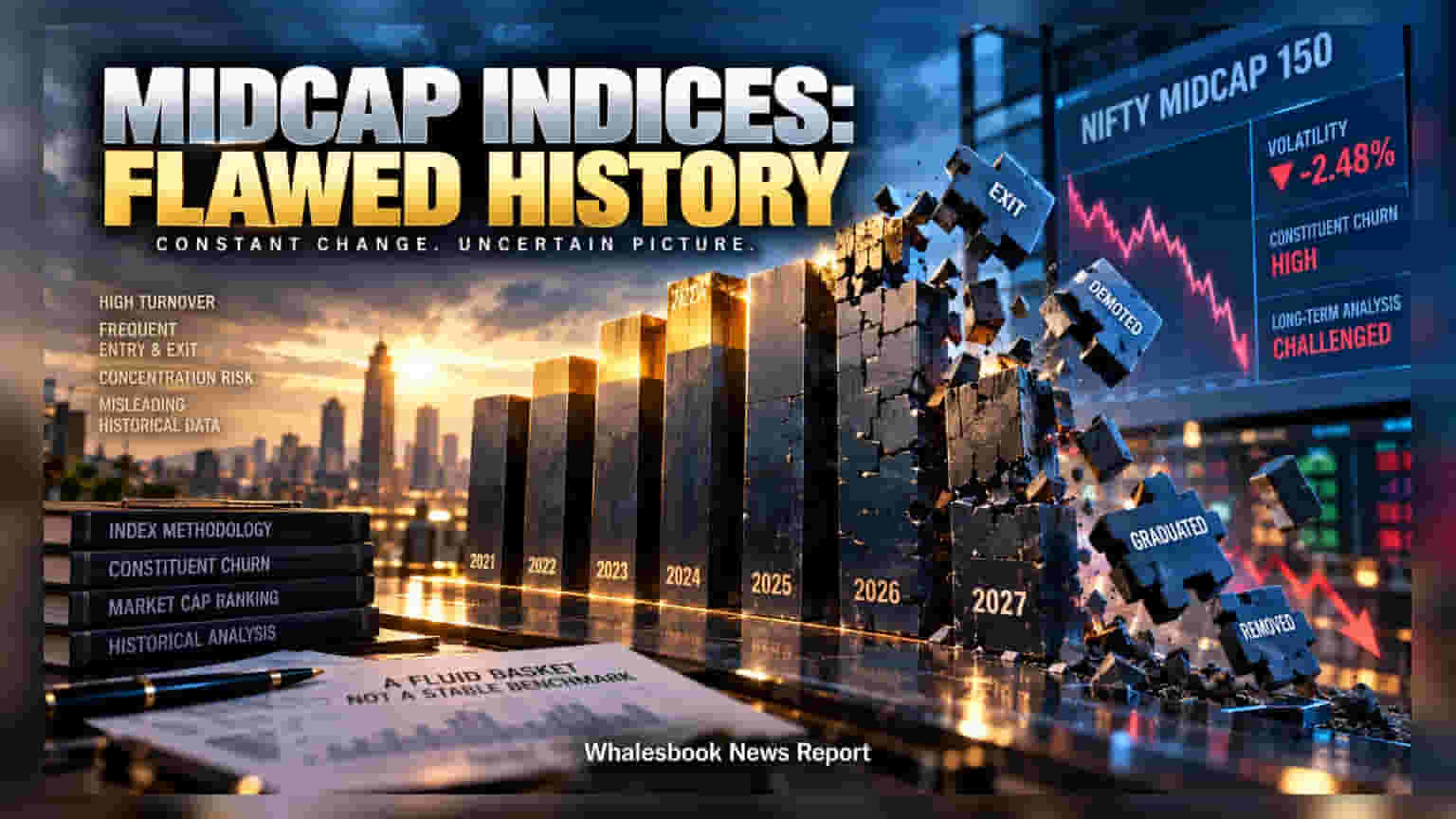
Kotak Institutional Equities warns that the Nifty Midcap 150 Index is unsuitable for long-term historical tracking due to frequent membership changes. The index faces high churn, with only 46 out of 150 companies remaining constant over a five-year period. This constant movement makes it difficult to reliably assess historical earnings and valuation trends, highlighting a significant challenge for investors using the index as a performance benchmark.
Kotak Institutional Equities recently highlighted that the Nifty Midcap 150 Index may not be the reliable tool for long-term historical market analysis that many investors assume it to be. The brokerage suggests that the index’s design, which relies on a mechanical, market-capitalization-based ranking system, creates significant structural issues.
At the core of the problem is the high turnover of companies within the index. Because the index is designed to include stocks ranked between 101 and 250 by market capitalization, it is constantly updating its list. This creates a revolving door effect, where companies frequently enter and exit the list as their market valuations move up or down.
The Impact of High Constituent Churn
The volatility is evident in the numbers. Between the 2021-22 fiscal year and the first half of 2027, only 46 companies managed to stay in the index throughout the entire period. In contrast, a total of 275 unique companies moved through the list, highlighting that the midcap basket is a transit zone rather than a fixed group of businesses.
This movement is often driven by the graduation process, where companies either grow large enough to move into the Nifty 50 or Nifty Next 50 indices, or shrink and are demoted to the Nifty Smallcap 250 index or removed entirely. According to the report, 41 companies graduated to larger indices, while 129 were demoted or removed during the analyzed period.
Concentration and Investor Risks
The report also points to concentration risks, noting that in any given six-month period, as few as 27 companies can drive over half of the index's price movement. This makes the benchmark highly sensitive to specific sectors or stocks that happen to be in the index at that moment, rather than reflecting the broader midcap economy.
For investors, this means historical analysis of the Nifty Midcap 150 Index can be misleading. It is less like a stable portfolio and more like a fluid list of companies. As a result, comparing earnings growth or valuation multiples over several years becomes difficult, as the basket of companies is constantly changing. Investors looking at long-term charts or performance data should be aware that the index they are viewing today is significantly different from the index of a few years ago.