 Whalesbook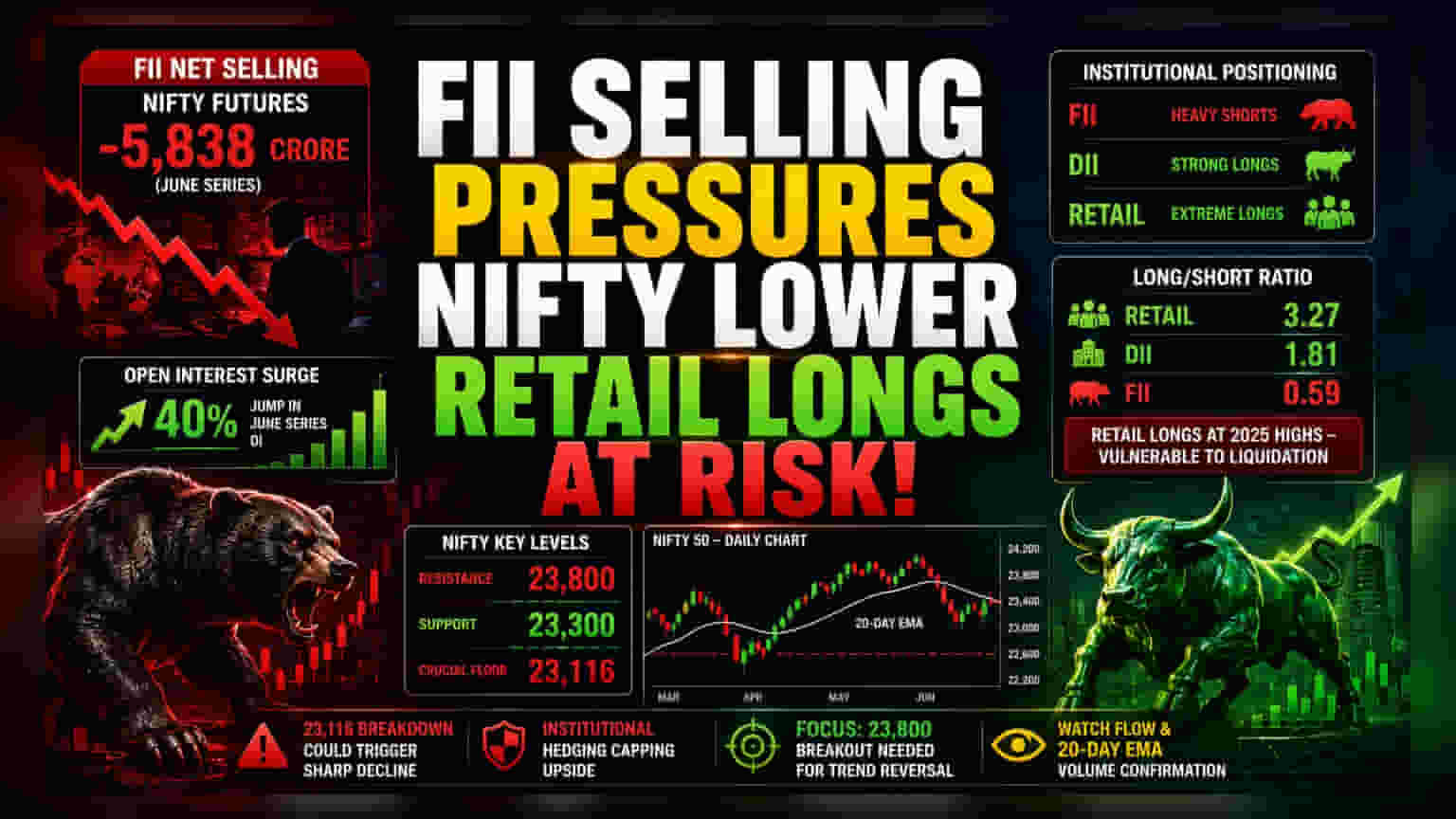


The Institutional Divergence
The persistence of selling pressure from offshore entities indicates a conviction-based bet on index weakness that defies recent price action. While the benchmark index attempted a reversal from its intra-day lows, the underlying derivatives data portrays a market tethered by institutional hedging and speculative short selling. This aggressive accumulation of short contracts represents a departure from standard rebalancing, suggesting that global desks are pricing in systemic volatility or potential macro headwinds that domestic sentiment has yet to acknowledge.
Analyzing the Capital Flow
Comparing current positioning to previous cycles, the concentration of selling in Nifty futures relative to the broader Bank Nifty and MidCap indices highlights a targeted effort to deflate large-cap momentum. The sharp, forty percent spike in open interest at the start of the June series serves as a warning sign. While Retail Investors and Domestic Institutional Investors have reached near-record long-to-short ratios, the imbalance creates a precarious environment. Historically, such extreme polarization—where retail optimism mirrors institutional pessimism—often precedes periods of heightened delta-neutral trading or forced liquidation events if the index fails to break through overhead resistance.
The Forensic Bear Case
The primary risk inherent in the current setup is the vulnerability of the retail cohort. With retail long-to-short ratios reaching levels not seen since late 2025, the market is structurally dependent on continuous liquidity from domestic participants to absorb the selling pressure from offshore desks. If the Nifty fails to maintain the 23,300 support level, the concentration of retail longs could trigger a cascade of stop-loss executions, forcing a rapid unwinding that amplifies downward momentum. Furthermore, the persistent failure of the index to reclaim its 20-day exponential moving average suggests that the current recovery lacks the volume-backed conviction required for a sustainable trend reversal. The market is essentially trapped in a liquidity tug-of-war, with institutional entities aggressively capping upside potential through heavy call writing at the 23,500 and 24,000 strikes.
Market Outlook and Positioning
Moving forward, the focus remains on the structural ceiling near the 23,800 level. Unless there is a significant shift in foreign sentiment or a sustained breakout above the 20-day moving average, the prevailing narrative remains one of range-bound consolidation under heavy institutional oversight. Traders should monitor the 23,116 floor, as a breach here would likely invalidate the current support structure and force a re-evaluation of the index's medium-term trajectory.