

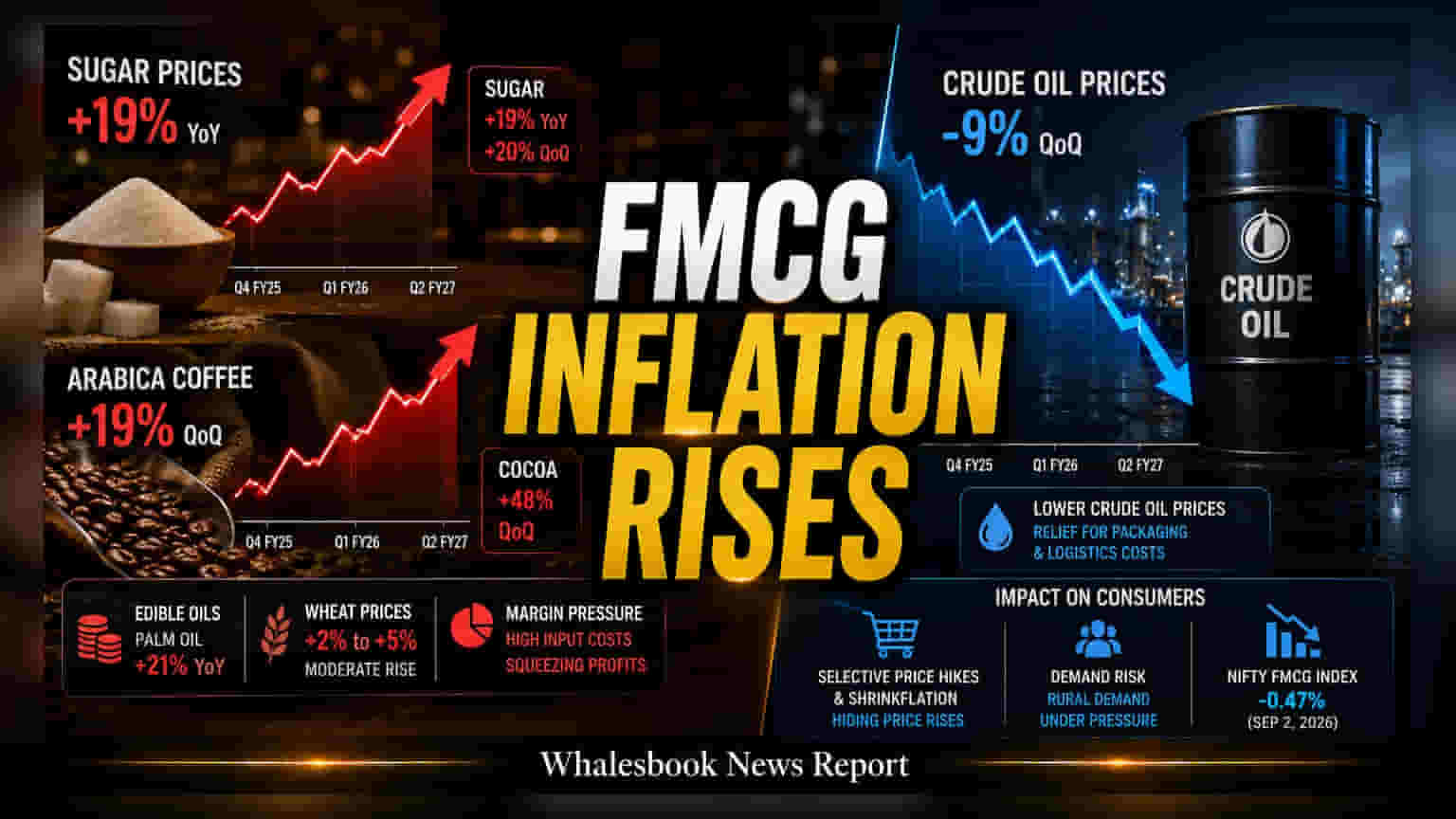
While FMCG companies are finding some relief from lower crude prices, soaring costs of sugar, cocoa, and edible oils are putting pressure on profit margins. Investors are bracing for uneven earnings growth, as companies face the difficult choice between raising prices and risking lower demand.
The Indian fast-moving consumer goods (FMCG) sector is navigating a complex period as of September 2026. While manufacturers have received some relief from the recent decline in crude oil prices—which often lowers packaging and logistics costs—this benefit is being quickly wiped out by a sharp rise in essential agricultural commodity prices.
The Cost Squeeze on Margins
For many FMCG companies, the primary challenge has shifted from general inflationary pressure to specific, high-volatility inputs. Sugar prices, a key ingredient for biscuits, confectionery, and carbonated beverages, have jumped 19% compared to last year and 20% compared to the previous quarter. This sharp increase is hitting companies directly in their profit buffers.
The situation is even more intense in the beverage segment. Cocoa prices have surged 48% sequentially, while Arabica coffee prices are up 19% compared to the previous quarter. For companies reliant on these ingredients, protecting profit margins has become significantly harder. Edible oils, including palm oil, have also seen hikes, with palm oil costs climbing 21% year-on-year, adding further weight to the production costs of packaged food items.
Diverging Performance Among Peers
Not every company in the sector is feeling the same heat. The impact of these price hikes depends heavily on what a company produces. Businesses that rely heavily on cereal-based inputs like wheat and rice are in a relatively safer position, as these commodities have seen more moderate price increases, generally around 2% to 5%. In contrast, manufacturers heavily exposed to the sugar and cocoa supply chains are under significant pressure.
This divergence is likely to show up in quarterly financial results. Investors should expect a wide variance in how individual companies report their profits. While some firms may manage to keep margins stable, others might report lower profitability if they are unable to fully pass these costs on to consumers.
Investor Monitorables
To manage this volatile environment, many FMCG majors are turning to a combination of selective price hikes and 'shrinkflation'—the practice of reducing product pack sizes while keeping the price the same. This allows companies to hide price increases from the consumer to avoid losing sales volume. However, there is a risk that if prices rise too sharply, consumers, especially in rural areas, may cut back on spending or switch to cheaper local alternatives.
The market has already started to show signs of caution. The Nifty FMCG index closed lower by 0.47% on September 2, 2026, reflecting broader concerns about how these costs will affect future earnings. Going forward, investors should watch for management commentary on how companies plan to manage these costs without hurting sales, and whether the much-anticipated recovery in rural demand can stay on track despite these inflationary pressures.