 Whalesbook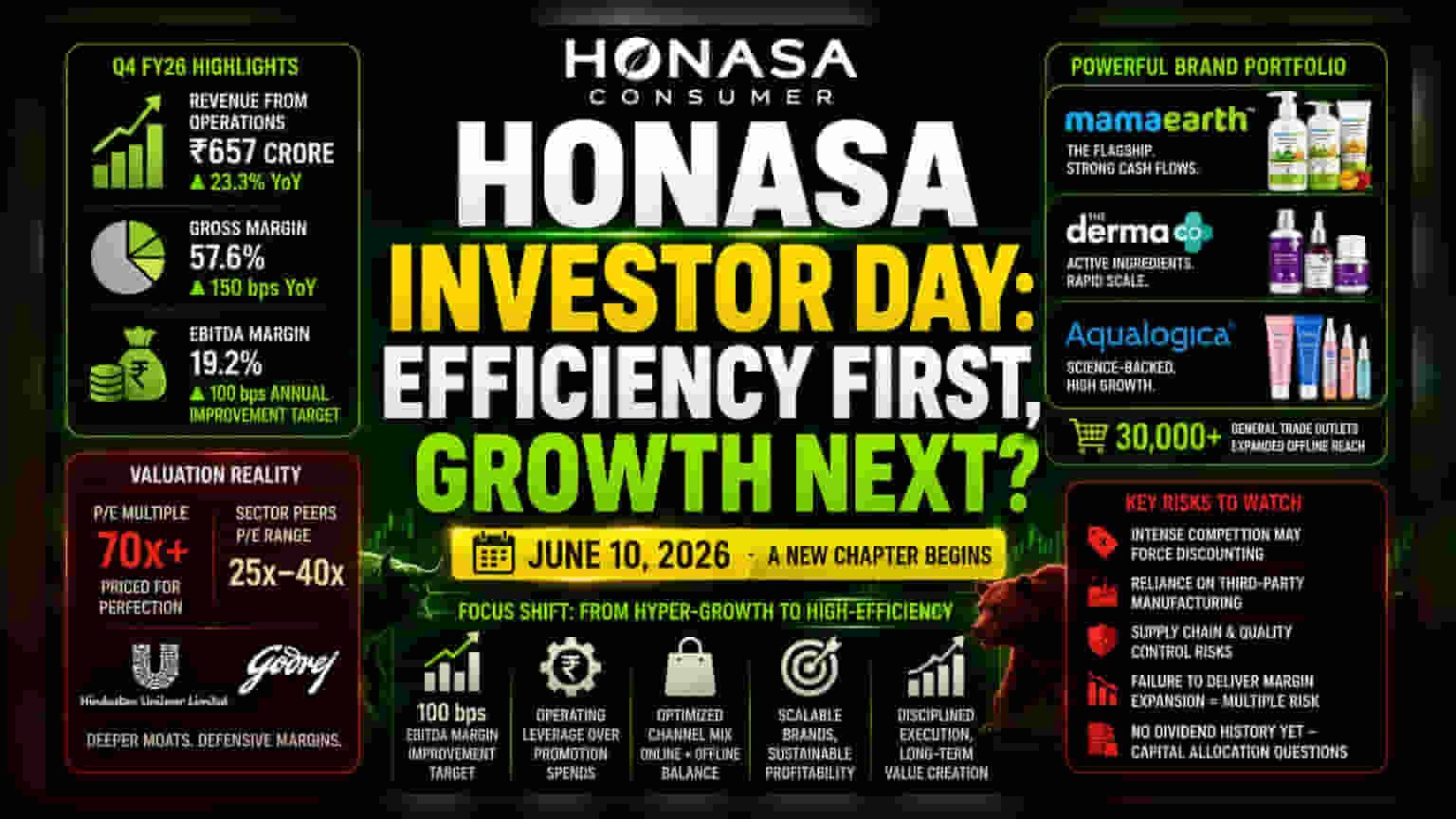


The Efficiency Pivot
Honasa Consumer’s forthcoming Investor Day, scheduled for June 10, 2026, marks a definitive departure from the hyper-growth phase that defined its post-IPO era. Institutional focus has moved away from mere market share acquisition toward a structured, efficiency-led operational model. Management’s guidance, which targets a 100-basis-point annual improvement in EBITDA margins, signals a commitment to leveraging the existing distribution network rather than relying on heavy promotional expenditure.
Scaling the Brand Architecture
While the flagship Mamaearth brand continues to provide the bedrock for cash flows, the market’s attention is now firmly fixed on the scalability of younger, active-ingredient-led portfolios such as The Derma Co. and Aqualogica. With revenue from operations jumping over 23% in the most recent quarter to ₹657 crore, the company must demonstrate that these sub-brands can achieve standalone profitability. Analysts are specifically hunting for clearer articulation on channel mix—specifically the contribution of the company’s expanded offline footprint, which now spans over 30,000 general trade outlets—to offset the saturation observed in digital-first channels.
The Valuation and Competitive Reality
Trading at a P/E multiple exceeding 70x, Honasa Consumer is effectively priced for consistent earnings compounding. This high valuation places the company in a precarious position compared to the broader personal products sector, which typically trades at lower multiples. Unlike incumbent FMCG giants such as Hindustan Unilever or Godrej Consumer, which command deep-rooted supply chains and robust defensive margins, Honasa’s asset-light model remains vulnerable to external shocks. Any failure to meet the 100-basis-point margin expansion target or a deceleration in the growth of its newer brands would likely trigger significant multiple contraction.
The Forensic Bear Case
From a risk-averse perspective, the primary concern remains the durability of the current profitability surge. While the recent quarterly performance was impressive, the lack of a long-term dividend history raises questions regarding management's long-term capital allocation philosophy. Furthermore, the company’s heavy reliance on third-party contract manufacturing provides scalability but leaves it exposed to quality control and supply chain volatility. Should the competitive intensity in the Indian beauty and personal care segment force a return to aggressive discounting, Honasa’s nascent margin gains could evaporate rapidly, testing the company's ability to maintain its premium valuation in a more cautious market environment.