

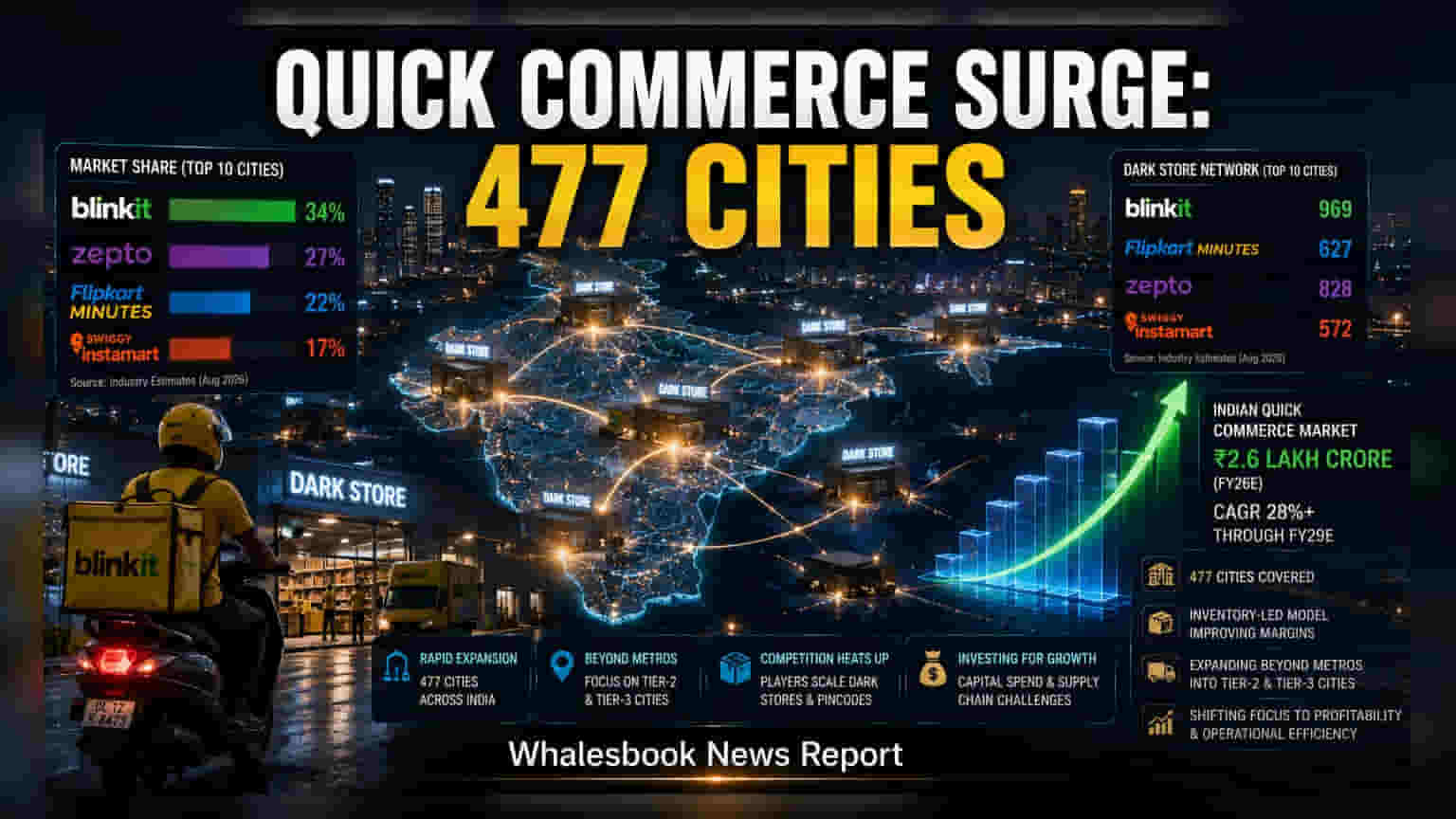
Quick commerce platforms have scaled operations to 477 Indian cities, with Eternal Ltd’s Blinkit maintaining a leading national market share of over 34%. As the industry shifts from metro-centric hubs to smaller regions, investors are tracking how players manage high infrastructure costs and supply chain constraints amid intensifying competition.
Quick commerce operators have rapidly accelerated their network footprint to reach 477 cities across India, marking a major shift in the country's retail landscape. This expansion is no longer limited to top-tier metropolitan areas, as companies pivot toward capturing demand in smaller, untapped urban centers. Blinkit, the quick commerce arm of the listed entity Eternal Ltd., currently maintains a strong lead with a national market share exceeding 34% and approximately 969 dark stores in the top 10 cities.
While Blinkit continues to command the largest slice of the market in major hubs, the competitive intensity is rising. Newer entrants and established rivals are aggressively scaling their own dark store networks to challenge this lead. Notably, Flipkart Minutes has grown its footprint to 627 locations, surpassing Swiggy Instamart in total store count and pincode coverage within the top 10 markets. Zepto also remains a significant competitor, holding 828 locations, forcing all players to continuously invest in store density to maintain delivery speeds and product variety.
For investors, the primary monitorable is how these companies balance rapid geographic growth with operational efficiency. The industry is currently transitioning from a focus on aggressive discounting to an inventory-led model, which aims to improve margins by controlling the supply chain more directly. However, this strategy requires significant capital spending to build and manage a dense network of warehouses and dark stores.
Operational challenges are also becoming more visible as the scale grows. Recent supply chain constraints, such as a localized tightening in sugar availability, have forced several major platforms to ration purchases of essential commodities. Such events highlight the complexities of managing inventory-led models at a national scale. Investors are also watching for how these platforms manage unit economics in Tier-2 and Tier-3 cities, where consumer behavior and logistics costs differ significantly from the high-density metro hubs where the concept originally thrived.
The industry's next phase will likely focus on consolidating these regional networks rather than just increasing store counts. As the market matures, the ability to maintain profitability while handling potential regulatory oversight and supply-side disruptions will be the key test for major players like Eternal Ltd. and its rivals.