 Whalesbook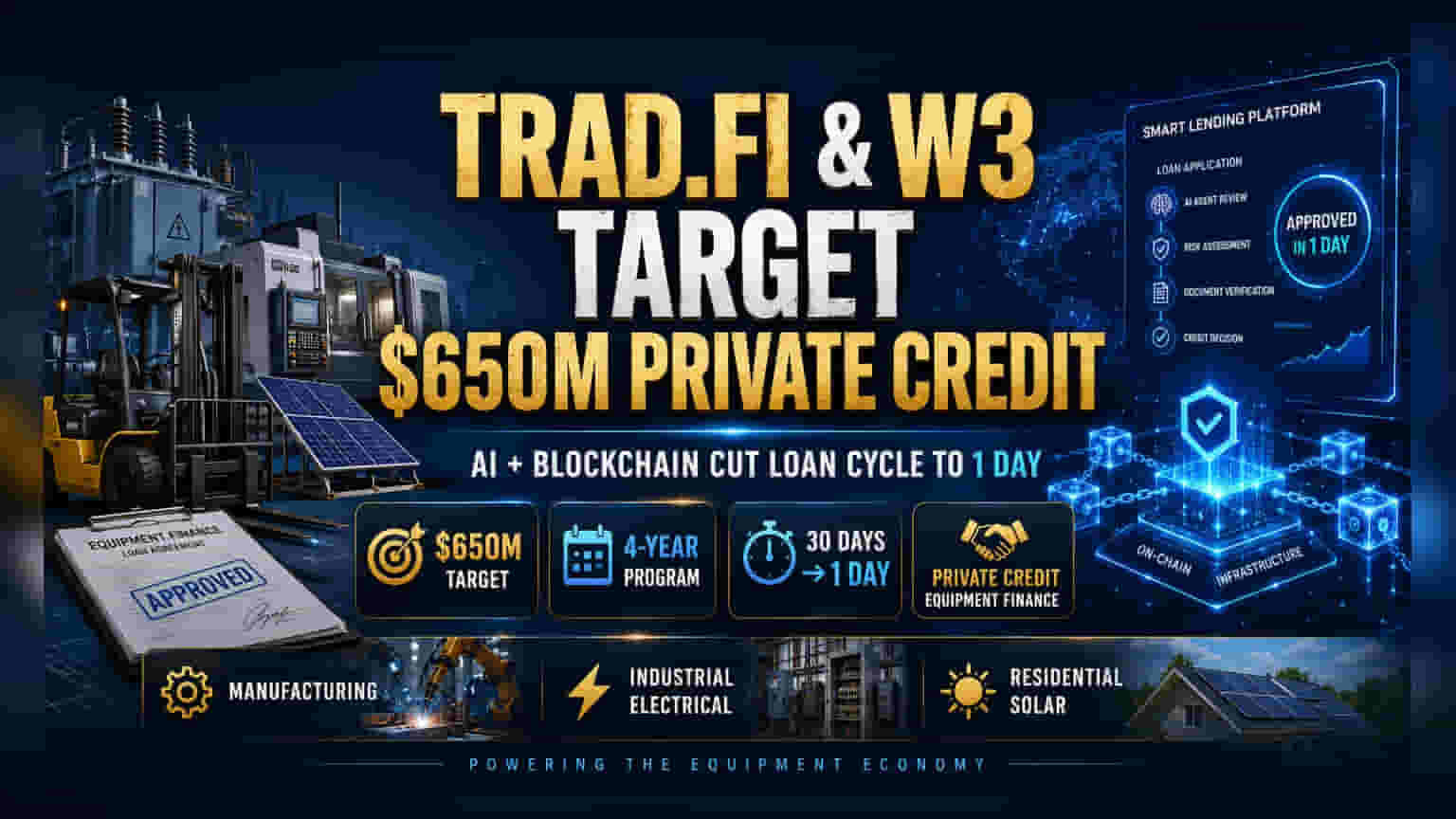


What Happened
Trad.Fi, a specialist lender for heavy equipment purchases, has entered a strategic partnership with W3, an AI-agent developer. The two companies aim to originate $650 million in private credit over the next four years. The program is specifically targeted at the U.S. equipment distribution sector, with a focus on manufacturing systems, industrial electrical infrastructure, and residential solar installations. By combining artificial intelligence with blockchain infrastructure, the initiative intends to cut down the traditional financing cycle—which often involves significant paperwork and manual review—from approximately one month to as little as one day.
Why This Matters For Investors
This development serves as a practical look at how traditional finance (TradFi) is integrating with digital asset infrastructure. Traditionally, the private credit market relies on manual, slow-moving processes that require human credit analysts, extensive document verification, and legacy bank transfers. By migrating these workflows onto the Avalanche blockchain, the partnership is attempting to automate the "plumbing" of the lending business. For investors and observers, the focus is on whether this technological overhaul can genuinely improve profit margins by reducing administrative costs and operational delays, which are significant pain points in equipment financing.
The Role of AI and Blockchain
At the heart of this project is the use of AI to manage the front-end of the lending business. The technology is tasked with evaluating borrower risk, conducting due diligence, and determining loan pricing. Traditionally, these tasks are labor-intensive. If the AI can maintain accuracy in credit assessment, it could allow the lender to handle a larger volume of loans with fewer manual hours. The blockchain component acts as the settlement and capital deployment layer. Once the credit is evaluated and approved, the funds are deployed through the blockchain. This setup is designed to create a transparent, programmable treasury where capital flows more directly to the intended assets, bypassing some of the intermediary layers that slow down traditional corporate lending.
The Bigger Trend: Real-World Assets (RWA)
This partnership is part of a broader, accelerating trend known as the tokenization of Real-World Assets (RWA). This process involves creating digital tokens that represent ownership or interest in physical assets like equipment, real estate, or corporate debt. While the total volume of onchain private credit has grown, the industry remains in a transition phase. Many institutional investors are watching to see if tokenized assets can offer the same liquidity and stability as traditional holdings. The goal of this $650 million target is to prove that blockchain infrastructure can handle institutional-grade volume while meeting the rigorous data and compliance standards required for US business lending.
Risks and Monitorables
While the promise of faster lending is clear, the initiative faces several practical challenges. First, credit risk remains the primary concern; technology cannot eliminate the possibility that a borrower may default on their equipment loan. Investors may track whether the AI-based risk assessment model proves as robust as traditional human underwriting over a full economic cycle. Second, legal and regulatory frameworks for tokenized debt are still evolving. The final legality of the tokenized credit instruments and the ease of enforcing claims in the event of default are critical monitorables. Finally, the success of the program depends on the actual adoption by businesses—they must be willing to engage with a lending process that is integrated with blockchain rails. The ability of Trad.Fi to consistently deploy capital at the promised speed, while maintaining high-quality credit standards, will be the key indicator of the project’s long-term sustainability.