 Whalesbook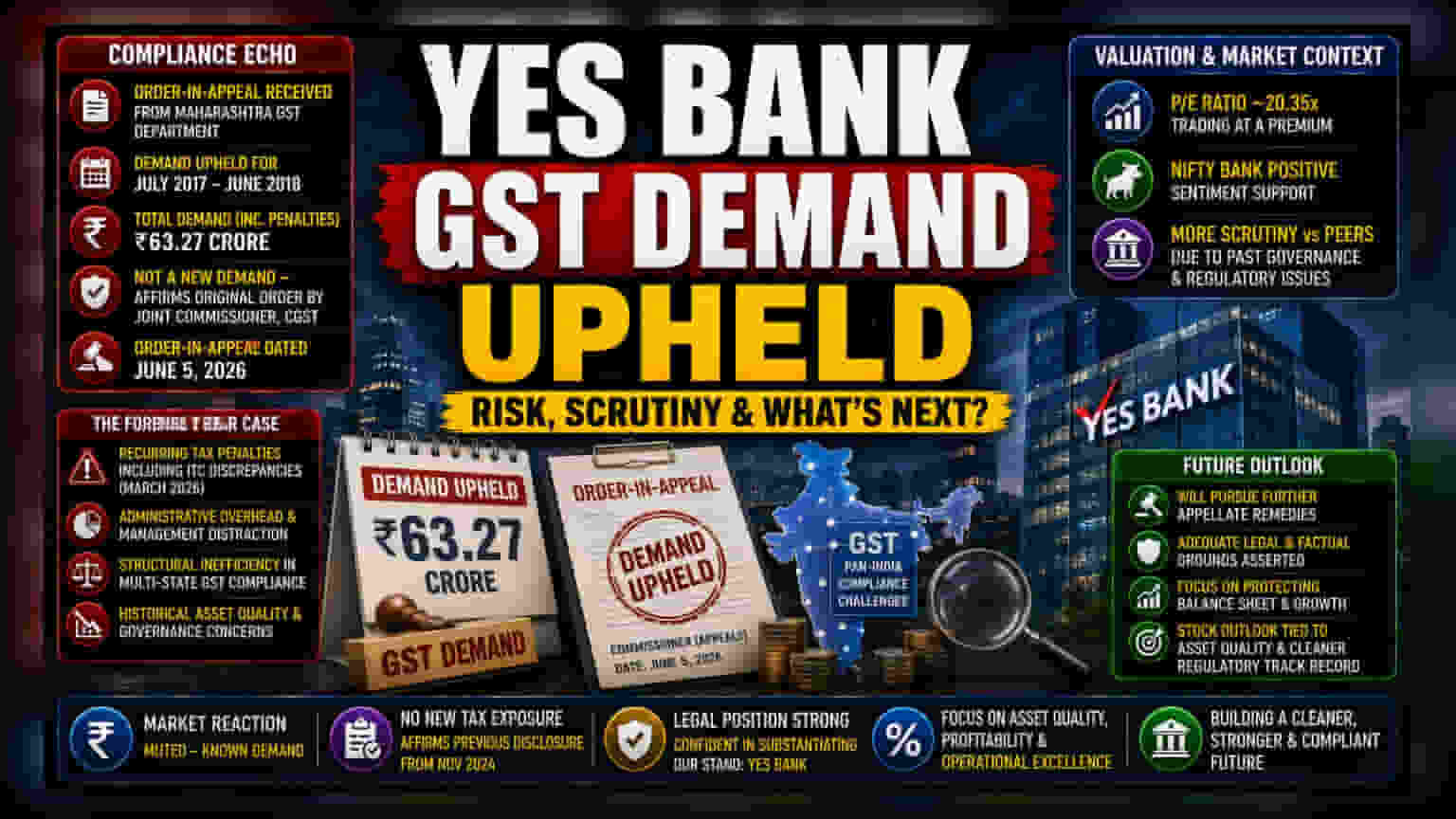


The Compliance Echo
Yes Bank has received an Order-in-Appeal from the Maharashtra Goods and Services Tax (GST) department, upholding a total demand of ₹63.27 crore inclusive of penalties for the fiscal period between July 2017 and June 2018. This development, confirmed by the Commissioner (Appeals) on June 5, 2026, acts as an update to a previously disclosed regulatory filing from November 2024. The bank clarified that this ruling does not create new tax exposure but rather affirms the original demand raised by the Joint Commissioner, CGST.
Valuation and Market Context
Currently trading with a price-to-earnings (P/E) ratio of approximately 20.35x, Yes Bank continues to navigate a complex regulatory environment while attempting to balance its asset quality with operational growth. Despite the bank's stock showing resilience—partially supported by a broader positive sentiment in the Nifty Bank index following recent monetary policy stability—the persistent nature of these legacy tax disputes highlights the lingering operational complexities involved in managing pan-India GST compliance. Unlike larger private sector peers such as HDFC Bank or ICICI Bank, which maintain significant operational buffers, Yes Bank remains under closer scrutiny due to its historical governance challenges and the high frequency of regulatory reporting requirements.
The Forensic Bear Case
From a risk-averse institutional perspective, the situation warrants caution regarding administrative overhead. The bank has faced a recurring pattern of tax-related penalties, including a notable GST penalty order for Input Tax Credit (ITC) discrepancies issued as recently as March 2026. While the bank maintains that these individual demands lack material financial impact, the cumulative effect of these disputes—combined with the bank's historical struggle with non-performing assets and governance lapses—suggests a structural inefficiency. Investors often view these repeated legal challenges as a distraction that forces management to divert resources toward litigation rather than core business expansion. Furthermore, the bank's reliance on legal remediation for tax disputes highlights the difficulties inherent in transitioning to decentralized state-wise GST registration, a common hurdle for banking institutions with large, multi-state footprints.
Future Outlook
Yes Bank has asserted that it possesses adequate legal and factual grounds to substantiate its position and intends to pursue further appellate remedies. The management’s focus remains on shielding the balance sheet from these legacy liabilities. While the market reaction has remained muted, reflecting the 'known' nature of this specific demand, the long-term outlook for the stock remains tied to the bank’s ability to demonstrate sustained improvement in asset quality and a cleaner regulatory record.