 Whalesbook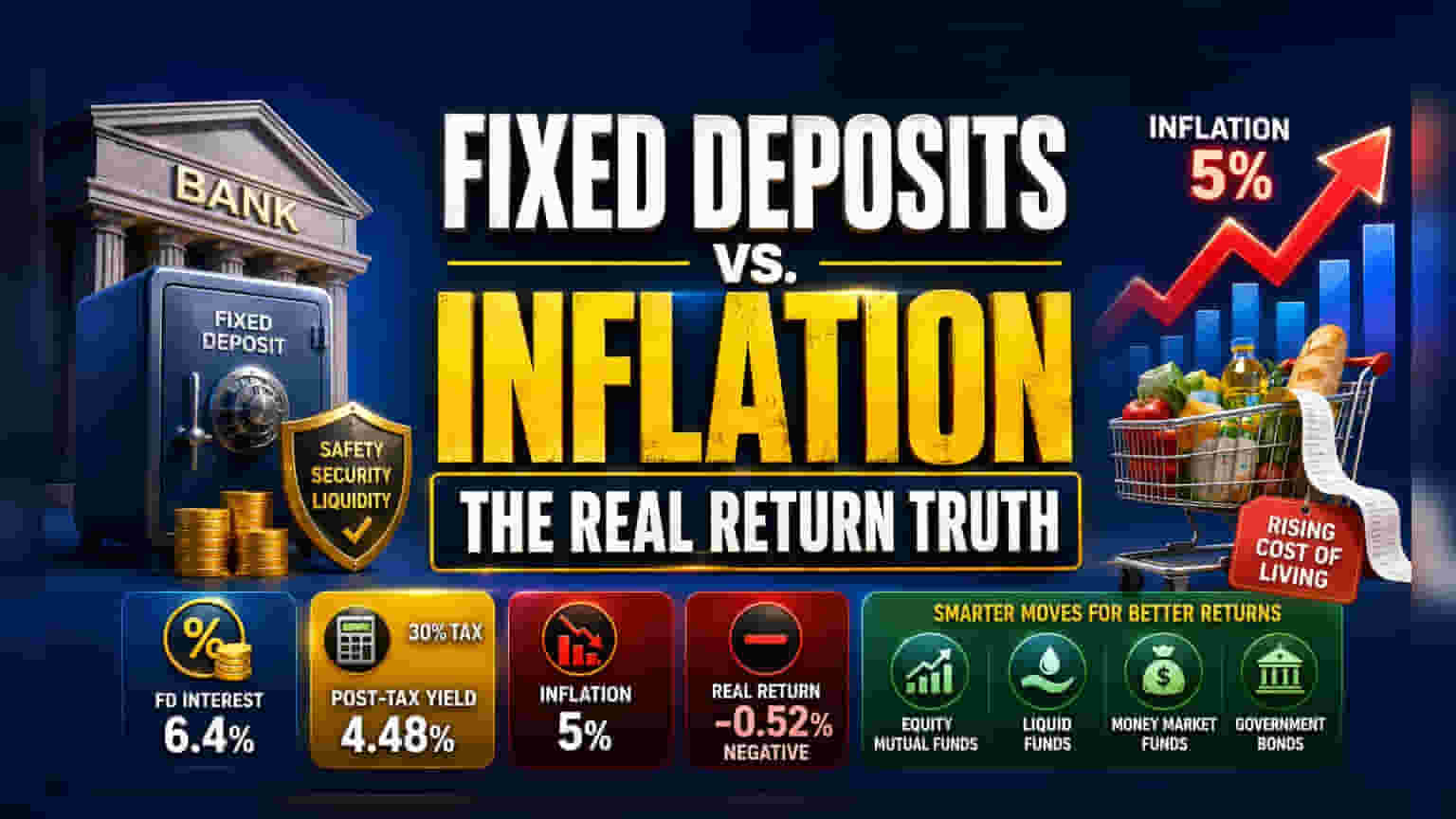


What Happened
Fixed deposits (FDs), long considered a staple for conservative investors in India, are currently facing a challenge in outpacing inflation. With consumer inflation recently tracking around 5%, many standard FD interest rates are providing thin margins for growth. While account balances show growth due to interest, the actual 'real return'—which is the return an investor gets after accounting for the rising cost of goods and services—is often quite low, and in some cases, effectively negative.
The Reality of Real Returns
The true test of an investment is whether it helps money grow faster than the cost of living. For instance, if an investor puts money in a fixed deposit earning 6.4% and inflation is 5%, the real return is just 1.4%. While this is technically positive, the situation becomes difficult when considering that money loses value over time. Short-term deposits, which often carry lower interest rates than longer-term tenures, can sometimes fail to beat inflation entirely, resulting in a loss of purchasing power.
The Tax Factor
A critical element that often reduces the actual benefit of fixed deposits is taxation. Interest earned on these deposits is fully taxable according to the investor's income tax slab. For an investor in the 30% tax bracket, a 6.4% interest rate is significantly diluted. After paying tax, the post-tax yield drops to roughly 4.48%. When this 4.48% return is compared against 5% inflation, the investor experiences a negative real return. In this scenario, the investor is technically losing purchasing power despite receiving interest payments.
Safety vs. Wealth Growth
This gap between inflation and FD returns highlights a fundamental investment distinction: the difference between preserving wealth and growing wealth. Fixed deposits are designed for capital protection and liquidity. They provide a guaranteed return and capital safety, which is essential for emergency funds or short-term needs. However, relying solely on FDs for long-term wealth creation can be difficult when inflation is high. Investors often use FDs to park money they cannot afford to lose, rather than to build a retirement corpus or achieve long-term growth.
What Investors May Consider
Given these constraints, many investors look to diversify their portfolios to better manage the impact of inflation. Options such as equity mutual funds are often considered for long-term goals due to their potential to outpace inflation over time, although they come with market volatility. Other alternatives like liquid funds, money market funds, or government-backed floating rate bonds are also explored by those looking for better liquidity or inflation-hedging. The decision to diversify depends on an individual's financial goals, risk appetite, and the time horizon for their investments.
What Investors Should Monitor
Investors may keep a close watch on the prevailing inflation numbers and the interest rate cycles set by banks. If inflation remains high, the pressure on fixed-income investments persists. Furthermore, understanding one's own tax slab is vital for calculating the actual post-tax return of any investment. Balancing safety with growth remains the primary challenge for retail investors in the current economic environment.