

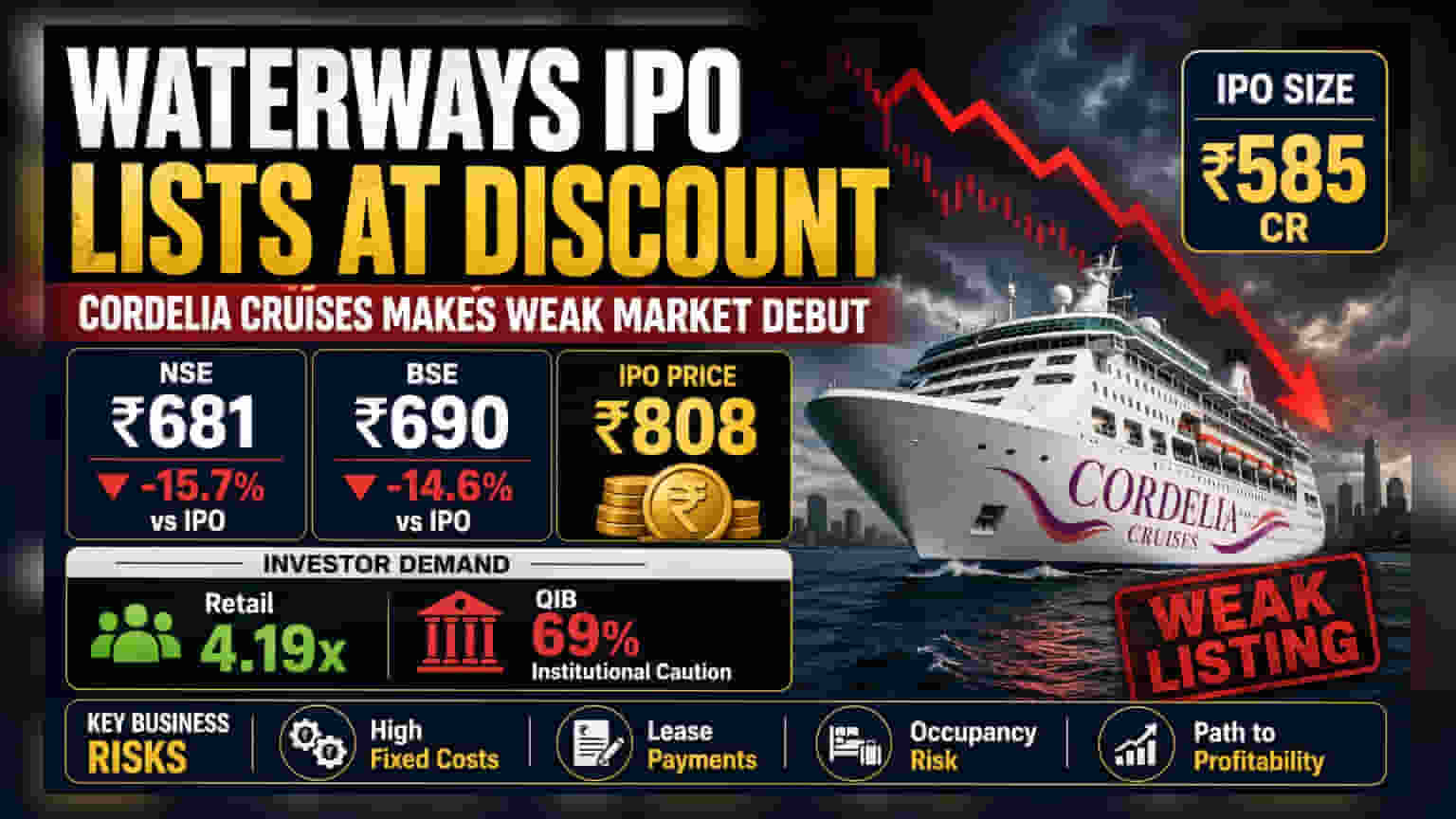
Waterways Leisure Tourism, the operator of Cordelia Cruises, debuted at a 16% discount on the NSE and BSE. Shares opened at ₹681, well below the IPO price of ₹808. The weak listing follows limited institutional interest during the subscription period, highlighting market caution regarding the company's financial health and capital-intensive business model.
What Happened
Waterways Leisure Tourism Ltd, the company behind Cordelia Cruises, started trading on Wednesday with a significant price drop. The stock opened at ₹681 on the National Stock Exchange (NSE), which is 15.7% lower than its initial public offering (IPO) price of ₹808. On the Bombay Stock Exchange (BSE), it opened at ₹690, a discount of 14.6%. The company had raised ₹585 crore through this IPO, but the market response today suggests investors are cautious about the company's current financial position.
The Institutional Caution
The primary reason for the weak listing appears to be low interest from Qualified Institutional Buyers (QIBs). While retail investors subscribed 4.19 times, the institutional portion was only booked 69% by the deadline.
Under SEBI regulations, companies reporting losses face stricter rules during IPOs. If the QIB portion is undersubscribed, the company cannot reallocate shares from other categories to cover the gap. This restriction can create selling pressure on the listing day because institutional investors are often expected to provide a base for the stock price. The low participation from these professional investors served as a signal to the broader market that they were not confident in the valuation or the business outlook at the IPO price.
The Business And Financial Reality
Waterways Leisure Tourism operates in the niche and capital-intensive cruise tourism sector. The business model involves high fixed costs, primarily related to ship maintenance, fuel, and significant lease payments.
According to the company's IPO filings, a portion of the money raised is allocated for lease payments to its step-down subsidiary, Baycruise Shipping and Leasing (IFSC) Pvt Ltd. For investors, this structure highlights that the company requires consistent, high occupancy rates on its cruises to generate enough cash to cover these heavy operating expenses. Since the company is currently reporting losses, profitability depends on scaling up operations and managing these large fixed financial obligations effectively.
Risks To Consider
The cruise industry is highly sensitive to discretionary consumer spending. If economic conditions tighten, families may reduce spending on luxury vacations, which directly impacts the company’s revenue. Furthermore, the company’s reliance on leased assets means that any delay or increase in lease costs could put pressure on profit margins. Unlike manufacturing businesses, there is little buffer for operating errors; high fixed costs must be met regardless of how many tickets are sold.
What Investors Should Track
Investors may want to watch for the company's first quarterly results as a listed entity. Key factors to track include:
- Occupancy levels: Are the ships filling up at projected rates?
- Cash flow: Is the company generating enough cash to cover its lease payments without needing further funding?
- Operating margins: Can the company lower its cost per passenger?
- Debt position: Does the company require more borrowing to maintain its fleet or expand operations?
Management commentary in the next few quarters will be critical to understanding if they can turn the business toward profitability and improve institutional confidence.