 Whalesbook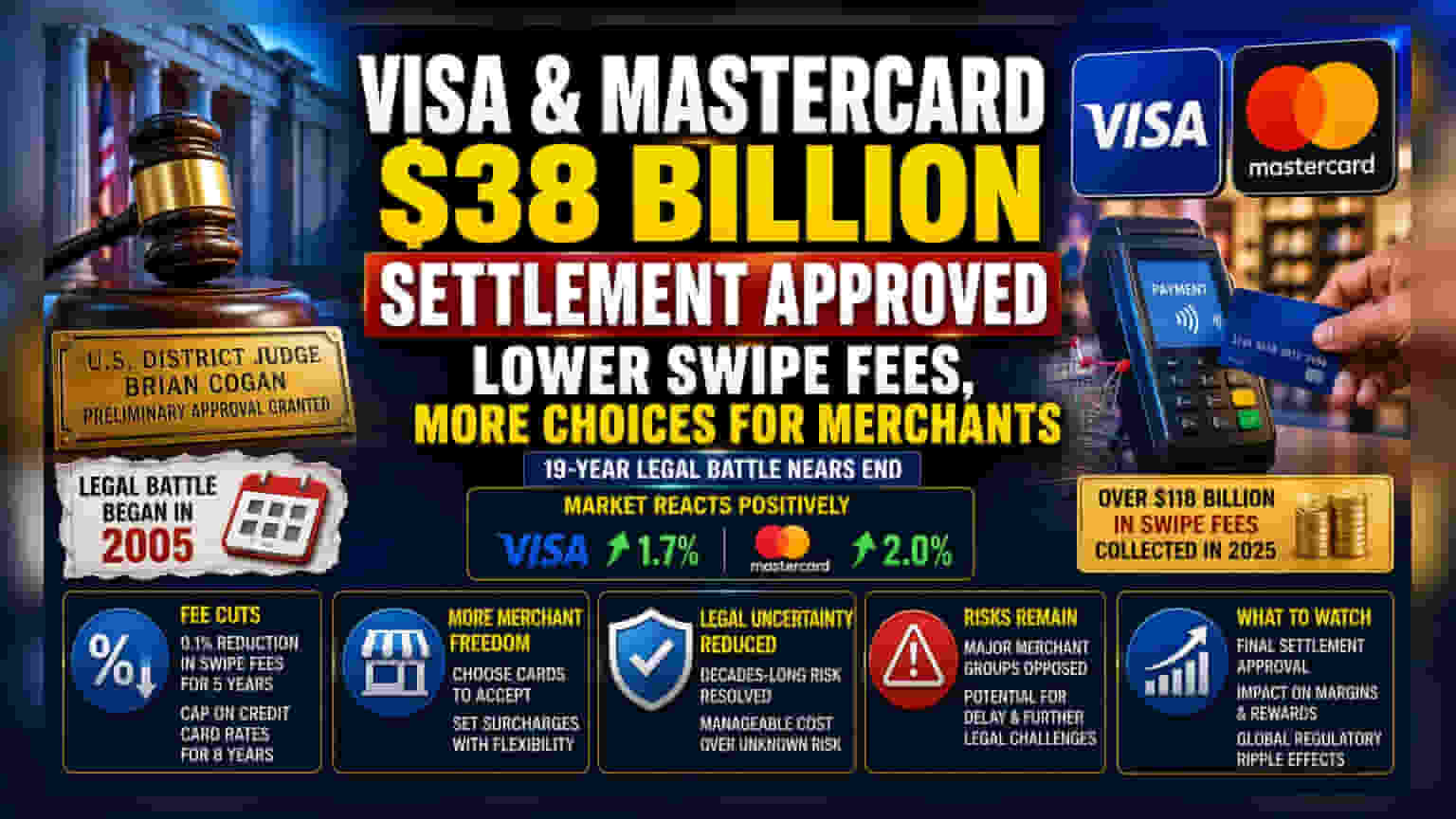


A U.S. court has granted preliminary approval to a $38 billion settlement involving Visa and Mastercard, resolving a long-standing antitrust case over credit card processing fees. The deal aims to lower fees for merchants and provide more pricing flexibility, removing a major source of uncertainty for the payment giants. While the stock market reacted positively, merchant groups continue to oppose the terms, suggesting the legal friction may not be entirely over.
What Happened
U.S. District Judge Brian Cogan has granted preliminary approval to a $38 billion settlement agreement between global payment networks Visa and Mastercard and millions of U.S. merchants. This decision marks a significant milestone in a legal battle that began in 2005. The core of the dispute involved "swipe fees"—the charges merchants pay to banks and networks every time a customer uses a credit or debit card.
The settlement intends to address long-standing complaints from businesses that these fees, which totaled over $118 billion for Visa and Mastercard in 2025, were set too high through unfair practices. Under the new agreement, the companies have committed to reducing swipe fees by 0.1 percentage point for five years and placing a cap on consumer credit card rates for eight years. Additionally, merchants will have more freedom to choose which types of cards they accept and how they apply surcharges to customers.
Why This Matters For Investors
For investors, the most significant aspect of this settlement is the reduction of legal uncertainty. For nearly two decades, the prospect of an unfavorable court ruling or a massive penalty has been a risk factor for both companies. By reaching this preliminary agreement, Visa and Mastercard have moved closer to stabilizing their business environment. While the fee cuts will have a direct impact on revenue, the market often prefers a defined, controlled cost over the unpredictability of a prolonged trial.
How The Stock Reacted
Following the court's announcement, the market showed a positive response. Shares of Visa Inc. rose by 1.7%, while Mastercard Inc. saw a 2% increase. This movement suggests that investors view the settlement as a manageable outcome, especially when compared to the risk of a more punitive ruling or broader structural changes to their business models.
Business Context and Margin Pressure
The payment processing industry relies heavily on volume. While a 0.1 percentage point reduction in fees may seem small, it applies across a massive number of transactions. The agreement forces the companies to adapt by potentially re-evaluating how they structure their rewards programs and commercial card offerings. Companies like Bank of America, Capital One, and JPMorgan Chase, which are involved in the card issuance ecosystem, are also affected by these changes. Investors will need to watch how these banks adjust their own revenue models to compensate for the fee limits set on the networks.
The Other Side: Ongoing Risks
It is important for investors to understand that this is not a universal victory. Several powerful merchant groups, including the National Retail Federation and the National Association of Convenience Stores, remain unsatisfied. They argue that the settlement does not go far enough to fix the underlying issues in the card market. Because these groups plan to continue their challenge, the potential for further legal friction remains. If the opposition successfully delays or complicates the finalization of this deal, it could reintroduce volatility for the stock.
What Investors Should Track
Moving forward, the key monitorable is the finalization of this settlement and whether it encourages regulators in other regions—including potential future conversations in India regarding merchant discount rates—to push for similar fee structures. Investors should also monitor the quarterly results of both companies for any commentary on how these fee caps are impacting their profit margins. While the legal uncertainty is lower today, the long-term impact on the transaction fee business model will become clearer as the terms are implemented over the coming years.