

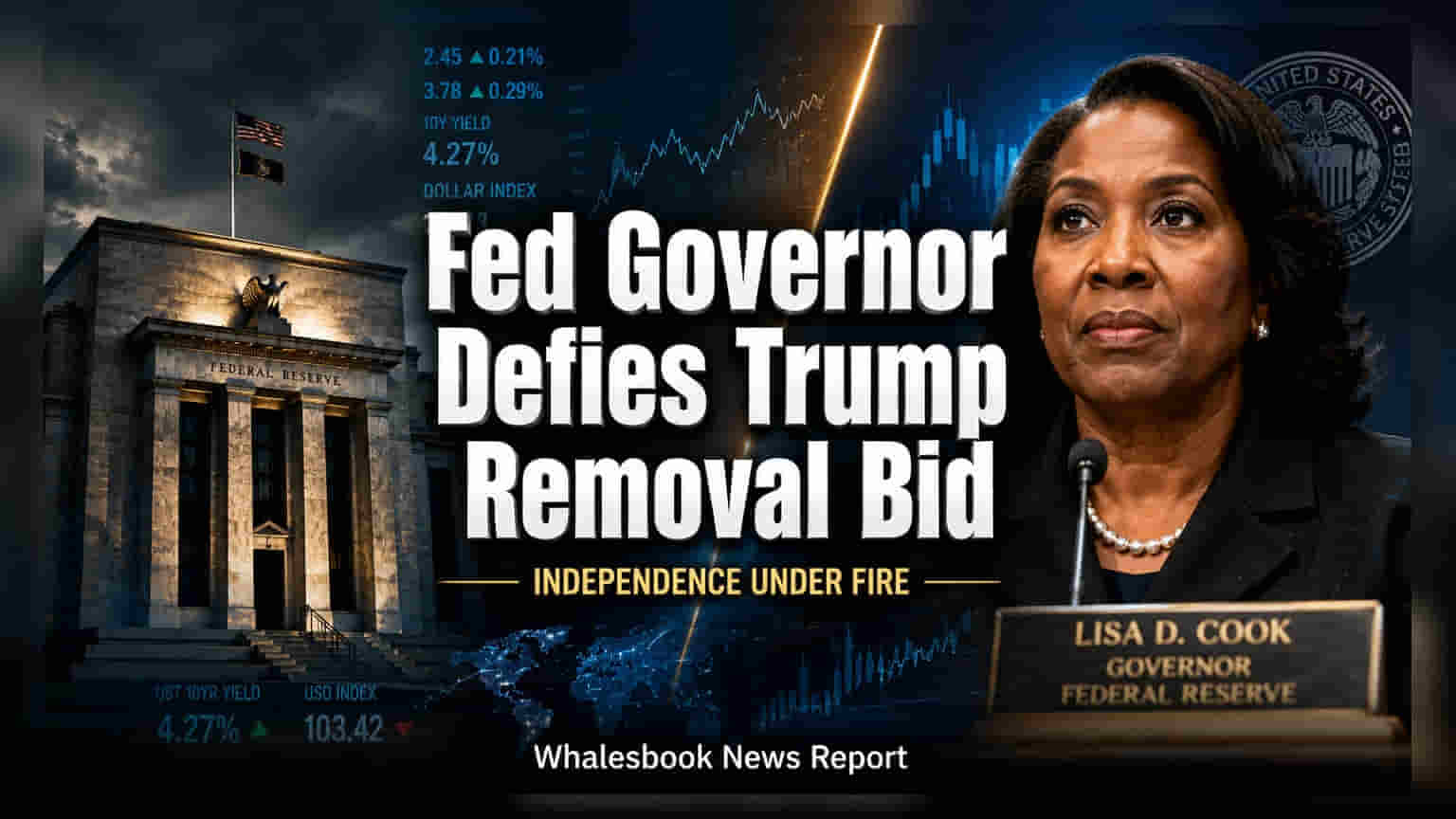
Federal Reserve Governor Lisa Cook has formally rejected the Trump administration's attempt to remove her from office, setting the stage for a significant legal battle. The dispute, based on allegations of mortgage fraud that Cook denies, challenges the long-standing independence of the central bank. Investors are watching closely, as any shift in the Fed's leadership could disrupt the current path of US interest rate policy, impacting global markets.
Federal Reserve Governor Lisa Cook has formally challenged the Trump administration's attempt to remove her from the central bank's governing board. In a response submitted on August 26, 2026, Cook and her legal team rejected the administration's legal basis for the move, characterizing the push as politically motivated. This development marks the latest turn in a historic conflict that has placed the institutional independence of the Federal Reserve at the center of a high-stakes legal confrontation.
The administration’s removal effort is built on allegations that Cook misrepresented her primary residence on mortgage applications. Cook has consistently denied these claims, asserting that any discrepancies were administrative in nature and that the accusations are an attempt to force a leadership change. This follows a June 2026 decision by the U.S. Supreme Court, which blocked an earlier removal attempt but established a procedural path for the White House to proceed if they provided due process, including proper notice and an opportunity to contest the charges.
The standoff is particularly significant because it challenges the independence of the Federal Reserve, a core pillar of the global financial system. This is the first time in the 112-year history of the institution that a sitting president has sought to remove a governor. The potential for a change in the board’s composition creates uncertainty regarding the future of US monetary policy. The White House has previously expressed frustration with the pace of interest rate adjustments, and critics argue that replacing a sitting governor could allow the administration to secure a majority on the board to influence policy decisions.
For Indian investors, the independence of the Federal Reserve is a critical factor. US interest rate decisions influence global capital flows, the strength of the US dollar, and the borrowing costs for emerging markets, including India. Any institutional instability at the US central bank can lead to market volatility, as investors rely on the Fed’s predictable, data-driven approach to manage inflation and economic growth. If the perception of the Fed's neutrality is compromised, it could force investors to re-evaluate their expectations for global liquidity and interest rate trends.
Legal experts note that this battle is likely to result in prolonged litigation, potentially distracting the central bank from its economic mandates. As the standoff continues, the key factor for investors to track will be any further legal rulings or official comments from the Federal Reserve regarding the stability of its operations and the continuity of its policy decisions.