

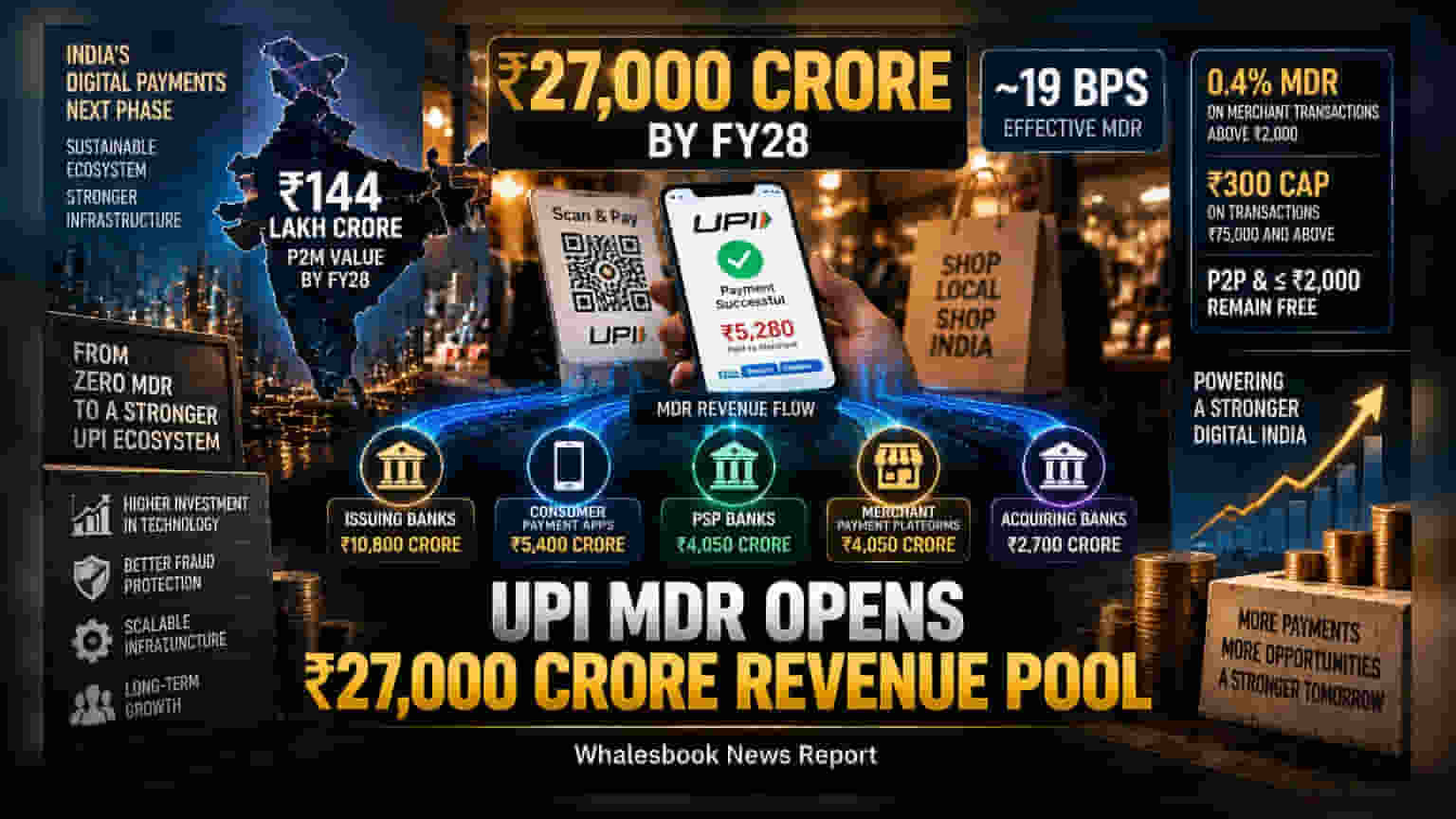
Starting October 15, 2026, the government will introduce a 0.4% merchant discount rate on UPI payments over ₹2,000. Analysts project this move could create a ₹27,000 crore annual revenue pool by FY28, aimed at funding infrastructure and cybersecurity. The charges apply to merchants, not consumers.
The Unified Payments Interface (UPI) is set to undergo a significant shift in its business model. Effective October 15, 2026, a new merchant discount rate (MDR) framework will be implemented. Under these new rules, merchants will be charged a fee of 0.4% for receiving payments via UPI, specifically for transactions exceeding ₹2,000. For very high-value transactions of ₹75,000 and above, the fee is capped at ₹300 per transaction.
This move marks a departure from the zero-MDR regime that has powered the rapid growth of digital payments in India over the last six years. Financial analysts estimate that this new structure could create an annual industry revenue pool of approximately ₹27,000 crore by the 2028 financial year.
How the New Fee Structure Works
While the headline rate is set at 0.4%, the effective rate across all transactions is expected to be lower, likely around 19 basis points. This is because a significant portion of UPI traffic remains exempt. Payments made by individuals to other individuals (P2P) continue to be free of charge. Additionally, all merchant transactions valued at ₹2,000 or less remain free for the merchant.
These exemptions are designed to protect the retail consumer experience and ensure that small-ticket daily payments, such as grocery runs or tea stall payments, are not affected by the change. The fee is exclusively a merchant-side cost and is not intended to be a direct charge to consumers.
Why This Matters for the Ecosystem
For years, banks, fintech companies, and payment service providers have been absorbing the costs of maintaining the UPI infrastructure, including heavy investments in cybersecurity, fraud prevention, and technology scaling. The new revenue pool is intended to provide a sustainable financial framework to support these necessary expenditures as transaction volumes continue to grow.
Analysts project that annual UPI payments to merchants will reach ₹144 lakh crore by FY28. Applying the effective fee rate to this base generates the estimated ₹27,000 crore revenue pool. However, it is important to note that this figure represents industry revenue rather than direct profit.
Challenges and Investor Monitorables
For investors and market participants, the actual benefit to individual companies will depend on how this revenue is distributed across the payment ecosystem. The earnings will be shared between issuing banks, acquiring banks, and payment apps, with the specific split yet to be finalized.
One of the main risks to watch is merchant acceptance. While the government has mandated that this should not be a direct charge to consumers, there is uncertainty regarding whether some merchants might attempt to pass on these costs or demand alternative payment methods to avoid the fee. The industry will also be watching to see how transaction volumes react once the zero-MDR era officially ends. The success of this transition will depend on whether the ecosystem can maintain its growth trajectory while introducing these new merchant fees.